ShobhaThe Little Garden That Could
Welcome! We are so glad to see you. Please feel free to take your time, ask questions and generally enjoy yourselves. As you’re aware, the recalcitrant weather has set the plants totally off schedule. So, be at liberty to use your imagination wherever and whenever. We’ve given up all expectations of timely blooms.
A word of caution – due to the severe winter we experienced, there’s been more than normal heaving of the ground. As a result, paving stones and bricks are uneven in areas. Please walk carefully – do look down! Don’t let the flowers and plants distract you!
Our small, suburban garden has limitations and constraints but in no way does it limit one’s creativity and personal expression.
We employ organic gardening practices (no pesticides, chemical fertilizers or insecticides), we collect rain water and, make our own compost. Native and/or eco-beneficial plants are the mainstay here but there’s always space for some ‘foreign’ favorites. All the serious stuff of sustainability, environmentally sound methods etc., notwithstanding, it is the sheer joy of gardening that is the motivation. The garden reflects our philosophy and our lifestyle.
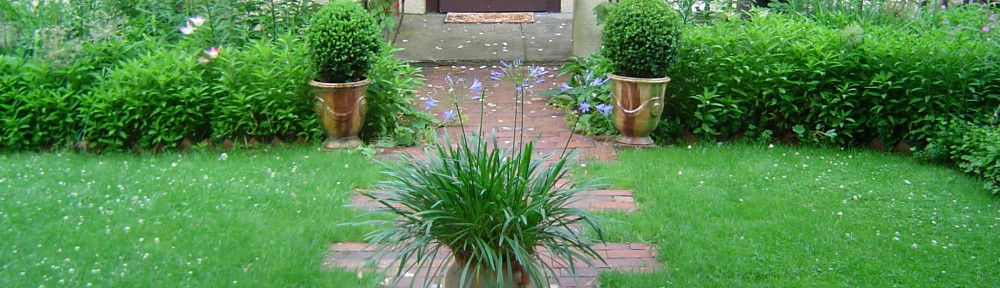
Start your visit with the front garden. You are facing the house. The fence along the street was designed to delineate the garden as well as to invite viewing. Similarly, the brick walkway is designed to be visually interesting while connecting street to house. The two flower beds near the house contain many bulbs and herbaceous perennials to provide color and texture through the growing seasons. Spring is truly underway when the multitude of tulips render this area into a riot of color. Above, are the window boxes which are changed seasonally. The front arch has clematis and a New Dawn rose. Notice the tiny areas of lawn – they exist to serve as a simple green backdrop to the flowers in the beds. We are not going for a pristine mono-culture. There are no other lawns in this garden.
Continue along the path to the left side of the house. On the right of which is a row of peonies. All along the left side is a Belgian fence espalier of apples and pears. This aesthetic feature not only functions as a fence, it is productive and easier to maintain as compared to regular fruit trees. As you walk along, on your right, you pass a David Austen rose ‘Boscobel’ and a damask ‘Leda’ rose, pots of fig trees and rosemary. Just before the steps to the greenhouse, is a hybrid persimmon tree being espaliered up the wall. In the greenhouse, is a small collection of citrus, jasmine and gardenia maintained in pots.
The magnolia below this greenhouse is being trained to grow into a fan espalier. The recent winter was brutal and it took a beating. However, it seems to be recovering well.
Feel free to take a break in the greenhouse . The hummingbirds might choose to visit the feeder by the door!
The side path ends in another arbor supporting a David Austin climbing rose ‘Strawberry Hills’. Proceed into the herb garden with culinary and medicinal herbs. Several of which are mentioned in Shakespeare’s plays. There is also a tiny potager bed with a mix of leafy greens. The rain barrel in this area is used to water the pots in the various areas of the property. Barring severely dry days, in general, we do not water the plants in the ground.
The newest member in the garden is our ‘Beejal’ – a baby elephant with quite an important story. You can read it at www.thegreatelephantmigration.org or, you can ask us to tell you her tale!
| The Great Elephant Migration | A Coexistence StoryThe Great Elephant Migration is a global fundraising adventure to amplify indigenous knowledge and inspire the h… |
Stepping down from here is the ( native) wisteria clad pergola. It is a perfect extension of our living area into the garden. The fountain is an appealing water feature. Notice the wood burning brick oven, and across from it, the (Concord) grape arbor.
The checkerboard garden* was designed to be viewed from above in the house. Last Fall, we completely redid the plantings. Due to the surroundings trees growing tall, this space had become more shady and the plants were struggling. So they were pulled out and relocated while more shade loving plants took their place. What you see is still very young. Hopefully by next spring it’ll be nicely filled out.
*It is what we call the ‘checkerboard’ garden. Set within a square -ish space, it is about contrasts. The squares of slate are hard and the squares of creeping phlox are soft. Inertia vs momentum. Permanent vs impermanent. Non-living and living. Order and disorder. And the whole within limits. Over the years, we’ve loosened up the design to permit self-seeded columbines and other ephemerals to join in the mix.
The lower garden is a ‘meadow’ naturalized with many different bulbs and native plants and grasses. Forget-me-nots, ajuga and dandelions have also made this their home. While it might meet the disapproval of those who want pristine, mono-cultured lawns, this area supports countless birds, bees, butterflies and other valued wildlife. It is an area of controlled chaos – a celebration of life! We welcome the diversity and surprises. Bordering it are oak-leaf hydrangea, hellebores, heuchera, ferns, roses, lilac, an Amelanchier, an Itoh peony and other native shrubs such as nine-bark , buttonbush and fothergilla.
Along the (neighbor’s) picket fence, is a young quince being trained into an espalier cordon fence for greater privacy and productivity while still adding beauty. Dutchman’s Pipe and Virginia creeper have been planted along the other neighbor’s chain-link fence with the fervent hope of covering it entirely. It’s been slow going!
The woods beyond provide a backdrop for the entire garden. It is also where we compost all garden waste.
The tree house enjoyed its 15 minutes of fame last week at a special lecture on Follies In The Garden: Ornament, Narrative And Architectural Delight held at the ICAA ( Institute of Classical Architecture and Art).
The freestanding greenhouse is used to keep the tender perennials safe through the winter as well as to get a jump start in spring with seeds and root cuttings.
The stainless steel Dominico Bellis sculpture ‘Wind Song’ was designed, commissioned and installed about 10 years ago. It echoes the movement of plants, people, wings of birds/insects and whatever the viewer imagines.
The stainless steel material catches and reflects the light and the plants themselves in interesting ways. Its shadows shift with the arc of the sun and adds another element of drama in this busy space.
The entire back gardens were planned keeping in mind that they are viewed from the house only from above. So it was important that they provide interest and beauty from that perspective as well.
As you now leave the back gardens and proceed up the driveway, you will notice the most unusual element in the garden. This is the vertical garden inspired by the ones created by French botanist and designer Patrick Blanc. Since this is a north-northeast facing wall, the choice of ferns and heuchera was natural. The combinations provide visually appealing contrasting textures, shapes and colors.
Because ferns emerge slowly at this time of year, the wall does not look so lush right now. However, by July, it is full and glorious and continues to look amazing well into fall.
We hope you will take the time to enjoy these and other features. Again, please feel free to ask questions and/or offer feedback. Gardening is a big classroom and we gardeners learn best from each other.
Thank you for visiting.
Shobha and Murali