Call Of The Cicadas

I’m waiting for the cicadas. When they come, it will be an experience to remember. Once in seventeen years is certainly an occasion. From what I understand, there will be quite a crowd. A rather loud crowd. But then, wouldn’t you want to party hard if you were released from underground after all that length of time?

I’ve heard the apprehension and even the horror that some folk have about this cicada invasion. I understand that not everybody is curious or interested. However, I’d like to reassure them that there is nothing to fear. Firstly, cicadas have been thought to be the same as locusts. Not so. True locusts are related to grasshoppers. Cicadas are in a taxonomic class of their own. They are not really harmful or dangerous. They do not bite humans and will not decimate your prize roses or tomatoes. Females lay their eggs by creating little slits in the bark of trees and shrubs but the botanicals themselves are not at risk. They simply acquire a few scars. I believe the media have hyped the situation. You were around seventeen years ago, do you remember it being absolutely horrendous? We wouldn’t react adversely if there was a glut of butterflies. The rather vociferous tree frogs are indulged every summer. So why the anti-cicada stance? Admittedly, cicadas might look threatening but just consider them to be nothing but gentle giants.

I remember how alarmed I was when I noticed nickel sized holes randomly positioned along a side path in my garden. My mind was put at ease by an expert at the New York Botanical Gardens who explained to me about cicadas. That was seventeen years ago. I’ve come a long way since then.

As for the classic cicada noise and the numbers that will be gathering all over, think of it as a huge, cacophonic teenage party. Except, there will be no drinking, no doing drugs nor will anything be broken. There will however be lots of making out – if things go according to plan. But these party creatures will all be adults. So it is entirely above board.

If you are thinking how it will affect your season, take a few deep breaths and shift your attitude. Stop fighting nature particularly when in the big picture, this is so utterly benign. Putting up netting where you will be dining outdoors would allow you to enjoy your meals without being surprised by healthy offerings of raw proteins. In certain parts of the world they are consumed for just that. If need be, a comfortable set of earplugs will cut out the cicada song. At the very worst, you will spend a bit of extra time indoors. But whatever you do, please do not think about using chemicals and such to kill the cicadas. If you do, there will be plenty of other useful critters that will also be eliminated. In addition, the toxin will find its way into the water table. No good will come from taking unnecessary drastic measures. Can we just learn to be more accommodating – the cicadas will not bother you again for another seventeen years.

I suggest we invoke our inner child and spend this cicada season with curiosity and wonder. Take a little time to check out the iridescent colors of their wings. Listen to their sound as you would to new music. Keep an open mind. Before you know it, the cicadas will have gone. Who knows what will be seventeen years from now.

If all this is sounding too cute, consider the following: In Ancient Greece, they represented immortality, In France, cicadas are symbols of good luck. In Japan, they signal reincarnation. In Javanese culture, their song indicates the start of the dry season when non-rice crops can be planted . In China, the periodic moulting of cicadas is seen as the transformation a person must go through to reach enlightenment. And in Mexico, cicadas are known as the ones that sing till they die.

Now, tell me, do you want to mess with your karma and harm such a noble creature?
Live and let live.
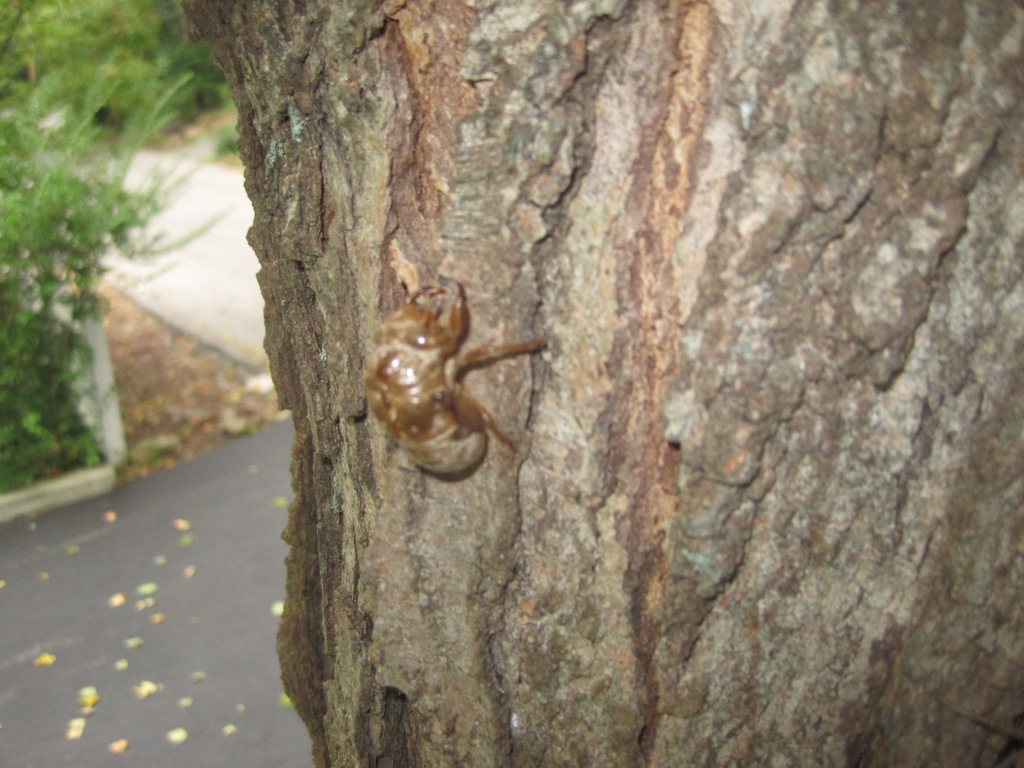
Cicada
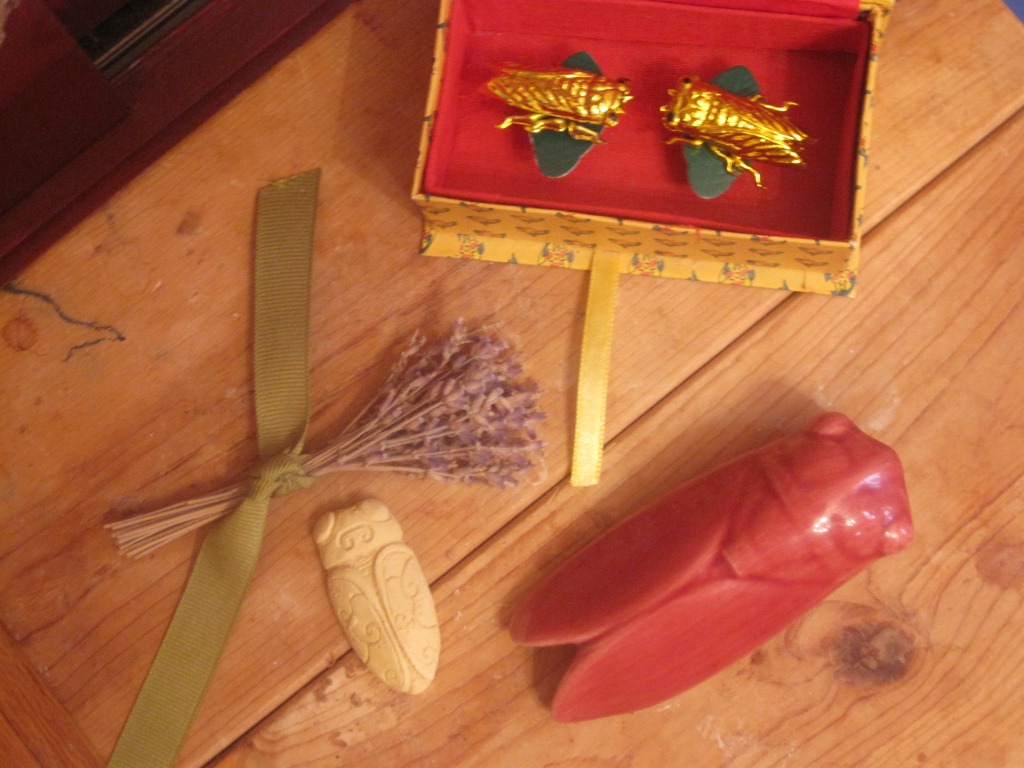
Cicada


Cicada talismans - I have them all over in my home and garden.

Cicada talismans – I have them all over in my home and garden.


(c) 2013 Shobha Vanchiswar

Where Do Butterflies Go When It Rains? Who Goes Around And Tucks In The Trains?

That refrain from a song by the Carpenters played in my head all through the time Hurricane Sandy was doing her worst. Apart from the understandable concern for the safety of family, friends and property, I could not help thinking, okay obsessing, about how the birds, bees and butterflies coped in the storm. In the big picture, those little creature matter mightily. Consider how much has has been impacted by the drastic decrease in the number of honey bees due to colony collapse disorder. Enough said.

Of course, unlike us humans who need the whirring of assorted machines to predict a change in weather, birds are finely tuned to barometric pressure shifts. They will then flee, seek shelter or actually move into the eye of the storm where all is quiet. This last option can carry them long distances and depending on the duration of the storm, they will remain without food or water which if prolonged will ultimately do them in. Most birds find old nests, tree cavities, dense shrubbery where they can ride out the storm.
No doubt, severe hurricanes and storms cause a rise in avian mortality be it due to starvation, exhaustion, habitat destruction, exposure to pounding rain or wind.

Butterflies are also able to read a drop in barometric pressure and know to seek safe locations. Under leaves, in piles of leaves, thickets and such.

Bees on the other hand, have it down to a science. Contrary to the supposition that they swarm before a storm, these smart creatures do not leave the hive if temperatures fall below 57 degrees Fahrenheit or if the wind speed is more than 12 mph. And of course, they have each other to huddle and keep cozy inside the hive.

Common to all of the creatures mentioned above is what is called ‘communal roosting’. Which just means getting close together sharing warmth and having safety in numbers. Sound familiar?

In times of adversity, the tradition of coming together to do what’s good for the whole seems to prevail across the species. For us humans, it means sharing and giving. For the most part, we are at our best in times of crises. Our pets get included in all the camaraderie.. Their safety is given high priority as well it should. But, what are we doing about those birds, bees and butterflies? Given how important they are to the health of our gardens, farms, forests, park lands and, consequently our own health, surely some attention on our part is required.

True, its not as though one can round up all these vital beings and give them a form of public shelter but perhaps we can provide conditions that lend some level of security in their natural habitats. Obviously, the unnecessary clearing of woods and forests is to be avoided. But it is really what we can do to support the creatures closer to home and farm that will be of direct use. Setting up bird, bat, butterfly houses, ensuring a source of water, growing plants, shrubs and trees that offer both shelter and food will go a long way. At the same time, doing away with toxic fertilizers, insecticides and weed killers should be mandatory. Safe and effective organic alternatives exist so please lets all adopt them. However much one is a neat freak, find it within yourself to keep one corner, a far spot not so easy to view if you prefer, a little wild. By that I don’t mean it should be unsightly. Instead, group together some assorted shrubs to form a thicket. Toss in a thorny bush or two into the mix of deciduous and evergreen plants. Select shrubs that are the natural food sources for the refugees. Situate these shrubs at some distance to allow for some privacy and sense of security. And following a storm, replenish bird feeders and water baths. None of this is so hard to do right?

There will of course be some casualties from each storm but staying tuned to nature and doing whatever is within our abilities would be doing right by ourselves and this earth to which we all belong.

When Sandy was blowing at alarming, ear piercing speeds, it must have been absolutely terrifying for those poor souls. I’d like to think they sensed and were reassured by the positive energy I was sending their way. Please don’t attempt to disillusion me.

Things To Do This Month

1 Clean up debris left by the storm. Rake leaves, pick up branches and twigs, cut away broken or dead tree and shrub limbs.
2. Check stability of supports, fences, gates, paths, steps and such. Fix what needs fixing.
3. Finish planting bulbs and perennials. The ground is still pliable. But hurry!
4. Cut back perennials, remove annuals and generally tidy up.
5. Put away all outdoor furniture and smaller pots.
6. Protect outdoor statuary and large pots.
7. Get amaryllis started so they will be in bloom at the holidays.
8. Fill bird feeders.
9. Keep sand or kitty litter and snow shovels handy.

Birds at the feeder in winter.

Gold finch in the butterfly bush.

Tom turkey visits

Red Admiral on allium

Red, white and blue!

Yet another butterfly – Tiger Swallowtail

(c) 2012 Shobha Vanchiswar


In the garden 2012-05-21

[gview file=”https://seedsofdesign.com/wp-content/uploads/2012/09/rin_the_gard5_21_12.pdf” height=”400″ width=”300″]

In the garden 2010-12-08

[gview file=”https://seedsofdesign.com/wp-content/uploads/2012/09/rin_the_gard12_08_10.pdf” height=”400″ width=”300″]

In the garden 2010-09-14

[gview file=”https://seedsofdesign.com/wp-content/uploads/2012/09/rin_the_gard9_14_10.pdf” height=”400″ width=”300″]

In the garden 2009-05-19

[gview file=”https://seedsofdesign.com/wp-content/uploads/2012/09/rig_05_19_09.pdf” height=”400″ width=”300″]

In the garden 2009-04-08

[gview file=”https://seedsofdesign.com/wp-content/uploads/2012/09/rig_04_08_09.pdf” height=”400″ width=”300″]

In the garden 2009-02-11

[gview file=”https://seedsofdesign.com/wp-content/uploads/2012/09/rig_02_11_09.pdf” height=”400″ width=”300″]

In the garden 2008-06-27

[gview file=”https://seedsofdesign.com/wp-content/uploads/2012/09/rig_06_27_08.pdf” height=”400″ width=”300″]

In the garden 2008-02-29

[gview file=”https://seedsofdesign.com/wp-content/uploads/2012/09/rig_02_29_08.pdf” height=”400″ width=”300″]