On Retrospection

I’ve spent the last couple of weeks going through 18 years worth of photos of my garden. That’s thousands of images. I was doing this to select my images for the talk I’m giving tonight. At times, my eyes would glaze over and I’d have to take a break to look at things that were entirely unrelated to plants. But, overall, it was a very good experience.

Seeing the timeline of how my garden has evolved was revealing in many ways. For one, I recognized how I have grown as a gardener – beliefs and principles that I started out with were strengthened. I matured so I got bold and authentic to create something that is genuinely reflective of who I am.

The garden has transformed slowly to emerge as a place where lots goes on and yet offers ample opportunities for calm and respite.

In looking through the photos year by year and month by month, I could see clearly how weather and climate have a direct impact. The amount of exposure to light has changed as surrounding trees have grown or been lost. With experience, my own tastes have been refined. I’ve learned so much.

And with age, I’ve developed strong opinions for those who garden without regard to the environment and climate change. My garden has developed into one that is vibrant, playful, beautiful, a bit wild and conveys an eco-concious sensibility.

Along with all the highs that the photos showed me, I was also reminded of the mistakes, failures, calamities. Some were mine and some were Mother Nature’s. These are what taught me the most. I’m no longer concerned about something failing or about how that failure will be viewed by others. I’m willing to try things out, experiment and see how it goes. As long as one’s intentions are to support the environment with sensitivity and care, a gardener is free to express herself honestly. That means we shouldn’t be gardening to impress, suppress or transgress. Instead, garden to make progress.

Word play aside, gardeners have an obligation to do right.

Back to my retrospection.

At the end of each gardening season, like most gardeners, I review what worked and what didn’t that year. And I resolve to do better the following year.

Looking through almost two decades of gardening, I saw how developments in my own (personal and professional) life influenced matters. As I got busy with things outside the garden, I neglected due diligence on pest management. Since only organic measures are practiced here, this is more significant than it sounds. It’s not merely a casual oversight when timely services are skipped. This could allow pests to thrive or plants to struggle depending on what was not done. Case in point, the time and temperature sensitive treatments that are required by the fruit trees. Along with good weather and ideal pollinator populations, these trees need to be fed and protected correctly. A lapse on my part can make trouble for them. And on certain years it has.

Confronting and owning my dereliction of duty has been humbling. I see how easily I blamed the weather instead. I’m resolved to doing better – by slowing down the hectic pace, simplifying things so I’m functioning with purpose and clarity and reintroducing myself to what used to give me such joy in managing my garden.

I believe we are all overdue for a proper dose of retrospection. In all areas of life.

I’m sharing just two pairs of photographs to show  some of the transformation that has occurred in my garden:

1992

1992

2021

2021

(c) 2021 Shobha Vanchiswar

[do_widget “Blog Subscriptions (Jetpack)”]


Timely Tasks

It’s been a hectic pace in the garden. I spent the weekend entirely attending to seasonal demands. The tiny greenhouse is now packed to to the gills with the tender members of the garden. Taking advantage of the extended warm weather, I took my time to carefully trim and clean all the plants (and pots) before moving them into this prime space.

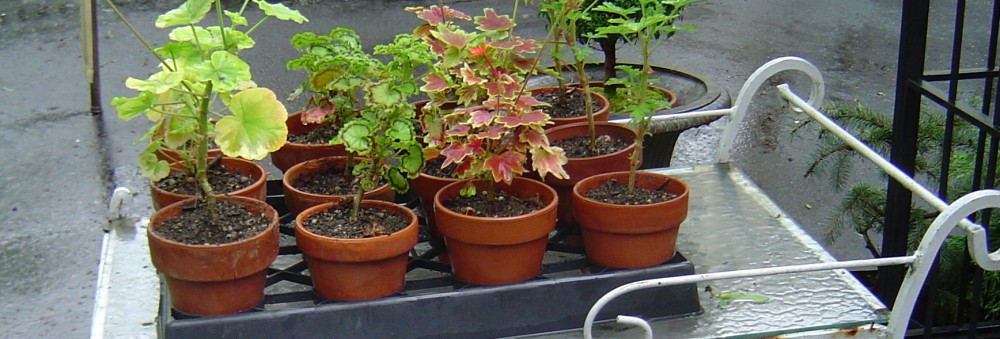
With some of the clippings, I started root cuttings. A nice variety of various geraniums both fancy leaved and scented, bay, rosemary, boxwood, myrtle, plumbago (an experiment) and Dichondra. Little bundles of bouquet garni were made with more clippings of bay, rosemary and thyme – they will be used through the winter to flavor hearty stews, soups and sauces. I made several batches of nasturtium pesto to freeze and some bottles of rose-geranium lemonade.

All the snakeroot was pulled out – this native is simply too aggressive. It had spread itself all over and was choking any plant that got in its way. A true thug. With the removal, I could feel the garden give a sigh of relief.

In comparison, the ornamental raspberry seemed almost shy. Almost. That got ruthlessly edited but not eliminated. A small bit was left in the meadow and will be monitored closely so as not to let it get unruly again. In the newly opened up space, I’ll add asters and other well-behaved natives.

A weed patrol was also conducted. They too take advantage of unseasonable warmth but I’m determined to prevent any of them setting seed. I know weeds are wily things yet hope springs eternal.

As other pots are relieved of their annual contents, they are washed, dried and stored away. It’s a lot of effort but so important for plant hygiene. Come spring, I’m always thankful for the work I did in the fall. With pots clean and ready, it is so pleasurable to get them planted whilst waiting for the plants in the ground to catch up.

All the discarded potting soil,clippings and fallen leaves mean the compost pile in the woods is well fed in autumn. Each spring, it is such pleasure to get rich compost from there. If you haven’t got a composter set up, this is a good time to begin.

Finally, for fun, a pumpkin witch and her cat took up residence in the front garden. Just in time for Halloween. Already they’ve become quite popular and the subject of many photographers as they pass by. Halloween was such a sorry affair last year that I wanted to do my part in making this year much better.

Made up of pumpkins/gourds and other garden materials, they will retire in total to the compost heap after the holiday. Win-win for all.

Full disclosure – I’m also hoping to set an example by demonstrating that using natural, compostable materials is environmentally responsible and can still be fun and creative.

Note : One week to go before my PHS talk! Don’t forget to sign up!

Natural born witch and cat by day.

By night

Clipping, cleaning and washing in progress

Awaiting propagation

A load of leaves headed to the compost

Bouquet garni ready for use

Rose-geranium lemon cordial and nasturtium pesto

(c) 2021 Shobha Vanchiswar

[do_widget “Blog Subscriptions (Jetpack)”]


Go Forth And Propagate!

I’m propagating this week. A bit behind schedule but then so is the season. Earlier in the year, whilst giving the boxwood and myrtle topiaries a trim, I started some cuttings which have taken root and seem to be doing well. So my focus now is on doing the same with scented geraniums, rosemary and bay. I’ve had good success with them over the years – great returns for minimal effort. A piece of stem bearing a couple of leaves and cut just above a leaf node inserted into moist potting soil is all that’s required. Monitor the pot and you know roots have been set when you see new growth. While it is not absolutely necessary, just to be on the safe side, I dip the cut end in rooting hormone powder before putting it in the soil.

This year, I fell in love with Dichondra Silver ponysfoot. It seems just as easy to propagate – Dig out some pieces of stem with roots attached and replant in potting soil. Keep moist and when it shows new growth, it can be relocated wherever desired. And I do desire greatly!

Other propagation to do is by division. Some of the heirloom irises are on top of the list. They were given to me by a friend when I first started on my present garden many moons ago. Gifts from other gardeners are always so precious. There are ferns, heuchera. Echinacea and asters that also need to be divided and replanted.

Meanwhile, the ornamental raspberry, native anemone and snakeroot need to be ruthlessly thinned out. They are aggressive so I’m not sure if I should give any away or simply toss the lot onto the compost heap. The pink turtleheads have self-seeded happily so some of those young plants will be pulled out and potted to give away.

The cardinal vines and plumbago were such a joy this year that I’m looking io generate more. Should I simply cut the plants back, dig up, split up and pot up? Can cuttings be rooted? Or is starting from seeds the best? Something to learn!

Friends have already stopped by and helped themselves to various seeds straight from the plants. What remains are for the birds. I’m not saving any seeds this year as I’m relying on self-seeded surprises.

Propagation. It’s a good thing.

Note: Click here for details on my upcoming talk to the Pennsylvania Horticulture Society.

Rooting cuttings

Dichondra looking lovely

Plumbago

A bed completely overrun by snakeroot

Fall in the meadow

The ornamental raspberry in the foreground tends to eclipse its neighbors

Vertical garden has that tapestry vibe

Nasturtium looking pretty

Snakeroot (Ageratina) throttling R. Boscobel

Asters gone wild!

(c) 2021 Shobha Vanchiswar

[do_widget “Blog Subscriptions (Jetpack)”]

October Overdrive


In these parts, the gardener shifts into overdrive in October. Lots to be done and it is often a race against time.

We rush to safeguard tender plants before the first frost. Harvest the remaining warm weather vegetables and fruits. Gather seeds to save for next year. Cut back, clear, clean, cover. Provide protection, put away, plant anew. Divide and redistribute. Finally, dig in all the bulbs that arrive just in time. And all along, squeeze in some time to enjoy the season because all too soon, we will be spending more hours cocooned indoors.

This year, due to changing weather patterns, it feels as though the fall hasn’t quite started. Trees are still quite green and few are showing any other color. Most likely there will be no real autumn color display. The leaves are simply going to turn crisp and brown and drop to the ground. Sad, I know but, all the more reason to take climate change seriously and do our part to mitigate it as much as possible. Instead of complaining lets all collectively respond with positive, proactive efforts.

I invariably feel a bit overwhelmed at this time. There is a long list of chores. I’ve found by prioritizing and breaking down the tasks helps greatly. Starting with getting the greenhouse cleaned and ready and moving in the pots of tender plants, I move on to dividing to replant and severely thinning out overzealous residents. Then I collect seeds, cut back and clear the spent plants. While some are left to serve the birds and give some winter interest, for the most part, I cut down the perennials. This is to facilitate the bulb planting that must happen between all the perennials and, also to give the garden a head-start in the spring as the garden’s Open Day happens early to mid-May when once again the list of tasks is long and time is short.

So, off to the garden I go. No time to waste!

Here is the list of October to-Dos:

1. Yes, weeding continues!
2. Time to plant perennials and trees. Give a good dose of compost to each. Water regularly. Perennials already in place can be divided and planted as well.
3. Cut back all spent plants except what is needed for seasonal interest.
4. Collect seeds. Store in labeled envelopes in a cool, dry space.
5. Last call to root cuttings of geraniums, coleus, rosemary etc.,
6. Get all pots of tender perennials into clean greenhouse or other winter shelters. Wash plants and pots thoroughly first – minimizes pest infestation.
7. Plant bulbs as weather gets consistently cooler. Bulbs can be planted until soil freezes solid.
8. Rake leaves. Add to compost pile or deposit in woods.
9. Give compost heap a good stir.
10 Clean out vegetable garden except for cool weather plants that are still producing. Apply several inches of compost on cleared beds. Plant green manure to enrich the soil – optional.
11. Clean and put away (or cover) outdoor furniture.
12. Check what needs repairing, repainting, replacing and get to it!
13. Lift tender bulbs, corms and tubers. Store in dry, frost-free place.
14. Drain and close all outdoor water faucets. Empty rain barrel and hoses. Store.
15 Clean all equipment and tools. Store neatly.
16. As temperatures plummet, protect tender shrubs and immovable  frost sensitive pots and statuary. I cover the former with burlap and for the latter, I first cover with sturdy plastic and then use burlap so it looks halfway decent.
17. Remove suckers from ornamental and fruit trees. Prune roses and wisteria and secure them well. Remove dead and decaying limbs from all plants.
18. Fill up bird feeders. Keep them filled through the winter. Put up nest boxes for the spring.
19. Get into the autumnal spirit – fill window boxes and urns with seasonal plants and produce.

Note: On October 26, I’ll be talking to the Pennsylvania Horticultural Society about how to think out of the box in a small garden with focus on espalier and vertical gardening. This is a virtual talk so everyone can attend!

Some scenes of my garden as it looks right now – wild and winsome!

Photo by @dorothydunn

Photo by @dorothydunn

Photo by @dorothydunn

Photo by @dorothydunn

(c) 2021 Shobha Vanchiswar

[do_widget “Blog Subscriptions (Jetpack)”]