Wild Thing! You Make My Heart Sing

Rewilding is the buzz these days. Le mot du jour. But what does that really mean? And how wild is one to go and still have a garden to speak of? Wildness is sort of an ambiguous word – it can mean different things to different people. Wildness typically means an area that does not have humans impacting it. We humans are tamers historically. So, loosening our control on our gardens and letting Nature take over runs counter to what a gardener (human) does. Not to mention, a garden by its very existence is a managed space. It is created by human effort. So why all the current hype about leaving well enough alone?

Rewilding is, as I see it, a pendulum-like swing from the over-cultivated, heavily manipulated, high maintenance gardens that were more for show and less about sustainability or conservation. After all, simply letting nature take over would not be good. It would result in woodlands emerging all over the space. While the woods are delightful and come with their own special and diverse flora and fauna, it could hardly be a garden. Besides, more important ly, the better part of pollinators would have no place to exist. Most woodland flowers bloom in spring and the rest of the year, blooms are scarce. Pollinators require sustenance during the other seasons as well.

This naturally means open spaces such as meadows and more to the point, gardens. A range of habitats are required to support diverse wildlife. Every kind of space has a specific purpose and fosters different wildlife leading to healthy ecosystems and environments that are in balance.

In the case of our gardens, it does not mean we hang up our trowels and say goodbye to doing the fulfilling work of transforming our spaces. As I see it, gardens can play very vital roles in the context of keeping the environment healthy as well as bridging the countrysides, farmlands, woodlands and waterways to support the diverse plants and wildlife.

The variety of habitats will support the myriad wildlife most individually suited to them. How we make our gardens rich in wildlife is determined by how we choose to garden.

First and foremost, reduce the area of lawn. They are detrimental to the environment. The cost in terms of money, time, labor and resources in order to keep a pristine, green lawn is prohibitive and ultimately, it does not encourage any pollinator or other wildlife to thrive. Instead, create areas for native grasses and plants. If space permits, add a few native trees, shrubs and groundcovers.

With whatever lawn that remains, mow less, keep the height of the mower blade high to protect the soil from drying up. Leave the grass clippings in place to go back to enriching the soil. Electric or manual reel mowers are preferred over gas mowers.

Allow wild flowers to emerge in the lawns. ‘Weeds’ such a dandelions, buttercups, clover and plantain are greatly loved by pollinators, So leave them alone! Use compost to feed the lawn – a single application in spring is sufficient. Compost does double duty as a mulch. Unless there is a drought, let the lawns and plants cope without watering. Native plants are hardy and adapt best to changing climates. Permit the plants to express themselves -there’s much to be said for the organic beauty of seeing where self-seeders pop up. My garden has several columbines and not a single one grows where they were originally planted. They have independently found the sites they grow best.

My meadow, the most wild part of my garden, is all native plants competing for space and pollinators. Whatever thrives is just fine. Sometimes, I need to run interference when a member gets too thuggish and ever so often I will introduce something new in the hope it’ll make it. Apart from that, the meadow is let to do its own thing. No watering or feeding. It gets a partial cutback in late fall when hundreds of spring bulbs are planted. That’s it.

This part of the garden is so full of life that I could sit and observe the goings on endlessly.

Elsewhere, the more structured parts are also full of native plants so there is continuity in design as well as in the wildlife they support. Fruit trees, water features, the vertical garden and adjoining woods, keep my garden rich in both flora and fauna. As regards the non-native members in my garden – they are non-invasive and ecologically beneficial.

In the final analysis, go a bit wild. Free yourself to let nature work with you. I promise, your heart will sing.

(c) 2024 Shobha Vanchiswar

[do_widget “Blog Subscriptions (Jetpack)”]

Coming Home

As much as I enjoy travel, nothing quite feels as comforting as coming back home. Refreshed from time spent away from the usual routines and inspired by all the new experiences and encounters, there’s an eagerness to settle back down and reboot life anew. Not a new life but the same one infused with new energy and ideas. It feels exciting and rich with possibilities.

In the familiar confines of home, surrounded by all the things that provide joy and/or motivation, I sit with a head full of thoughts and schemes. I look at innumerable photos and a slew of cryptic notes made hurriedly during my travels. Unlikely color combinations, creative products, newly discovered foods, ancient customs witnessed, styles and patterns of traditional clothing, architecture, music, gardens, home décor – everything is fodder for creativity. How to best implement what I’ve seen and learned in my garden, home, art and personal life is a thrilling challenge. As my eyes wander around home and garden, I see the results of what past travels have inspired. To others the connections may not be clearly apparent but its all there. Just with my own twist or interpretation.

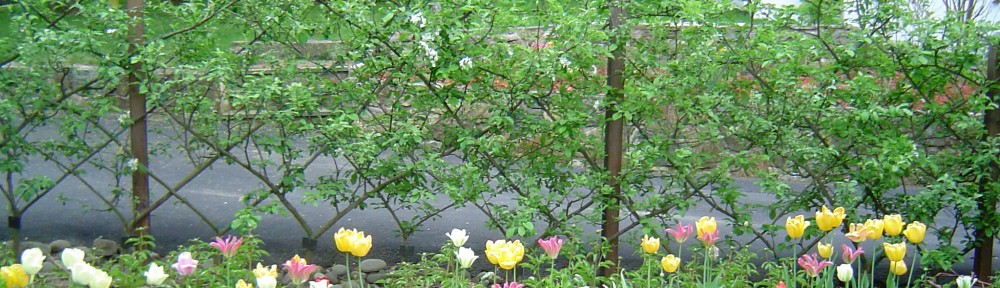
Key features in my garden such as the espaliered fence of fruit trees, the lush vertical garden, the pergola with native wisteria sprawled over it are obvious examples but adapted to suit the location and climate. The checkerboard garden came from seeing a huge chess board installed in a garden in France – not directly related. The design of the walkway was inspired by a pattern of piping in a blouse worn by a woman selling fruit at a market in Sweden.

In recent years, the colors of the tulips that bring great cheer in the spring, are inspired by art works in various museums. The color choices have evolved over the years. No doubt they will continue to do so.

It is similar in the house. Colors, furnishings, meals and music stand testimony to how travel opens the mind and enriches lives.

My own art is influenced more subtly – I’m not always aware until much later how I’ve been influenced by the light, colors and styles of the landscapes seen.

Unlike how it is when I come home from a summer trip, a winter homecoming is a gift of time. No pressing garden chores await. While the garden is asleep, I have the luxury to take my time to think, plan, design, source, schedule, create.

I returned very early Tuesday morning just as the snow had begun falling. The drive home was slow as the roads were already icy. Now, with unpacking done, accumulated mail sorted, laundry completed, I’m at leisure to harvest what inspirations I’ve picked up from my trip.

As the garden lies coated in white, the bones are sharply visible – my imagination has free rein to think about new plants to introduce, edits to make, colors to experiment and, revel in a most spectacular garden that lives for the moment only in my mind.

Everything is possible.

I present my ‘blank canvas’ –

(c) 2024 Shobha Vanchiswar

[do_widget “Blog Subscriptions (Jetpack)”]

Resolving January

Having reviewed in November, reflected in December, January is when it’s time to resolve. Resolve ideas and/or problems, resolve to do and make better. It is after all, the month when the world works on resolutions is it not?

As I go through my notes of observations, thoughts, wishes and wants in the garden, I’m generally struck by two things. The length of the musings and the sheer ambition of the gardener. Its laughable at first glance. But then, on reexamination, several things require the same action, a few items are quick fixes, some matters need a bit of tweaking while a couple are mere suggestions for pondering, others are long term projects and the remaining are simply pipe dreams.

Once triage, troubleshooting and targets have been sorted out, things look so much more manageable. Seed starting is scheduled, ditto for repairs and replacements. I break down bigger projects into doable sections and plan accordingly – taking into account seasons, my own work/personal calendar, time required and the possible need for additional manpower. Plants to be added are sourced and ordered – preferably from local nurseries. When and where to plant them determined.

Naturally, it all depends on the various circumstances, availability of what is needed, my budget and how easily I can obtain the necessary plants and/or structures. I have learned that no matter how well I’ve planned and prepped, it pays to stay flexible. Mother Nature has a habit of tossing out curve balls just for fun. My best effort is to have a plan, a commitment to execute it to the best of my ability and always allow for the Universe to intervene. Because, for better or worse, it will.

I’m still away from my garden and reveling in warmer climes but Nature continues to be my Muse –my recent watercolors –

(c) 2024 Shobha Vanchiswar

[do_widget “Blog Subscriptions (Jetpack)”]

A New Year, A Fresh Start

A very happy New Year! May this be the year our gardens outdo our expectations and show us how to be our best selves.

A light warm-up of garden to-dos for this first month of 2024 –

  1. Take down holiday decorations. Before disposing off the Christmas tree, cut branches to spread as mulch on flower beds.
  2. Keep bird feeders full. Whenever possible, keep water available for the birds.
  3. Inspect stored tubers, corms and bulbs for signs of mold and rot. Get rid of any that don’t look healthy.
  4. This is a good time to examine the ‘bones’ of the garden. Make notes of what needs developing, changing or improving.
  5. Make icy paths safe by sprinkling sand or grit. Avoid toxic de-icing products.
  6. If ground is wet/soggy, take care to protect the sodden areas by not walking on it too much. Better yet, protect it by putting down a temporary path of wood planks.
  7. Take an inventory of garden tools. Get them repaired, replaced or sharpened.
  8. Gather up seed and plant catalogs. Start planning for the coming season.
  9. Begin forcing the bulbs kept cool since late fall. Time to start an indoor spring!
  10. Keep an eye on indoor plants ( in the house or greenhouse). Inspect carefully for signs of pests or disease. Act right away if either is detected. Organic practices only please.
  11. Still on indoor plants: water as needed, rotate for uniform light exposure, fertilize every two to four weeks. Remove dead or yellowing leaves.
  12. Survey the garden after every storm or snowfall. If any damage such as broken branches or torn off protection has occurred, try to fix it as soon as possible. Likewise, large icicles hanging from roof edges pose a threat to plants below: shield the plants if the icicles cannot be removed.
  13. Enjoy the quiet respite offered by this first month.

Some images from my recent stay in Bali to give you a little escape from the cold clutches of winter. Bali is where the the sacred and sublime mingle seamlessly with the hustle and bustle of commerce and tourism –

(c) 2024 Shobha Vanchiswar

[do_widget “Blog Subscriptions (Jetpack)”]

Giving Thanks

The week of Thanksgiving is one I cherish deeply. It’s a call to stop all the busy-ness and use the time to appreciate the many blessings I’ve been privileged to receive. This practice gives me the right perspective as we get into the holiday season and emerge into a new year. It’s a reminder to stay focused on what really matters and to stay true to my values.

This year in particular, when the world is in so much turmoil and there is pain and misery beyond belief, it is hard to think of celebrations and festivities. But, this is exactly when we must summon the love we have in our hearts and express it by way of saying thanks, giving hugs, lending a hand, listening attentively, paying a sincere compliment, making someone smile, sharing a meal. Simple, powerful acts of kindness.

I share with you two poems I wrote for the last two Thanksgiving.

Gratitude Is A Muscle

Gratitude is a muscle

Use it or lose it

Flex it and it grows

Practice makes perfect

One reaps what one sows.

Shobha Vanchiswar

Thanksgiving

A harvest, a fruit

A forest, a tree

Abundance isn’t always

what the eyes see.

An open door, a glass of water

A sunny day, a summer shower

Simple respites

hold mighty power.

A stranger’s kindness, a child’s wave

A timely hug, a puppy’s lick

Gestures small in size

impact so big.

Love of family, support of friends

Reason to laugh, purpose to live

Immeasurable riches

sincere thanks to give.

Shobha Vanchiswar

May your Thanksgiving be rich in peace, love and laughter.

Inspiration – images from the 2023 Holiday Train Show at the New York Botanical Garden. Do go see this show in person!

(c) 2023 Shobha Vanchiswar

[do_widget “Blog Subscriptions (Jetpack)”]

Act Of Faith

Bulb planting got done last weekend. All of a 1000 give or take a few. The weather cooperated beautifully. Sunny, not too windy and comfortably cool conditions made the daunting task much easier to tackle. I say daunting because it is. There are so many holes to dig, drop a bulb and then fill back whilst maneuvering ones way around myriad established perennials. In my garden, it takes two days of steady planting by a team of two minimum. One drills holes the other fills.

In the past, I did the whole thing myself. But age catches up and help is necessary – family is roped in. I’m immensely grateful for their willingness to go along with my horticultural ambitions or, as they like to call it, my craziness. This year, I’ve been handicapped by wayward knees so it has been particularly meaningful to get the support of loved ones.

Like a child of a farming family taking time from school to help with planting/harvest, my daughter drove down from her graduate school in Ithaca to do her fair share in getting the bulb planting done. I’m thinking next year, I’ll try to get her cohorts from school to join in and give my husband a break!

Despite having a direct, realistic understanding of the weather patterns and climate shifts, the loss, reduction or changes in certain flora and/or fauna of value to the ecosystem, gardeners are an optimistic lot. The very business of gardening is about the future. What I plant now will only yield in time ahead. Through all the vagaries of the weather and general circumstances, on pure faith we sow, plant, water, feed, weed and nurture. It’s going to be just fine – we feel this viscerally. It would be impossible to garden without that conviction.

When it comes to bulb planting, it takes an extra dose of faith. The bulbs look innocuous – brown, rotund, little nuggets full of the promise of a beautiful tomorrow. With the goal of celebrating the end of winter and the arrival of spring, we envision the flowers put forth by the myriad bulbs and plant. We bury the bulbs in cavities of appropriate depths scattered through beds and meadow and come away with the conviction that they will deliver. Our full trust in Nature is commendable. In our interactions with other humans we do not display quite the same degree of faith. Human nature seems so much more fickle and treacherous than Nature herself.

Currently, at a time when we cannot ignore the acts and words of so many people within our midst as well as afar that demonstrate the worst of human traits, we must seek solace somewhere. That somewhere is a garden – ones own or elsewhere. Here, we find comfort and courage to face the future. In planting a bulb, a seed or a young plant, we firmly express our faith that there will be better tomorrow. Life would simply be unbearable otherwise.

Note: I encourage those without gardens to grow something(s) in a pot. A houseplant, an amaryllis, micro-greens, anything. I promise, you will feel so much better as you watch it grow. Have faith.

Images of bulb planting this past weekend – A mix of assorted tulips, alliums, camassia, fritillaria and ornithogalums were this year’s choice.

(c) 2023 Shobha Vanchiswar

[do_widget “Blog Subscriptions (Jetpack)”]

November! Last Call!

November! The month of winding down the gardening, finding comfort indoors and giving thanks. A month for review and gratitude. This gift of time behooves me to use it well. As I go about the final round of garden chores, I take stock of how things went for both garden and gardener. Were expectations met? Did I do right by my covenant to do no harm? What balls were dropped? What were the successes/failures? It’s an inventory of what all has happened in the garden this passing year.

I make note of my assessments and observations. In December, I will reflect on the points. But for now I must get the remaining chores completed.

Things To Do In November

1. First and foremost, put away all Halloween decorations. Set up Thanksgiving displays – gourds, pumpkins, ornamental kales and cabbages, chrysanthemums and asters.

2. Having cut back plants and cleared debris, mulch all plant beds with fallen leaves and/or bark chips. Putting down layers of newspaper or opened up paper grocery bags over the soil and then covering with fallen leaves is a really good, eco-friendly, sustainable practice.

3. Hurry up and finish all pending tasks from last month!

4. Finish planting spring flowering bulbs.

5. Protect pots to be left outdoors, vulnerable plants such as boxwood, certain roses, and garden statuary.

6. Reinstall and fill bird feeders. Note: in my area, we are cautioned to not put up feeders due to bear sightings.

7. Be prepared for snow and ice. Keep snow shovels, grit or sand, firewood stocked and handy.

8. In case of power outage, have candles, flashlights, matches and batteries on the ready. A radio too – I have a radio that uses batteries but it can also be charged up by mechanical cranking. Came in handy when a few years ago we lost power and Internet for a whole week due to Hurricane Sandy.

9. Finish raking leaves. Remember, leaving fallen leaves in place is encouraged. I keep only the various paths and my tiny lawn clear as the former needs to be kept safe for passage and the latter risks getting smothered to death if the thick pile of leaves shed from surrounding trees are left in place. Those leaves on the lawn are raked and distributed over the adjacent beds.

10. Clean and store tools. Get appropriate ones sharpened.

11. Start setting aside seed and plant catalogs. Soon you will be planning for next year!

12. While the weather is pleasant enough, keep on weed watch!

13. In the greenhouse, be sure the heater is doing its job. Ventilation is also important to keep plants healthy.

14. Start a routine for regular watering of plants indoors. Keep vigil for early signs of pests or disease.

15. Start growing amaryllis and paperwhites for seasonal cheer. Similarly, put bulbs such as hyacinths, muscari , crocus and tulips in for cooling. (I use my refrigerator). In about fourteen to eighteen weeks, you can start forcing them and pretend it is spring indoors!

16. Enjoy a beautiful Thanksgiving. Plan for it.

Some scenes from the garden and home –

(c) 2023 Shobha Vanchiswar

[do_widget “Blog Subscriptions (Jetpack)”]

Great Disturbances

It’s a chaotic time across the globe. Too much happening to ignore. While I escape into the garden, a book, a movie or the brushstrokes on paper, I cannot avoid being affected by what’s going on near or far. The climate, political chaos, living conditions, religious and racial disputes, wars… so much discord. No living being is untouched. As humans, we have to care, feel and respond. In ways big or small, we are each beholden to do something. Anything to make the world better.

I know I’m not alone in how overwhelming it feels. But we cannot, must not despair. I’m opting to bring out the compassionate warrior in me and fight for what I know to be right – for myself, my near and dear ones, my community, country and planet.

To start, lets just resolve to be kind to each other. Smile at people known or unknown, hold open a door for someone, pick up litter, plant a native tree or shrub, help a neighbor, pay an honest compliment, apologize without reservation, listen without judgment to an opposing viewpoint. The ripples of kindness will spread wide. We are not helpless – our humanity must triumph.

In the garden this week, I’m simply going to enjoy the season such as it is. A little clean up but mostly, appreciating this garden that gives me so much joy. In the face of so much disturbance, it cannot be taken for granted.

Seasonal Disturbance

The trees seem reluctant

to disrobe this year

Even the leaves are reticent

to reveal veins coursing

colors borne of the earth

Clouds shepherded

by the wayward wind

Gather in formations

akin to adversarial regiments

Threaten violent outcomes.

Perforce some leaves

will fall prematurely

Others sentenced to

languish and wither

On limbs too tired to care.

This moment in flux.

Feeds the uneasy heart

Anxious and uncertain

of changing climates

And changed live.

—Shobha Vanchiswar

Autumn vibes in the garden – not as dramatic as in the past but still beautiful –

(c) 2023 Shobha Vanchiswar

[do_widget “Blog Subscriptions (Jetpack)”]

To Cut Or Not To Cut – That Is The Conundrum

Now that the big task of getting the many ( including some very large) plants trimmed, washed and moved into the greenhouse, I’m feeling rather relieved. It’s usually a race against time to get this job done before tender perennials and tropicals are subjected to an early frost. Not so this year – I’ve had the luxury of taking my time to give adequate attention to each plant. And I’m grateful for it. Even so, its a bit disconcerting that temperatures haven’t really dipped as expected. Wonder how fall and winter will pan out.

The task at hand is the clean up of garden beds and the meadow. There’s a great deal of direction to delay cutting back of plants till the spring. Leave them be for birds to forage and to provide winter interest. I have two problems with that. Firstly, my spring blooming bulbs are planted every fall within those areas. So, fully grown plants preclude proper bulb planting. One cannot get into the beds and plant around them – I tried it one year and it was ridiculously hard. I was left severely scratched up and had body parts complaining loudly of the torture of being subjected to contorting my way around.

Secondly, by late fall/early winter, any seed heads left on the plants are depleted of seeds. They’ve given it their all. Any foraging or sheltering to be done happens at ground level. And, after the first big snowfall, any upright plant is smothered down. No poetically charming winter interest to be had by way of swaying stalks or dramatic seed pods. Then, in spring, after the snow has melted, its all one slimy, unsightly mess. The task of clearing it up is gross and if not removed, the glorious emergence of the bulbs is spoiled.

However, since I’m a believer in providing for the critters and doing good things for the environment, I’ve hit a happy compromise. The beds of perennial plants stay up till the very day before bulb planting commences. This is usually during the second week of November. My cue to schedule Bulb Planting Days is when the shipment arrives – they send it at the appropriate time according to Hardiness Zones. All the cuttings are moved to the compost heap.
After bulb planting is completed, leaves fallen over the tiny lawn are removed and used as mulch over these beds.
Note: This week, I’ll be dividing certain perennials and replanting.

Similarly, in the meadow, the cut back happens just before the bulbs must go in. Here however, several plants are left to stand – they remain full in form and provide good hideaways for the fauna. The heavy leaf fall in the meadow is left in place as well. So there is really adequate food and shelter here as well as in the adjoining woods. Other shrubs on the property also provide for the wildlife.

The general cut back and clean up permits work that needs to get done now and also sets up the garden for a comfortable segue way to the spring season. Nothing is left too pristine or lifeless. Neat but not too neat though, to some human visitors, it is not neat enough!
Ultimately, I remain with the sense of satisfaction of doing what really works for my garden without neglecting the creatures that inhabit it. No principles need be compromised.


Such a balance is possible in every garden. It isn’t ever all or nothing. We don’t have to do everything the ‘experts’ say – just as in child rearing, a sincere gardener must take into account the data and current practices, then apply their own understanding, instinct and judgment to do what is best for their specific gardens and the environment at large. We are, after all, the privileged and benevolent custodians of our piece of land. As we are of our children. Neither truly belong to us.

A few images of goings on in the greenhouse, meadow and elsewhere in the garden:

(c) 2023 Shobha Vanchiswar

[do_widget “Blog Subscriptions (Jetpack)”]

Overture To October

I do believe Fall is the busiest season in the garden. There is plenty to do but the weather typically makes it very pleasant to do them.

As I’d mentioned last week, I’ve already taken care of some big tasks. But those were specific to my garden. The comprehensive list below is one that should generally serve all gardens. Get cracking!

 Things To Do In October

1. Yes, weeding continues!

2. Time to plant perennials and trees. Give a good dose of compost to each. Water regularly. Perennials already in place can be divided and planted out as well.

3. Cut back all spent plants except what is needed for seasonal interest and feeding wildlife.

4. Collect seeds. Store in labeled envelopes in a cool, dry space.

5. Last call to root cuttings of geraniums, coleus, rosemary etc.,

6. Get all pots of tender perennials into clean greenhouse or other winter shelters. Wash plants and pots thoroughly first – minimizes pest infestation.

7. Plant bulbs as weather gets consistently cooler. Bulbs can be planted until soil freezes solid.

8. Rake leaves where necessary. Add to compost pile or deposit in woods. Otherwise, let fallen leaves be to provide shelter to critters and protect soil. The leaves will eventually break down to enrich the soil.

9. Give compost heap a good stir.

10 Clean out vegetable garden except for cool weather plants that are still producing. Apply several inches of compost on cleared beds. Plant green manure to enrich the soil – optional.

11. Clean and put away (or cover) outdoor furniture.

12. Check what needs repairing, repainting, replacing and get to it!

13. Lift tender bulbs, corms and tubers such dahlias, cannas etc.,. Store in dry, frost-free place. If grown in pots, simply cut down the plant and move the pots into a sheltered space like a garage or basement – water occasionally through the winter just to prevent desiccation of the tubers. In spring, bring pots outside, feed them well and kick start the growth.

14. Drain and close all outdoor water faucets. Empty rain barrel and hoses. Store.

15 Clean all equipment and tools. Store neatly. Get blades and such sharpened.

16. As temperatures plummet, protect tender shrubs and immovable  frost sensitive pots and statuary. I cover the former with burlap and for the latter, I first cover with sturdy plastic and then use burlap so it looks halfway decent.

17. Remove suckers from ornamental and fruit trees. Prune roses and wisteria. Remove dead and decaying limbs from all plants.

18. Fill up bird feeders. Keep them filled through the winter. Put up nest boxes for the spring.

19. Get into the autumnal spirit – fill window boxes and urns with seasonal plants and produce.

20. Bring in flowers like hydrangea, seed heads and foliage for seasonal themed arrangements.

21. Take time to enjoy the fall colors and beauty. This is a particularly lovely season.

(c) 2023 Shobha Vanchiswar

[do_widget “Blog Subscriptions (Jetpack)”]