Nexus

A great garden is the perfect nexus between science and art. The science dictates the way one gardens – choice of native/ecologically beneficial plants, sound organic practices, soil amendment, water management, planting sites, pruning, propagation etc,. The arts guide the use of color, shapes, size, textures, elements of visual interest like pattern of paths/stonework, sculptures, overall design and so on. Together, a definitively pleasing garden is born. As both a scientist as well as an artist myself, I strive to apply my skills and knowledge to create a well balanced garden. It’s an eternal work in progress which is what keeps the effort of gardening challenging, interesting, exciting and deeply rewarding.

How a visitor to a garden views it is usually indicative of their mindset. While, in general, all respond positively to a beautiful garden, there is often a telling bias towards art or science. There’s no right or wrong – like in everything, we come with our preconceptions, prior knowledge and experiences. I, personally enjoy listening to the diverse comments and feedback from visitors to my little garden. Over the years, I’ve gained much in remaining open to opinions. Seeing my garden through the eyes of others is something I thoroughly enjoy. While I garden according to my own sensibilities, I love the chance nugget of information or insight that comes my way.

For some years now, my garden has played muse to artists. They come from everywhere bringing with them their unique style and ideas. This past Saturday, a group of NYC contemporary water-colorists held their annual workshop here – it’s become quite a tradition and one I look forward to. While several of them have painted here many times over the years, some were first timers. One artist who resides in Panama, plans her annual trip to the US to coincide with this workshop in my garden. That, to me, is hugely gratifying and humbling.

In any case, it is such fun to see where and what each artist chooses to paint. And how they interpret it on paper! Some make repeat paintings of the same view while others move around.

The workshop concludes with a grand showing of everyone’s output and a super-helpful critique from artist and instructor Naomi Campbell ( not the famous model). I’m invariably blown away by all the work on ‘display’.

When everybody has left, I walk around the garden with a renewed appreciation and outlook of my horticultural creation. And I’m eager and inspired to get back to my own paints, paper and easel.

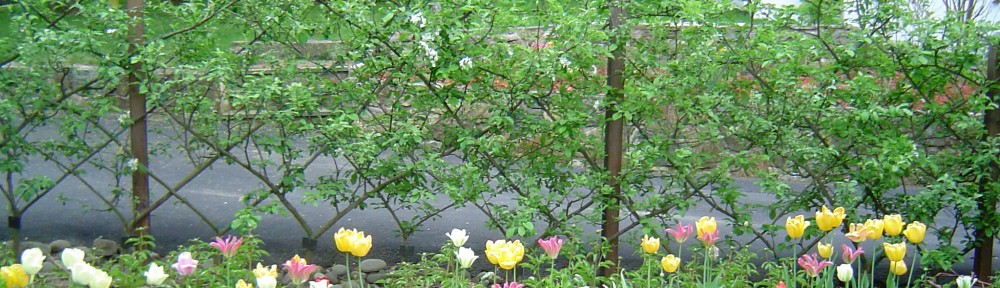
Later this week, a tree expert is stopping by to see the espaliered trees. The scientist eye and word is eagerly awaited!

(c) 2025 Shobha Vanchiswar

[do_widget “Blog Subscriptions (Jetpack)”]

Recap, Review, Recharge

Lyndhurst In Bloom has come and gone. Weeks of plotting and planning reduced to a short 2 day event. Was it worth it? Absolutely!

I was very gratified to see my vision realized perfectly. It came together exactly as I had intended. The feedback has been wonderful – better than I had dared to hoped. All in all, a great experience.

Each of the other installations were inspirational. So different and yet, they all seemed to relate to each other. That’s serendipity. Bonus – some exciting new professional as well as personal friendships forged.

I am taking the time this week to review and savor the entire experience. Acknowledging the work, the stretching of skills and, creative energy that was involved is important. No less important is the support received from family, friends and the folks at Lyndhurst ( specifically the inimitable Emma Gencarelli who puts together this huge undertakng) who gave me the opportunity in the first place.

Some garden work did get done too! The very large pots were brought out and they will be potted up soon. A bit of weeding – yes, that is best started as early as possible. It appears that weeds possess an inexplicable advantage – they get going before almost all other plants. There’s a research project awaiting some out-of-the-box thinking graduate student of botany.

I’m eager to get more time in the garden – it’s just about a month to Open Day. No time to waste! This week, I intend to plant summer bulbs, get the vertical garden going, bring out the more hardy plants out of the greenhouse, start leafy greens seeds and keep going with weed patrol.

Now, allow me to share some footage from my Lyndhurst In Bloom 2025 installation – I was unable to add the video so please imagine the field recordings of birdsong as well as the amazing fragrance!

(c) 2025 Shobha Vanchiswar


[do_widget “Blog Subscriptions (Jetpack)”

April Anticipation

April has started out correctly -with showers. May flowers are duly anticipated. But looking around, there is clearly all the hallmarks of expectancy everywhere. Buds slowly loosening up to reveal tiny glimpses of promised color, what sounds like birds going about their business includes songs of partnerships being forged and future possibilities, signs of dormancy being broken as the soil gives way to emerging growth anticipating the return of light and warmth.

With the prospect of lush blooms, I, as gardener have peony rings set in place. The birdhouses have been cleaned and await new or returning families. The very act of gardening is all about anticipation and it is this month especially that underscores that.

With that in mind, here is the To-Do list for April:

Things To Do In April

1. Time to restart the compost pile! Give it a good stir and add fresh compostables. If you don’t have a composter, please do make or buy one.

2. Clean up all winter debris.

3. Can you believe weed patrol begins now? Be regular about it and you will always be on top of this chore.

4. Seedlings started indoors can be planted out once the soil has warmed up and has been well prepared for planting. Stay vigilant for spells of late frost. Keep cloches and fleece covers at hand.

5. Attend to the lawn. De- thatch, aerate, reseed and finally, fertilize with a good layer of compost.

6. Similarly, feed trees, shrubs and all garden beds with compost.

7. Remove burlap and other protection from plants and pots.

8. Divide overgrown perennials.

9. Plant summer-flowering bulbs.

10. Remove any dead, damaged or diseased stems/branches from roses, other shrubs and trees.

11. Start using an organic control to put off slugs and snails.

12. Put out nesting material such as wool, moss, cotton string, shredded paper, small twigs, feathers and hay for the birds. No synthetic materials please!

13. Uncover the outdoor furniture and give them a good cleaning. Now you’re prepared for the first truly warm day!

14. Plant or move evergreen shrubs and conifers.

15. Take the time to revel in the beauty of the bulbs in bloom.

P.S. Last call to get your tickets to Lyndhurst In Bloom ! It’s this coming weekend April 5 & 6.

In my garden today –

(c) 2025 Shobha Vanchiswar


[do_widget “Blog Subscriptions (Jetpack)”

Decompress And Debrief

What a week it was! Busy, hectic and full of excitement. It was spent installing my art for the Lyndhurst In Bloom event. Transforming a vision to reality is a process fraught with ideas, doubt, fun, tweaking, rethinking, redoing, second guessing everything and, finally pulling it all together. A roller-coaster ride.

And then the preview night arrived – it had all come together and I was ready to enjoy the evening. Whew!

The feedback that evening and through the weekend was good and gratifying. I’m really glad I’d said ‘yes’ to this opportunity. It made me stretch and explore, dig deep and think out of the box. It was truly exciting. I’m very pleased with how the final installation looked as well the public response. I learned a lot too.

I had many requests to share as much as possible about my project from those who could not attend. So I submit here the mission statement for it and lots of photos. Lyndhurst had a professional photographer take pictures but I will receive them only later.

And now, after a day spent collecting my thoughts and decompressing, I head into the garden and onward to the garden’s Open Day!

Before Flowers, Beyond Flowers

Lyndhurst Mansion will forever be connected to the Gilded Age. A time associated with rapidly expanding industries, significant progress in science and technology and of course, opulence and excess. What is often overlooked is that this period was also when Environmentalism as a national movement got started. It was a seminal moment when Yellowstone National Park was established in 1872. The first of its kind in the world.

We are now at a similar inflection point where we must renew our covenant as protectors of the environment.

On that note,Welcome to The Gilded Age 2.0. What was the scullery has become an ode to seeds.

The very fundamental source of all life is highlighted. Every seed contains the past, present and future. Seeds hold the history, geography, science and art of life on earth. 

Yet, while there is universal agreement that seeds are important, one tends not to pay serious attention to them. Benign, diminutive, innocuous with an appearance perceived as dull, they’re easy to go unnoticed. When was the last time you deliberately examined a seed pod, capsule or head?

They are exquisite in design and each uniquely suited to its natural environment and manner of seed dispersal be it by gravity, wind, ballistic, water or animal.

The viewer is invited to take the time to examine the watercolor art works, displays of the real materials themselves, various ways to propagate – seeded paper hung like prayer flags as testaments of faith, hope and service, seed bombs to broadcast generously, seedlings started in flats/)pots for assigned places and purposes, some set aside to exchange with fellow gardeners,

A lot of gardening is focused on flowers. People don’t realize plants can be beautiful after flowering, and they cut them down before they can even see it. I look outside now and see the clematis that flowered in the summer but is more interesting now that it is showing seed heads.

If you make a four-season garden you have to learn to accept decay and see the beauty of it. It’s about the texture and shape, the seed heads and the skeletons. So instead of using the scissors you use your eyes.” Piet Oudolf

Note: The dried materials seen here were gathered from my own garden with some treasured additional contributions from Harnek Singh – @plantstani and Timothy Tilghman of @untermyergardens.

Sustainability at its best!

My garden is open to the public May 4 through the popular and highly acclaimed Open Days Program of the Garden Conservancy.

Shobha Vanchiswar

Artist, gardener, designer, environmentalist

Welcome To Before Flowers, Beyond Flowers-

A few of the other lovely installations –

(c) 2024 Shobha Vanchiswar

[do_widget “Blog Subscriptions (Jetpack)”]

Parallel Processing

Working on two deadlines at the same time is anything but dull. The pressure is on full throttle – final stretch to Lyndhurst In Bloom which happens this weekend and less than a month to my garden’s Open Day. Both are very personal to me as they speak of my philosophy, my creativity and skills. In both cases, I’m aiming to share whats important to me – the natural world that deserves to be appreciated, admired and protected at all costs. Along the way, we find joy, laughter and comfort.

In the garden, given the vagaries of the weather, it’s been slower than I’d like. Between cold and rain, I’ve had to be cautious about bringing out plants from the greenhouse and/or planting too soon. This past week, I focused on replacing groundcovers that had simply run their course. In the garden, perennial doesn’t mean forever. They come back every year but many will eventually run their course and peter out over time.

This was the case with a favorite of mine – Mazus reptans. Originally planted along the side path that connects the front and back of the garden, it had faithfully performed spectacularly. But over the last couple of years, it started losing momentum and finally, very little showed up last spring. This is a very pretty garden stalwart. Undemanding, requiring no direct sunlight it carries on. Diminutive leaves delicately scalloped around the edges form fresh mats that knit together to beautifully cover the earth. The flowers come up a bit later in spring and look like small moths charmingly speckled in purple and white. So very pretty. After the flowers, the green carpet remains and serves for rest of the growing season.

It was a joy to find them in my local nursery and plant them in on Sunday.

Meanwhile, the creeping phlox in the checkerboard garden had been challenged by moss that wanted to take over. Last years wet summer had clearly favored the moss. So much of the moss got removed and new phlox was added to the ones that remained. This garden will have to be reexamined as it is entirely possible that conditions have changed more permanently with surrounding trees and shrubs casting more shade along with all the rain we seem to be getting lately. For now, the new phlox will do. I must research some other interesting yet suitable alternatives.

Opposite from attending to spring chores, is my project on seedpods for Lyndhurst In Bloom. A wholly different season and still so very interdependent. The diversity, sheer beauty and genius designs in packaging so well suited to how the seeds are dispersed is breathtaking. I’ve learned so much through my efforts at painting them. But as I created some arrangements this past weekend, I found myself learning more about how exactly those designs functioned. Quickly meshing into a network or snagging a hold on a neighbor just to get a bit of leverage, quivering at the slightest disturbance, using its sticky seed coat to attach firmly till its safe to open and send its seeds out into the world. They all wait patiently for the rain, wind or critters to help them. Some, do it on their own via ballistic action or gravity. And in each, the circle of life carries on. Just brilliant.

In all the busyness, I’ve been mindful about taking the time to enjoy the process. Giving each task due attention is imperative. Because to have a garden to work in is a privilege. To have the opportunity to show my art is a gift. To share both garden and art is a blessing. I’m aiming to deliver with Grace.

(c) 2024 Shobha Vanchiswar

[do_widget “Blog Subscriptions (Jetpack)”]

Spring Up!

Happy Spring! The first day of the season and as if on cue, the daffodils have begun the celebration. I cannot recall the last time there was so much early growth on this day. Despite the uneasiness, I can’t help but feel eager to see what’s popped up overnight. And this year, the season has hit the road running. The snowdrops are done but the Hellebore. Crocus and Scilla have been dancing gaily for several days already. The Daffodils have just joined in. The party has begun. Even the birds are raucously going about their business of disturbing the morning quiet earlier in the season than ever before. Note to self – clean out the birdhouses so new tenants can move in!

Feeling cautiously optimistic, this past weekend, we began the seasonal chores in earnest. The arrival of 5 young ( two years old) apple trees to replace ones we’d lost over recent years in the espalier spurred us into action. The weather was mild enough, the soil quite pliable to plant and so it seemed foolish to wait.

This in turn led to chores like digging up some boxwood that had been struggling the last few years. While new replacements will be procured, the evicted plants will be given a go with some TLC and cossetting in pots to see if they might come around. I do hate just tossing plants away.

The large pots were dragged out of winter storage, positioned in their rightful locations and filled with fresh soil and compost. They will be duly planted up next weekend. It’s best to work systematically and mindfully. I’ve learned not to rush. Though all of a sudden I’m beginning to feel the pressure of the myriad tasks that must get done ahead of the garden’s Open Day on May 11. The work of getting ready for my installation at Lyndhurst In Bloom is also underway. The weekend of April 20 is only a month away!

The juggling act requires not only a good deal of organizational skills but a good sense of humor to boot. Admittedly, it’s all exciting.

As I schedule out my chores, I imagine gardeners everywhere doing the same. Making lists, trips to the local nursery, extensive searches online for plants and such, examining the garden closely. But mostly, I allow myself to feel a sense of camaraderie where, in the guise of gardening, we indulge in the sheer joy of once again being out in the garden. It is our happy place.

Together, lets make this a very happy, healthy and productive Spring.

This week in my garden:

(c) 2024 Shobha Vanchiswar

[do_widget “Blog Subscriptions (Jetpack)”]

Resolving January

Having reviewed in November, reflected in December, January is when it’s time to resolve. Resolve ideas and/or problems, resolve to do and make better. It is after all, the month when the world works on resolutions is it not?

As I go through my notes of observations, thoughts, wishes and wants in the garden, I’m generally struck by two things. The length of the musings and the sheer ambition of the gardener. Its laughable at first glance. But then, on reexamination, several things require the same action, a few items are quick fixes, some matters need a bit of tweaking while a couple are mere suggestions for pondering, others are long term projects and the remaining are simply pipe dreams.

Once triage, troubleshooting and targets have been sorted out, things look so much more manageable. Seed starting is scheduled, ditto for repairs and replacements. I break down bigger projects into doable sections and plan accordingly – taking into account seasons, my own work/personal calendar, time required and the possible need for additional manpower. Plants to be added are sourced and ordered – preferably from local nurseries. When and where to plant them determined.

Naturally, it all depends on the various circumstances, availability of what is needed, my budget and how easily I can obtain the necessary plants and/or structures. I have learned that no matter how well I’ve planned and prepped, it pays to stay flexible. Mother Nature has a habit of tossing out curve balls just for fun. My best effort is to have a plan, a commitment to execute it to the best of my ability and always allow for the Universe to intervene. Because, for better or worse, it will.

I’m still away from my garden and reveling in warmer climes but Nature continues to be my Muse –my recent watercolors –

(c) 2024 Shobha Vanchiswar

[do_widget “Blog Subscriptions (Jetpack)”]

POV

This past Sunday and the Monday prior, groups of artists have come to paint in my garden. As I truly believe that gardens are best enjoyed when shared with others, it gives me enormous pleasure to see people enjoy my garden. When something that gives me comfort and inspiration does the same for others, we become connected at a deeper level I think. The shared experience fosters a bond for sure.

I’m always curious to understand how others experience and perceive anything I create. Be it a poem, a painting, a meal or my garden, receiving feedback is an important factor in my growth as an artist, poet, gardener or cook. Going a step further, its how I grow as a creative individual. But one doesn’t always get to know what others experience since not everyone feels compelled to share their thoughts. Of course, most folk readily say kind, complimentary things and only a few will offer honest, constructive criticism. How well I accept the latter depends naturally on who is speaking. A person who’s opinion I value or somebody who simply says something from ignorance or misguided intent – it makes a difference.

But when it comes to artists in my garden, what they choose to paint and their resultant works says it all. No words required. So many points of view and interpretations helps me see my garden anew each time. This is valuable as, for my part, I get to see my garden from different perspectives which then helps me develop or evolve certain areas further or maintain other spaces as it is for now. For certain, I learn much in seeingthe garden through the eyes of others and that gives me a deeper understanding of my own creative process. It’s also a testament to how successful (or not) my design efforts are. Those paintings are a bit like performance reports. I pay attention and then take from each what either helps me grow creatively or validates what I’ve done. What elements, plants or areas caught an artists attention informs me on whether my work with the design, shadows, shapes, colors, play of light, use of negative space have been noted and appreciated. Every now and then, I get to see something so familiar to me in a completely different manner. That’s big.

In any case, every artists’ work matters to me. Simply knowing they are in my garden by choice does my gardener and artist heart a world of good. I am humbled and deeply grateful.

Here are images from two different days of artists in the garden and their resulting works. It’s interesting to note where and what each decided to paint –

(c) 2023 Shobha Vanchiswar

[do_widget “Blog Subscriptions (Jetpack)”]

Trial And Error

On one hand, the garden is a vast artist’s canvas to express oneself, make a unique statement, create beauty and bounty. On the other, it’s a big laboratory to try out ideas, experiment and observe, learn from failures and successes. In the end, we understand the world and ourselves better. I revel in it all.

In combining the science and art of gardening, I’m in my element. As scientist and artist, the garden provides the perfect nexus to bring it all together.

As I’d written in earlier posts, I will be making seed bombs and testing them out this season. Previous failures in growing poppies by sprinkling them around in late March have failed. Hence the decision to trial seed bombs. Easy enough to do and, if it works, I’d have come up with a good solution. In my mind’s artistic eye, I see a melange of poppies dancing in the meadow like ballerinas. We shall see how things turn out.

Earlier this year, I made an impulse purchase of a bag of Liatris bulbs. Immediately, I envisioned the garden in mid-summer lit up in mauvish-pink candles. I’ve yet to get most of the bulbs in the ground but this past weekend, as I potted up pansies, I buried some of the liatris in the same pots My thinking is that the liatris will come up in time and, once the pansies are done, they will be replaced with something more complementary to the poker shaped flowers of the liatris.

I’m anticipating the arrival of dahlia tubers. Having never grown them before, I’m eager to get started. Some will go in the bed across from the vertical garden and others into pots. The idea of pots is two-fold. I ordered more tubers than the aforementioned bed can handle and also, the pots can be moved around anywhere a splash of color is needed.

The pears-in-a-bottle experiment from 2020 was a success so I’m planning to repeat that this year. Maybe with apples too.

Experiments excite me so I’m very impatient to get going. Naturally, I want everything to succeed but no matter the outcome, I’d have learned from each one. Along with the garden, the gardener grows too.

Note: I subscribe to a Poppy CSA from @bearCreekFresh. The first weekly delivery of about a dozen stems arrived last Thursday. Poppies are ethereal. Their organic transformation from bud to flower is a performance art I cannot get enough of. Every stage of the plant, from bud to seedpod is beautiful to behold. #buylocal

Pear In A Bottle 2020

My watercolor of Liatris

(c) 2022 Shobha Vanchiswar

[do_widget “Blog Subscriptions (Jetpack)”]

Open Season

After all the weather related trials and tribulations, the garden opened for visitors this past Saturday. After a year of forced ‘hiatus’, the Open Days Program was up and running! And it felt so good. Opening my garden to visitors is a sly way to meet lots of like-minded folk and have fun, interesting conversations all day long. While the visitors invariably appreciate the sharing of my garden, little do they know how much I enjoy meeting fellow gardeners and garden lovers.

Open Day 2021 was no exception. Following a few days of torrential rain, Saturday was sun filled and bright. The humidity and temperature was high but, nobody cared. It felt wonderful to be outdoors. I was so ready to see people that the fact that the garden was a bit toned down on the flowers in bloom section, did not bother me. Abnormal heat from the previous week had put paid to several flowers that would typically have been at peak beauty. But, there was enough color provided by the baptisia, roses, geraniums, native wisteria, hibiscus, nasturtiums, peonies, irises and others.

As gardener and designer, I know my garden all too well. Warts and all. So it is hard to be objective. The critical mind always takes over. Stuff will bother me that absolutely nobody will notice. Still, until I improve or change it, the ‘problem’ will nag me. And by its very existence, a garden is never done. There is always more to do, undo and redo. And then, like a knight in shining armor, Open Day arrives to rescue me from myself.

After doing the usual last minute fussing and primping, the garden is what it is as the clock strikes the start of Open Day. Visitors arrive and perhaps it was my imagination but this year, they seemed more eager to tour and observe. Like me, they too must’ve missed Open Days. How else can we see all the beautiful private gardens that we yearn to see and covet?

On my part, I’m always impressed by the depth of knowledge and degree of curiosity that visitors bring . I’m gratified when they take note of elements and plants that I’ve designed and/or selected. Seeing my garden through their eyes and preferred interests is enlightening and fun. We commiserate about trends and fads, discuss cultivars and species, joke about chores, share ideas and information and linking it all together is our deep and abiding love for gardening.

I don’t know or care to know their political leanings, religion, socioeconomic status, level of education or other credentials. All that matters is the universal connection we have to nature and consequently to each other. Surely, if we can come together on all aspects of gardening, that in itself becomes, literally and figuratively, the common ground upon which we, as a people can build better relationships and understandings.

At the end of the day, I was, as always, euphoric about the new alliances made, plant suggestions, garden recommendations, good feedback on my own garden, humorous anecdotes shared and hopelessly optimistic about achieving all my horticultural dreams.

After the last guests had left and all paraphernalia had been put away, it was with such satisfaction that I ‘closed’ the garden. Days like that are truly special. At many levels.

My sincere thanks to all who came from near and far – I loved meeting each of you. Deepest gratitude to all who purchased from the Printed Garden collection. Your generosity supports good causes like the ACLU and orphan children with HIV.

Note: Do sign up to visit private gardens through the season and all across America at the Garden Conservancy’s Open Days Program. They will inspire, motivate, teach and entertain. I promise!

All but the first image below were taken by ceramist and photographer August Brosnahan:

(c) 2021 Shobha Vanchiswar

[do_widget “Blog Subscriptions (Jetpack)”]