FOMO In The Garden

FOMO – Fear Of Missing Out

I really appreciate that our very human anxiety about feeling left out or missing out on something has been recognized and owned. As social animals, we need to be included and informed on all the goings on. Every one of us can recognize that FOMO feeling – we’ve not only been there but we continue to go there. It simply cannot be helped. Which is why we say ‘yes’ so often. And why we bring upon ourselves a state of business that more often than not, provides no satisfaction.

I’m currently going through a different sort of FOMO. It’s a deep seated resentment of missing out on the happenings in the garden. Due to the days of intense heat alternating with long bouts of rain, I’ve had very little opportunity to hang out in the garden. The humidity in particular really does me in. Snatching windows of tolerable conditions to get basic chores done is about all I’ve managed. There has been no real chance to enjoy what’s in bloom (or not), observe wild life and just linger in the life affirming atmosphere of the garden.

These conditions invariably makes me a grump. The sense of not being there to note the myriad events in my garden is unsettling to say the least. What’s the point of planning, planting and working in the garden if I’m not there to savor the fruits (no pun intended) of my labor?

Instead, on my rushed forays, I spy poppy petals scattered around but not a single flower in sight. Missed those blooms. I dutifully refill the hummingbird feeders but do not get to watch any of the thirsty drinkers. I know the cicadas have emerged, mated, laid eggs, eggs have hatched and nymphs have molted only because I spot the exuviae, their transparent exoskeletons still clinging on to tree trunks. How I’d have loved to monitor those stages! Soggy roses browning on the limbs tell me I missed their beauty and fragrance. And so it goes …. on and on.

A similar FOMO is experienced when I must go away for any reason. I might be super-excited to travel to beloved places and yet, I’m loathe to leave my garden. I know what I’m going to be missing and that makes me sad. In the big picture, none of this is a huge deal. I know that. But I’m here owning my own FOMO. It’s real and not to be ignored. There, I’ve said it. Anyone else coming forward?

Note: I’m sharing some of my recent black and white paintings. They were after all inspired by the garden

Gardenia

Tree Peony

Clematis

Columbine

Magnolia Grandifolia

Parrot tulip

Iris

(c) 2021 Shobha Vanchiswar

[do_widget “Blog Subscriptions (Jetpack)”]

July Ripples

July

July comes in many waves

surges first in stars and stripes

then butterflies surf garden sites

spilling over in swells and sprays

as heated rollers collapse the days.

Shobha Vanchiswar

The past week has been trying. The heat wave followed by heavy rains pretty much kept me indoors. In the beginning, it was kind of fun to have legitimate reason to loll in air-conditioned comfort and read at leisure. But after a couple of days, I started fretting over the garden. When I finally ventured out, as expected, the weeds had made great strides. A few days without vigilance and the hooligans had gone to town. What weeding could be done between rain showers was done. But that’s it. It just wasn’t possible to do more.

This week is once again fraught with erratic weather but I think I can no longer take it easy. There’s more weeding, plenty of deadheading and cutting back awaiting. The spice bush and climbing hydrangea are being strangled by Virginia creeper that somehow escaped notice till now. And the ornamental raspberry is threatening to overrun the meadow. The bees love it so, thus far, I’ve been reluctant to disturb their bliss. It’s going to be quite a job to pull out a substantial chunk of this hardy plant but I cannot afford to delay– several other plants in the vicinity are being smothered.

Meanwhile, with all the warmth and humidity, the snail and slug populations have exploded. A real bumper crop. Aaaargh!

The list of chores grows and the weather refuses to cooperate. So I’m left with no choice but to get out and get on. Sigh. My pile of summer reading must wait.

Note: Some images of whats doing in my garden at present –

Milkweed

Ornamental raspberry

Coneflowers

Nasturtium

Canna

Gardenia

First fig

Day lily

R. strawberry hills

Astilbe

Acanthus rising

(c) 2021 Shobha Vanchiswar

[do_widget “Blog Subscriptions (Jetpack)”]

Living In The Sun

A big takeaway from the past year was that everyone rediscovered the power of nature. The visceral need we have for the open spaces rich in vegetation and fresh air was unarguably recognized. Those of us blessed with any size of land found sheltering at home less stifling than apartment dwellers. Parks and preserves saw a remarkable up-tick in visitors. Following more than a year of restrictions, how we live has become a focus.

Inside the home, we have quickly realized that our spaces are not designed for our current needs. For that matter, many homes were never set up for us to spend a great deal of time in it. With the flexibility of working at home full-time or part, office space is a necessary requirement. The family dining table can no longer do double duty. In order for any member of a household to get some time and space alone, bedrooms are now not merely for rest/sleep. Open living plans, hugely popular pre-pandemic are now regarded as unsustainable for multiple people living and working from home. Interior designers have noted the new needs and are responding with ingenuity and creativity.

Similarly, the gardens of many demand re-imagining. First and foremost, let me get a pet peeve out of the way – can we please stop calling our outdoor piece of property a ‘yard’? A yard is simply the grounds surrounding a building or a unit of measure. A yard does not evoke a beautiful space. Think about it. There are dockyards, shipyards, farmyard, junkyard, barnyard … you get the idea. Without the prefixes court- or vine-, yard by itself does not conjure up greenery. However, ‘garden’ immediately makes one see plants, grass, flowers and fruits. Somewhere pleasant. Words matter.

Gardens are not just for show. They should be designed for people to spend time in them – cultivating, meditating, socializing, playing, eating, reading, napping. That pretty much means outdoor living. Be it a balcony, a narrow strip or a bigger space, we must think about how they can serve multiple purposes aesthetically and effectively. I would add that all designs must be sustainable, eco-friendly, organic and environment conscious. In my book these requirements are non-negotiable.

A simple bench set in the garden provides a place to sit, read, converse and observe. Add a table and now you have a spot for eating, working, painting, writing, playing cards or board games. A swing under a tree or a hammock slung between two trees offers a different attractive choice. You see?

Of course, the right plants are critical. Color, texture, shapes, heights, widths, fragrance, tactility and functionality are all key attributes to consider. Native/eco-beneficial too. Good design makes a garden beautiful and functional.

Pulling together all the required elements to create a garden that suits the way one lives is perhaps most challenging. And exciting.

In my own garden, there are various places for escape, rest and activity. In the front, the two Adirondack chairs were installed to provide a place from which one could enjoy this area of the garden. It’s close enough to the street that spontaneous conversations with neighbors out for walks happen. From mid-afternoon on, the sun has moved on and one can sit in shade and read, work on the laptop, take a tea break, watch the birds, butterflies and bees.

The terrace on the side, is a lovely spot for breakfast before it is bathed in full sun till early evening. In summer, it’s too hot by noon. In cool months the sunny location is a gift. A table with chairs and an umbrella that can be tilted for requisite shade makes spending time here amidst the sweet smelling citrus and gardenia (in pots)is a rather sublime experience. Members of the household routinely hold Zoom meetings from this location. The hummingbird feeder nearby is visited often and always brings joyful distraction.

Similarly, the tree house has also stretched itself from just a cool spot to hangout (or camp out) with friends to a cool spot to work. Wi-Fi extends to this perch so what at one time was also a place to do homework, now permits all manner of work be conducted. As well as the occasional nap.

From late fall to early spring, the greenhouse, set up with a small table and single chair takes on the role of sheltering a myriad assortment of plants as well as an escape for any family member who needs a little nature therapy. Or simply needs to get away from the rest of us. This past winter, it became my husband’s corner office! He found it more enjoyable than sharing the house with the rest of us.

The table under the pergola on the terrace in the back is used in countless ways. We eat, entertain, work, read, paint, play, bird-watch and generally hangout. All day long. Adding an outdoor heater last fall has made it possible to use this area almost all year round. String lights and a chandelier keep us going well into the night. Poker nights, hysterical rounds of charades and long, lively conversations happen here frequently. Life.

There is a bench towards the back of the ‘meadow’ that serves as an escape from the madding crowd and also a restful spot from which to enjoy the flowers in bloom and observe more closely the activities of all sorts of pollinators. Seeing the meadow from a different perspective can be eye-opening.

A similar bench under the grapes on the far side of the terrace is another good location for bird-watching and catching some sun and quiet time.

The garden should be a true extension of the home. It’s meant to be lived in. Not merely viewed. It’s good for health.

Note: We’re in the midst of a heat wave. Hope these images give you some respite:

(c) 2021 Shobha Vanchiswar

[do_widget “Blog Subscriptions (Jetpack)”]

Nurturing Nature?

This past weekend, we finally took a mini-vacation. A long weekend at the beach – a much craved change of scene. After staying home for so long, it felt strange to be packing and yet, so familiar. Our eagerness to be in the sun, sand and water brought back memories of other beaches around the world when it all felt so accessible. Yet, here we were going to a beach house within the state and it felt surreal to be going anywhere at all. Clearly, returning to ‘normal’ is a process.

The one response that came back without hesitation was my worry about the garden. For as long as I can remember I’m loathe to leave my garden for any length of time. What if it got too hot/ too windy/too cold/too wet? What if pests take over? Will the weeds take over? Without deadheading, plants that should bloom longer will set seed! How to make sure the mowing ( of a very tiny ‘lawn’) gets done? An endless list of potential problems plague me.

Despite all the trips made over the decades and the garden surviving each time, I fret about the garden and miss it even before I’ve left. Crazy. I know.

It felt even harder to get away this time. After all, the garden has been the mainstay through all the months we’ve had to be sheltering at home. Without it I’d have found life during the pandemic so much more difficult. Caring for the garden was my salvation. And now I was being called to let it go. Albeit very temporarily. I still found it challenging.

This got me thinking about all the things we do for our gardens that might well be viewed as unnecessary. Even a bit too much. I cannot help myself. It’s who I am. Please tell me I’m not alone as I recount some of the stuff I’ve done to safeguard my piece of paradise.

Years ago, the morning of the day of my departure to a destination overseas, two little baby robins fell from a nest high up in a tree. Obviously, I could not get them back to the nest. I could not stand sentry over them myself as I was going away. The thought of predators coming for these birds made me very anxious. I put the little ones in a shoe box lined with leaves and grass and set it where I hoped the robin parents would find and feed them. And instead of packing and doing the numerous things that needed doing for the trip, I spent the better part of the day calling all sorts of agencies to see if they could advice or help in any way. No luck. They mostly thought I was unduly concerned. But I did find out that should a domestic cat kill a bird on my property, I could sue the owner of the murderous cat. Really? Punishment for a cat doing what is in its very nature? Even I, in my heightened state of worry could see the absurdity of this law.

I finally conceded that I’d done my best and frantically moved to finish packing and dash to the airport.

The following year, because the eggs in the nest that sat nestled amidst the branches of the climbing rose that scrambled over the arbor leading to the front door had hatched and we were once again headed out on vacation, I slung a child size hammock beneath so if the babies fell, they would land safely in it and the parents could still tend to them. This arrangement effectively precluded access to the front door but who cared!

On my return, the hammock looked unused and the nest was empty and intact. Presumably all had gone well. Whew. Having to explain to neighbors this strange arrangement without coming across as batty was however a different matter.

Last week, we netted the espaliered fruit trees to protect the pears from marauding squirrels. The evening before going away for aforesaid weekend to the beach, it occurred to me that one of the hummingbird feeders sat too close to the netting and I was concerned the diminutive drinkers could get entangled n the net if they didn’t pay attention. I had to most certainly move the feeder to a safer spot nearby. My husband kidded me about imagining ‘drunken’ hummingbirds leaving the bar and getting entangled but I was not to be dissuaded. Feeder was not only moved but I waited till I saw that the initially confused hummingbirds discovered the new location and resumed their drinking activity.

Just having/hiring someone come by to check on the garden to water and weed is not enough. I need someone who is very familiar with my garden and also loves it. Okay, at least really likes it. Person must be kind and caring in general. I’m happy to report that I’ve found just such a person. A nephew who lives 20 minutes away and is willing to indulge his eccentric aunt. Dedicated garden–sitters are true godsends and I have no doubt there’s a special place in heaven for such people.

But please, please tell me I’m not the only gardener obsessing about how to keep the garden cared for whilst one is away. After all the ribbing about babying the garden that comes my way, I need some serious validation. Help.

P.S. In case you’re wondering, the weekend away was lovely. Weather cooperated and the beach was just wonderful. I watched a gull pick clams from the water, fly up high and drop the clams so they opened on impact and the bird could easily access the contents.

I got yelled at for coming too close to the roost by a nesting osprey. It was at least 20 feet above ground and had nothing to worry about. But then, who am I to talk about worrying.

I was entranced by a flotilla of ducks guiding their babies ashore to settle down for the night and great egrets parading around nonchalantly like they were too cool for school.

Dog roses were in full bloom along the beaches. And in the gardens I passed by were other roses, hydrangea, yellow baptisia, magnolia and Montauk daisies looking quite spectacular. I also noted deer and rabbits in good numbers. I wonder what sort of compromise they’ve reached with the gardeners.

Note: Enjoy the images of nature that made my weekend so rewarding:

Swan

Going ashore for the night

Duck flotilla

Osprey

(c) 2021 Shobha Vanchiswar

[do_widget “Blog Subscriptions (Jetpack)”]

My Big Little Garden

A few days ago, I watched the The Big Little Farm – ‘an award-winning documentary about bringing a farm back to life after years of neglect. New farmers, the Chester family, work with nature – not against it – to create a living system with biodiversity where each plant, animal and insect contributes to the health of the land’. I encourage everyone to watch it. It is inspiring, informative, life-affirming and heartwarming.

The basic principles applied in the film are easily implemented in our gardens both public and private. It is how we humans should be cultivating the land. In harmony with nature, maintaining that balance that is so fragile and yet so critical.

The day after I saw the Big Little Farm, I sat a while outside thinking about the film. I could drew a parallel with the evolution of my own garden. When we first bought our property, it was a completely neglected piece of land. The house, built in 1915 was sound and solid. It needed updating but nothing drastic. The garden however, was a total shamble. Left on its own for a few years, it had lost the the battle with the woods in the back which had started encroaching well into the property. We had to measure exactly where the property line was and then started removing all manner of invasive vegetation and debris.

To the side of the property, weeds had quite literally become trees. You couldn’t walk there let alone examine that side of the house. Just out of grad school, we were so naive that we bought the house without really knowing what condition this part was in. After we closed on the house, we had to hire a tree service to remove the “weeds” and open up the space to create a proper path connecting front to back. Mercifully, that side of the house was intact.

In front, there were sickly evergreens right up against the house. They’d grown so tall and gangly that you couldn’t quite see the house. Imagine how dark it felt inside.

Separating us from our neighbors on either side were jungle-like hedges and raggedy shrubs totally gone out of control. In general, we’d inherited a complete mess.

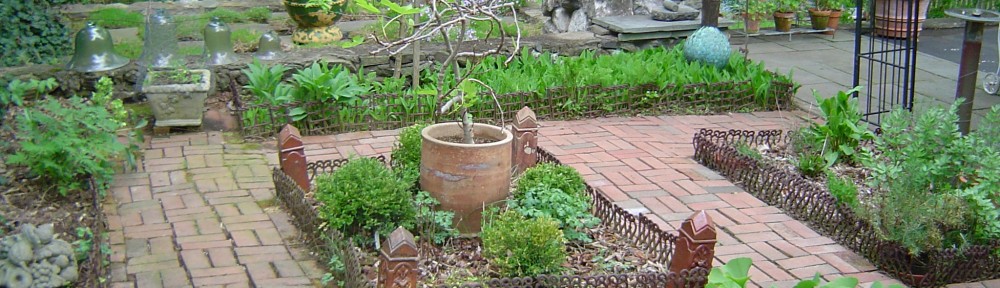
Slowly, we cleared and cut, waited and watched, planned and prepared. I realized I could create garden ‘rooms’ with the different levels that were naturally presented. One squarish area sat atop the old septic tank. This meant that beneath a foot and a half to two feet of soil, was a thick layer of concrete. Nothing with deep roots would do well here. I made it the potager where herbs and vegetables could grow. (The neighbor’s cedar tree was much shorter at that time – it is now huge and casts more shade than I’d like). The fact that I’ve added native wisteria and espaliered pears on two sides of this space is typical of how I’m always pushing the limits.

After the clearing and opening up happened in the front, a charming garden was envisioned. I believe I succeeded and the beds are a happy mix of bulbs and mostly native perennials that have something in bloom through three seasons. It starts off in spring looking colorful and orderly, then gradually gets looser and assertive in the summer and by the fall, it looks rather wild and rambunctious. I like it that way. As do the bees and butterflies.

The meadow in the back was my big push to eliminate all lawn and create a lush area of native plants where native wildlife could thrive and result in an ecosystem that was in balance. This is the most ambitious project in the garden. It’s still evolving but, it is certainly already the busiest area! Birds, bees, butterflies, worms, toads, garden variety snakes and a whole slew of other insects thrive here.

Right from the start, we knew we wanted to practice organic methods and began composting kitchen and garden waste. We also set up a rain barrel to water the garden. We eschewed gas powered mowers and found ourselves a manual push-reel mower that had been put out at the curb for garbage pick-up. This was in the early 1990’s. We knew nobody who was composting or using rain barrels. Gas was cheap and non-organic products were prolific. We were bucking the trend and labeled quaint or hippie-ish. This was amusing to me – I have a strong background in Microbiology and molecular biology. All I’d been doing was applying that knowledge to restore the health of the soil and ecosystem of the land. Straightforward science.

Through old-fashioned research ( pre-Google) and much trial and error, the garden is now a place of biodiversity, beauty and balance. It is a very hardworking garden and tries to serve all life forms well. As small as it is, this garden works big. I’m constantly learning and growing with it. Perhaps most significantly, it stands testament to what each of us blessed with a bit of land (or pots) can do to become a contributing part of the larger effort to keep our planet and ourselves healthy, happy and in harmony.

Note: A bit of what’s doing in the garden this week –

Some images from how the garden used to be. I wish I’d known to take more photos of the ‘Before’.

The potager/herb garden is ready for planting!

A bit of the mess on the side-path taken from indoors.

The original front garden!

Ripping up turf and compacted soil over the old septic tank

(c) 2021 Shobha Vanchiswar

[do_widget “Blog Subscriptions (Jetpack)”]

Open Season

After all the weather related trials and tribulations, the garden opened for visitors this past Saturday. After a year of forced ‘hiatus’, the Open Days Program was up and running! And it felt so good. Opening my garden to visitors is a sly way to meet lots of like-minded folk and have fun, interesting conversations all day long. While the visitors invariably appreciate the sharing of my garden, little do they know how much I enjoy meeting fellow gardeners and garden lovers.

Open Day 2021 was no exception. Following a few days of torrential rain, Saturday was sun filled and bright. The humidity and temperature was high but, nobody cared. It felt wonderful to be outdoors. I was so ready to see people that the fact that the garden was a bit toned down on the flowers in bloom section, did not bother me. Abnormal heat from the previous week had put paid to several flowers that would typically have been at peak beauty. But, there was enough color provided by the baptisia, roses, geraniums, native wisteria, hibiscus, nasturtiums, peonies, irises and others.

As gardener and designer, I know my garden all too well. Warts and all. So it is hard to be objective. The critical mind always takes over. Stuff will bother me that absolutely nobody will notice. Still, until I improve or change it, the ‘problem’ will nag me. And by its very existence, a garden is never done. There is always more to do, undo and redo. And then, like a knight in shining armor, Open Day arrives to rescue me from myself.

After doing the usual last minute fussing and primping, the garden is what it is as the clock strikes the start of Open Day. Visitors arrive and perhaps it was my imagination but this year, they seemed more eager to tour and observe. Like me, they too must’ve missed Open Days. How else can we see all the beautiful private gardens that we yearn to see and covet?

On my part, I’m always impressed by the depth of knowledge and degree of curiosity that visitors bring . I’m gratified when they take note of elements and plants that I’ve designed and/or selected. Seeing my garden through their eyes and preferred interests is enlightening and fun. We commiserate about trends and fads, discuss cultivars and species, joke about chores, share ideas and information and linking it all together is our deep and abiding love for gardening.

I don’t know or care to know their political leanings, religion, socioeconomic status, level of education or other credentials. All that matters is the universal connection we have to nature and consequently to each other. Surely, if we can come together on all aspects of gardening, that in itself becomes, literally and figuratively, the common ground upon which we, as a people can build better relationships and understandings.

At the end of the day, I was, as always, euphoric about the new alliances made, plant suggestions, garden recommendations, good feedback on my own garden, humorous anecdotes shared and hopelessly optimistic about achieving all my horticultural dreams.

After the last guests had left and all paraphernalia had been put away, it was with such satisfaction that I ‘closed’ the garden. Days like that are truly special. At many levels.

My sincere thanks to all who came from near and far – I loved meeting each of you. Deepest gratitude to all who purchased from the Printed Garden collection. Your generosity supports good causes like the ACLU and orphan children with HIV.

Note: Do sign up to visit private gardens through the season and all across America at the Garden Conservancy’s Open Days Program. They will inspire, motivate, teach and entertain. I promise!

All but the first image below were taken by ceramist and photographer August Brosnahan:

(c) 2021 Shobha Vanchiswar

[do_widget “Blog Subscriptions (Jetpack)”]

The Wow! Factor

It is human to want the Wow! Factor. When we take effort to create or do something, we seek gratification in impressing others. A meal, a sculpture, a song, an outfit, a speech, the list is endless, we want some kind of accolade that confirms our excellence. In turn, we expect to be impressed when we experience, attend or view someone else’s effort. Ordinary is ho-hum.

Gardens are no exception. Gardeners want to create something special and garden visitors want to see something special. As my Open Day approaches, I am acutely aware of this tenet.

Typically, most gardens on the Open Day roster, are large gardens. Large is impressive. Swathes of lawn, tall specimen trees, sweeping borders, big garden rooms demonstrate the impact of size. There are vistas and vantage points. It is hard not to be in awe.

On the other hand, small gardens like mine must work hard to justify their presence on that impressive roster. As my friend Timothy ( head gardener at Untermyer Gardens) said to me recently – “It’s much harder to do what you do in a small garden.” Thank you Timothy! Simply hearing him say that felt validated.

Yet, over the years, I’ve observed that garden visitors feel more comfortable in modest gardens. This is because, those gardens are more relatable. After all, more people have similar sized properties themselves. It is easier to see how similar plantings and/or design elements can be replicated. It takes a greater stretch of the imagination to scale down something from an estate sized landscape to a typical suburban plot. I’m always gratified when at the end of their visit, folk tell me how many notes or photos they’ve taken to help them in their own gardens. That is exactly what Open Days should be about – to share, learn, empower and support. Note: I am not immune to a bit of praise 😉

In return, I too have learned from visitors – from unfamiliar plants to seek out to gardens/nurseries/places I ought to visit. Best of all, I’ve gained some wonderful friends over these years. With a shared passion already established, it is easy to grow a friendship.

As much as it has welcomed Open Day visitors for the past dozen years or so, at its heart, my garden has and will always be a place for me and my family. It is where we spend a great deal of our time working, creating, eating, relaxing, hanging out and of course sharing it with friends. I never design any aspect or area to impress anybody. What the garden is, is a testament to my creativity, design, philosophy and lifestyle. As I look around with a critical eye, I see myself reflected clearly in this space. It is my heart opened up.

This year, the weather has been unseasonable and unpredictable so, like you, I have no idea what will be in bloom to wow the eyes. Do come and visit this Saturday, June 5 between 10:00 am – 4:00 pm. My garden and heart await.

Note: Starting this year, all Open Day tickets must be purchased on-line. The link to get Open Day tickets goes live Wednesday June 2. The Garden Conservancy will send the link out to all its members and those on the mailing list. If you are not a member or on the list, please check their website. There’s no excuse for not stopping by at my garden!

I’m sharing pictures from my friend Lulu’s spectacular garden this week. She has an impressive peony collection (tree and herbaceous).

(c) 2021 Shobha Vanchiswar

[do_widget “Blog Subscriptions (Jetpack)”]

April Flowers

Is it just me or is 2021 rushing by? After waiting impatiently for spring, I’m surprised that it’s already the end of April. There’s a fullness in the garden that makes me stop and wonder ‘how did all this happen so fast?’ I still have so many seasonal chores to do that it feels like a race to catch-up.

The fruit trees and roses were given a good feed over the weekend to get them prepared for the hard work ahead. The pear blossoms are fully out and look ravishing. I spotted a bee flitting around them yesterday so fingers crossed that there will be a good harvest in the fall. The apple blossoms are just emerging and the fat buds stained a pretty pink are a joyous sight I’ve come to wait upon rather anxiously. All too often in past years, a sudden cold spell has kept the bees away and put paid to potential fruit.

When temperatures were predicted to dip below freezing this past Friday night, we rushed out to protect the pear trees burgeoning with bloom. Happy to report the flowers came through unscathed.

My new ‘field’ with the sedge, white violas and snakeshead fritillaria continues to delight. Forsythia and Amelanchier, in yellow and white respectively, echo the colors of the daffodils which are still going strong in the meadow. The myriad other plants are emerging strong and getting ready to succeed them with their own flowers. Spring never fails to thrill.

Out front in the perennial beds, the tulips have begun blooming and each day brings more color and excitement.

Everywhere one looks, there is new growth to see. The succession of flowers carries one through the seasons and I’m always wanting to slow the pace just so I can luxuriate a while longer with each plant at its best. Spring picks up momentum as it proceeds and it can overwhelm the senses – what a happy state to be!

As May is nipping at April’s heel, I’m trying to get the greenhouse emptied out. The pots of citrus, jasmine, gardenia and Datura have been enjoying their extended stay in warmth and comfort. But, its getting time to get the greenhouse cleaned and prepared for its summer job of nurturing tomatoes and other summer veggies. I’m very eager to commission the self-watering pots I purchased in December. They are big and should accommodate the plants very handsomely.

The new-ish oak barrel I received from a brewer friend needs to be set up for its new role as rain barrel. The old barrel served very well for many years but is now falling apart. I might still be able to salvage the bottom half and use it to house new plants that are not quite ready for permanent homes in the garden.

The new birdhouse that was set up in the front appears to have its first occupants. I spied a wren going in and out over the weekend. While I’d hoped for bluebirds, I’m content with the wrens. I just don’t want the English sparrow to become a fixture in my garden.

The vertical garden is filling up with heuchera and ferns once more. In a month, this wall will start looking lush and textured once more.

Oh! How I love Spring!

Note: Do not miss out on these opportunities!

  • My garden’s Open Day is June 5.  The Garden Conservancy has worked very hard to make Open Days happen with Covid compliant policies in place so do be sure to get all the information. I cannot wait to welcome everyone into my garden.
  • Do not forget your Mother’s Day shopping! Order now!
  • I’m super excited to be participating in Together ApArt at the ArtsWestchester’s Gallery– I have art and poems in this show. It’s a return to in-person gallery shows and that in itself is really significant. We can, once again, experience art as it ought. Your attendance will be greatly appreciated. Here too, visits require appointments – a sign of the times we live in. For those of you who live farther away, the show is also on-line so do take a look!

Some of the goings on in my garden right now –

(c) 2021 Shobha Vanchiswar

[do_widget “Blog Subscriptions (Jetpack)”


Earthly Days

I’ve been sticking rather low to the ground lately. Literally. Remember when I planted hundreds of native sedge Carex appalachia plugs in a part of the garden and then added in hundreds of F. meleagris last fall? Well, this ‘field’ is looking absolutely delightful right now. The sedge is greening up nicely and the frittilaria are up and waving their checkered bells very sweetly. I’m smitten. Imagining is one thing but having it become a reality is excitement overload.

All weekend I kept taking frequent breaks from other garden chores to gaze at my little ‘field’. Joy. Joy. Joy.

This sedge is the larval food for the Appalachian brown butterfly. I’ve given my family direct orders to take pictures of any brown butterflies they might see flitting around the garden lest I miss such an important sighting.

Life in the garden is one of the most satisfying experiences in life. Connecting with nature is fundamental to our very existence. The past year demonstrated this imperative loud and clear. With Earth Day two days away, I reckon it’s a good reminder to renew this bond to make it stronger, better, healthier.

As gardeners, we are acutely aware of what’s happening in the environment. The situation is dire and its all hands on deck to mitigate climate change. I recently watched a morning news segment of a major network wherein each host voiced the one thing they have adopted to be more ’green’. They mentioned things like returning dry cleaning hangers, carrying their own bottle of water and such. All good practices but I had to think – surely all of these measures ought to have been adopted a long time ago no?.

At this point, we should be doing so much more. And please lets not get complacent about how we’re conscientious in our recycling. Simply tossing all recyclables into the appropriate bins and putting them out for pick up is not a big effort. Reducing the amount in those bins is.

In the garden, organic practices, collecting rain water, composting, using electric tools instead of gas powered ones, growing a majority of native plants, encouraging pollinators of all sorts, mulching etc., has always been my modus operandi. What I struggle with are the plastic pots the plants come in. Even the ‘biodegradable’ ones aren’t so great as they take a really long time to degrade. I truly wish all nurseries would take back the empty pots to be returned to the growers for reuse. I understand this is not so easy to manage but there must be a viable solution.

On a bright note, growers that ship out plants directly to gardeners are coming up with many ‘green’ ways to safely transport plants. Perhaps something similar can be invented for nurseries and garden centers. Personally, I’d be more than willing to take my own containers to fill with plant purchases – much the same as taking bags to the farmer’s market or supermarket.

Similarly, in the house, we use non-toxic/organic/homemade cleaning products, consume organic, locally sourced foods, carry our own drinking water, cloth napkins, use beeswax cloth, silicone freezer/sandwich bags, reusable bowl covers to reduce the usage of plastic, aluminum or other paper wraps. Paper towels and toilet paper are from Who Gives A Crap that uses 100% recycled paper and donates 50% of its profits to build toilets in needy areas all over the world.

Recently, we switched to toothpaste tablets from By Humankind. This totally eliminates toothpaste tubes – something that is not even recyclable. The same company also sells floss that dissolves or can be composted. The entire packaging it arrives in is compostable. The containers to keep the tablets and floss are made of glass with silicone tops. They’re really clean and minimalist looking. By subscribing, one receives refills to serve several months at a time. This helps with the carbon footprint. Ditto for the aforementioned paper products.

While we have been using woolen dryer balls instead of dryer sheets to fluff and ‘soften’ clothes for some years, we were a bit hesitant about ‘green’ detergents that could clean the clothes properly. We tried a few options but were not too satisfied. Just recently, we’ve made the switch to laundry soap sheets from Tru Earthno more dealing with plastic jugs or cardboard boxes.. One sheet per wash – hot or cold and usable in any type of machine. The soap itself is free of all harsh-to-the-environment ingredients. The jury is still out on the efficacy of the sheets but I’m very optimistic.

I go into those details because we can each do better in every aspect of our lives. There are  always more efforts to be made of course but for now, I know I’m trying my very best to do as much as I can. In the end, that’s what matters – committing wholeheartedly to doing our part in caring for this beautiful, wondrous planet we call home.

FYI – The companies I’ve mentioned were discovered in my research to find good eco-products. I am NOT sponsored by any company.

Note: Reminder! Mother’s Day is fast approaching! Do shop from the Printed Garden Collection mom will love the products!

Daffodils

Amelanchier in bloom

Tree peony pushing up.

The ‘field’ of sedge and frittilaria.

Watercolor


(c) 2021 Shobha Vanchiswar

[do_widget “Blog Subscriptions (Jetpack)”]


April Awakening

April

Starts as a joke

Teases with the weather

Dresses in shades of green

Giggles in daffodils.

– Shobha Vanchiswar

April’s joke this year was to give us a winter blast. It was not funny at all. I was concerned for the emerging buds on the trees and shrubs. The star magnolias in the neighborhood were looking beautiful and then, overnight, they succumbed to the cold and all the petals turned limp and brown. Don’t you just hate when that happens? A real shame. A reminder that life is ephemeral, make the most of the moments.

The weekend however was gorgeous. The early bulbs bloomed confidently in the warmth of the brilliant sunshine. Spreading out across the ground so casually as though they know exactly how cool they are. I adore the days when the scillas, crocuses and hyacinthoides are having their moment. Before the rambunctious daffodils commandeer my attention. The minor bulbs are like an exquisite, sweetly simple overture to an epic symphony full of drama and crescendos.

While it was too cold to do much last week, the weekend permitted a fair amount of organizing and clean up. I potted up urns and such with pansies and daffodils and immediately they made the garden look smart and ready. Cosmetic elements for sure but so transformative.

The first proper garden celebration in over a year also took place on Sunday. What a joy to be with beloved friends once again. Fully vaccinated feels very good!

The early morning choir of birds have begun chiding me for lingering in bed too long. They are incredibly loud and I might have to start rising with them. The guilt is overwhelming. As much as I am loathe to get out of bed early, I know that I’ll feel wonderful once I’m up. And so much gets done that it leaves more time at the other end to sit back in contentment.

It’s tempting to bring out the plants from the greenhouse but the weather can be capricious. Perhaps in a couple of weeks. Meanwhile, there is other work to do – seeds to start, new plants to get and install, the tiny lawn to de-thatch, aerate and reseed. The list is long as always. But, I’m going to enjoy the garden as it ought – make time to watch the birds and other critters, closely observe the plants, feel the garden soothe my soul. Otherwise, what exactly would’ve been the point of it all?

What I’m enjoying in the garden at present –


Set to celebrate.
For Table linens

(c) 2021 Shobha Vanchiswar

[do_widget “Blog Subscriptions (Jetpack)”]