Clean-up Conundrum

The fall clean-up is underway. It always feels a little bit too early because the garden still looks as though it is not fully done with the season. Like a popular party girl reluctant to call it a night – hair now sexily disheveled, clothes sorta fetchingly rumpled, looking a bit tired but still enthusiastic and frankly, should be heading for bed before she embarrasses herself and passes out. I hold back on the drastic chop-down for as long as the weather will permit.

As much as I think it is nice to leave a good portion alone for winter visual interest and food for birds, I’ve found it to be a bit impractical. For access to plant the hundreds of bulbs amidst all the perennials, there needs to be serious cut back and clean up. Experience has shown that whatever is let to remain invariably gets smothered with the first snowfall.

At the end of it all, I’m left to bring everything to order in a hurry as the garden must get ready for Open Day in spring. It’s invariably a short window for planting and gussying up. Compelled to wait for the snow to melt, means the ground is too mushy and there’s danger of trampling over emerging growth. Besides, so much else needs doing and time is at a premium.

I do leave some ornamental grasses untouched just to ease my mind. In reality, the shrubs and trees around the property provide the birds with adequate shelter and whatever they enjoy foraging. The woods in the back are certainly a winter resort for all critters. The bird feeder merely supplements their diet. That is to say, the birds are well provided.

Visual interest in winter is actually provided by other elements in the garden. In the front, the perennial beds might be bare but the espalier owns the focus. Its geometrical design looks good throughout and a dusting of snow highlights it beautifully. The shadows that hit the ground in the low winter light is so extra – ephemeral art.

In the back, the grid design of the potager/herb garden looks fine at all times but it really steps up its game in the snow – especially as it is viewed from the house at a height. Ditto the checkerboard garden.

And in the meadow – this is a hub of avian layovers and flight paths. At any given time, there is some sort of activity going on – one just needs to slow down and watch.

The sculpture ‘Wind Song’ is a major presence all through the year but once the meadow has been given its annual clean up, it literally shines. The reflections and scattering of the sunlight and the shadows it casts make it a quiet performance art. I should have a camera set up to capture it throughout the cold months. Hmmm, this year, maybe I will.

Despite popular advice to keep plants untouched, I’m really quite comfortable to do the big clean-up in fall. There’s enough left in the garden for both birds and gardener to pass the winter peacefully. And, when springs comes around, I have a bit of a head start.

Note: The Untermyer Symposium ‘Restoring Historic Gardens’ is this Saturday, October 19. Hope you are coming!

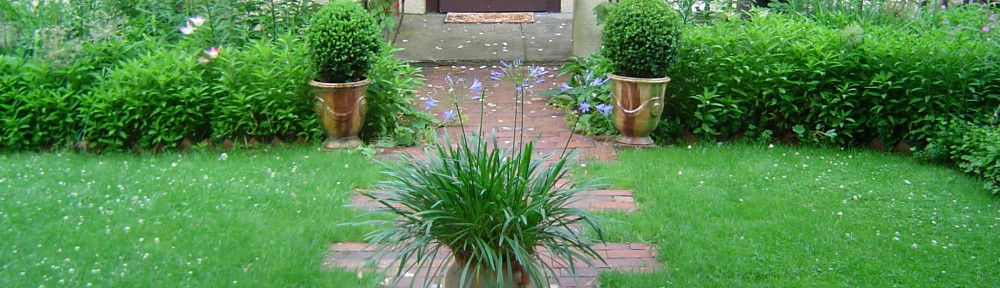
The walkway
Note the shadows!
Herb garden
Checkerboard garden
“Wind Song”

(c) 2019 Shobha Vanchiswar

[do_widget “Blog Subscriptions (Jetpack)”]

Coming To Grips

Last Sunday was all gardening. I already feel like I’m racing against the clock. The focus was on getting the pots of tender perennials and tropicals into the greenhouse. It’s a process. First, after the tomato plants are evicted, the greenhouse has to be cleaned thoroughly. Inside and outside. Then, once the glass panels are dry, the insulating sheets of clear bubble-wrap must be put up. Lastly, all the winter occupants are made ready for their move indoors.

Any weeds that have crept in are removed from the pots. Yellowing or unhealthy looking leaves and stems are removed. Plants such as boxwood, bay and myrtle must be given a proper trim. Finally, the plants and pots are ‘power-sprayed’ with water to wash off all dirt and any critters hiding around. Then, and only then, are they brought into the greenhouse. Doing everything possible to keep pests and disease away is critical.

Since space is at a premium and there must be good air circulation around the plants, there is a priority system. There are first class and second class residents. The citrus, bays, boxwoods, myrtles, hibiscus, agapanthus, rosemary, thymes and auriculas are first class. All the fancy leaved and scented geraniums as well as other herbs are second class – while I adore them, they are not as precious and can be easily replaced. So, what cannot be accommodated in the greenhouse will either be given an alternate place to spend the winter or handed off to willing recipients. C’est la vie.

This is an all day endeavor and how my body feels the next day proves it is more physical than it sounds. Hauling the big pots in is the hardest and for this, help arrived in the form of nephews. Young and strong, they were an enormous help. Twenty years ago, the task was done by just my husband and myself. Now, we dare not risk our backs by being foolhardy. Sigh. It’s not easy coming to terms with the reality of aging. After all, in my head I’m still twenty-five.

With the precious plants safely under cover, the attention is now on cleaning up, raking leaves, depositing the annuals on the compost pile, cutting back and such. The bulbs ordered with much hope and ambition in July have arrived. They will go in by the first week of November. I can’t wait to have all 700+ planted – my muscles are already cringing in fear of the aftermath. By that point, winter cannot come too soon. The very thought of rest is pure heaven.

Note: The Untermyer Symposium is on Saturday October 19. Should be quite informative, inspiring and, interesting. Get your tickets now!

Paperwhites coming along
The wall.
Getting the greenhouse insulated
Able bodied helpers
“Power-washing”
Herbs to dry
The last of the tomatoes. Green tomato cobbler on the menu!

(c) 2019 Shobha Vanchiswar

[do_widget “Blog Subscriptions (Jetpack)”]

Homecoming

Traveling makes one modest: one sees what a tiny place one occupies in the world.”

The Letters of Gustave Flaubert, 1830-1857

It feels good to be back home. Refreshed from my travels, I’m eager to get back in the garden. Returning after an absence always makes me approach it with some trepidation. What if something has gone terribly wrong? is a thought that hits me every single time. Thankfully, all is well. Sure the weeds have made merry, the beds are a bit messy with some plants calling it it quits for the season and, the tiny lawn is in need of a trim but in general, it’s all par for the course. The garden is transitioning into autumn.

I’d been concerned that the hummingbird feeder would run empty and thereby the birds would be denied their regular supply but it’s perplexing that after a whole two weeks, the feeder is still a third full. Have the hummingbirds moved on already? I sincerely hope nothing untoward has happened to them. I must look into understanding this before I’m consumed with worry.

The figs tree was heavy with ripe fruit that were enjoyed right away. In fact, the enthusiasm over the splendid harvest made me forget to take a photograph before they disappeared. You just have to take my word for it. The tomatoes are still going strong and I’m getting ready to make sauce for canning.

The asters are just starting to bloom and I think they’re a bit late. Usually, they’re in full swing by now. I’d actually thought I might be late to the show. The vertical garden is having its moment – looking lush and full just as so much else is waning.

The turtleheads in the meadow are growing strong. I love how dependable they are. I’ve come to the realization that the flowers of the oak-leaved hydrangea (H. quercifolia) do not last as long into fall as the my other hydrangea(H. paniculata). The former already look crisp and brown while the latter have moved from white to that soft blush that I so adore. However, the leaves of the oak-leaved have the added bonus of changing color so, I’m looking forward to that display.

All the Concord grapes have either dropped too early or the robins that nest amidst the vine have got to the fruits first. No jelly this year. So be it. Postscript -just last night I discovered that the gardeners at Hortus Arboretum and Botanical Gardens use ordinary paper lunch bags to protect their grapes. Somehow, these humble bags even survive the rain! I’ll be trying that next year.

No apples or pears either. Just as the fruit trees were in beautiful bloom in the spring, a very cold spell hit and the pollinators stayed home. The flowers spent themselves out soon after. First hand lessons in the garden. The leaves of the apples dropped off by early August and I saw that the trees at Stonecrop gardens had a similar problem but those still bore some ripening apples so, I’m a bit envious. I can only assume that the very hot months of summer took a toll and the leaves fell early.

Even in his most artificial creations, nature is the material upon which man has to work.”

— Marcel Proust, Swann’s Way

It’s been a really weird summer season this year – much too hot with spells of either too much rain or complete lack thereof. Perhaps this will be the new normal and we will have to adjust what and how we garden. I’m trying to keep pace. This is after all, our future. That has to concern everyone.

In a month, I’ll be cutting and tidying in preparation for the winter. Hundreds of bulbs ordered earlier in summer will also arrive at that time for fall planting.

As the sun sets earlier and earlier, I’m determined to enjoy every available hour of daylight before I get caught up in all the busy-ness. All too soon, it’ll be winter and I want to be warmed by that sense of smugness that I had a good time while I could.

Note: I invite you to come to the “Restoring Historic Gardens” Symposium at Untermyer Gardens on Saturday October 19, 2019. I’m excited to be moderating the panel discussion that will follow after the three speakers share experiences with their respective historic gardens.

The “Walk In Our Shoes” exhibit is on till September 30. Hope you will visit this wonderful art show.

Turtleheads in the meadow
Hydrangea paniculata
Crispy flowers of the oak-leaved hydrangea
The leaves of the oak-leaved slowly changing color
Cardinal flowers still doing well
The wall
Tomatoes in the greenhouse
Figs ripening
Hot!
Pretty

(c) 2019 Shobha Vanchiswar

[do_widget “Blog Subscriptions (Jetpack)”]
Balancing Act

For the past ten days, I’ve been enjoying down time on the barrier islands of Chincoteague and Assateague off the coasts of Maryland and Virginia. It has been part of the quest for balance in life. When we plan a getaway or vacation, it is that need to counteract the everyday demands of work and other responsibilities. An opportunity to press the reset button so we maintain an even keel and thus keep perspective of what truly matters. Nothing quite as effective as a healthy dose of nature to do the job.

It is heart-achingly beautiful here. Known primarily for the wild ponies that inhabit them, these islands are the last remaining undeveloped outer banks. And remain they shall, thanks to the designation of being a National Seashore/Wildlife Refuge under the National Park Services. Like all our other National Parks, they are priceless national treasures.

It’s a fragile, ever-changing ecosystem here. Between the waves and winds of the mighty and temperamental Atlantic Ocean, the terrain,flora and fauna are in constant flux. New ‘islands’ are built, old ones shrink or grow, shorelines shift, the resilient wildlife adapt and somehow, an equilibrium is maintained. Retreating dunes mark the island’s westward move and as the water in the bays rise in response to rising ocean water, the coastlines are redrawn. New habitats are created and old ones re-adapted. Plants and animals adjust to these changes. Rich in aquatic life, the bays provide a vital ecosystem. The salt marshes, defined by the ebb and flow of the tides are yet another complex, vital ecosystem in themselves. The plants that thrive in salt marshes may be few but they shelter a diverse number of wildlife. The dunes and upper beaches are in constant motion and support a different variety of plants and animals.

Even as eel grass is tossed up by storm surges, it is turned into a substrate that enriches the soil in the marshes. Ribbed mussels have a relationship with the long water roots of salt grasses found along the edges of the marshy islands. Egrets ride on the horses to see what choice morsels they might reveal as they plod around and disturb the wet land. In turn, they help the horses by dealing with the biting insects so prevalent here. The horses feed on the salty grasses and also the poison ivy – I found that latter item quite interesting.

In an ideal situation, these parts would manage fine and life would play out naturally. It’s a real gift that we humans get to visit and observe. But yet, we manage to upset the balance. Despite all the cautions and advice from the park rangers, people often try to get too close to the horses ( selfies!) or try feeding them. The horses, as a result can get too familiar with our presence and come to expect treats to supplement their diet. These are wild animals with strong teeth and legs – their bites and kicks are fearsome. Getting too close or goading them has unfortunate consequences for man and horse. Why oh why can we not stay away from our own worst habits?!

We got very lucky with Hurricane Dorian last week. A harmless tropical storm was all we experienced. Two windy days of which one was rainy. Some localized flooding but nothing problematic. I imagine this was however, a more serious threat for the wildlife as they were deprived of their regular feeding forays and had to seek shelter to wait out the weather. For me, it was enough to be made acutely aware of how fragile life is and how much we take it for granted.

When I return home shortly, I plan to carry this awareness in my heart and strive harder to stay centered, as always, taking my cues from nature in maintaining a balance.

P.S- I also plan to increase my annual contribution to the National Parks. In recent times they have seen major budget cuts. This is nothing short of a crisis of tremendous proportion with far-reaching consequences. I beseech every single one of you to do your part in preserving our national treasure – this beautiful, majestic land of mountains and plains, lakes, rivers and coasts that we call home.

See the images below for a glimpse of Assateague/Chicoteague beauty.

Note: I’m participating in this show. I hope you will see it.

(c) 2019 Shobha Vanchiswar
[do_widget “Blog Subscriptions (Jetpack)”]

Labor-less Days

I don’t care what anybody says, summer is still three weeks from being over. There’s plenty of time to sip and savor. Sunsets to watch, fruits and vegetables to pick and eat fresh, siestas to take in the hammock, barefoot morning strolls around the dew-drenched garden, al fresco meals to be had … summer is a state of mind.

Having recently returned from a trip overseas, I did go through a bout of whipping the garden into some order. Nothing drastic. Just to have it look sufficiently fetching and looked after. Apart from the ongoing tasks of weeding and watering, this is the window to loll about before the fall frenzy begins.

While others are in the back-to-school mode and getting their own schedules and agendas in order, I take this opportunity to extend my summer bliss. There are still books to be read and friends to catch up with.

Certainly, the signs of fall are there. The sun sets earlier, leaves are slowly turning, apples are beginning to blush and there is that barest hint of cooler days approaching. All of that notwithstanding, I see the turtleheads coming into full bloom, the Joe Pyes are abuzz and aflutter with pollinators, the phlox is saturating the garden in perfume, the cardinal flowers are beacons for hummingbirds and there are yet tomatoes ripening on the vine for summer salads and sandwiches.

For now, I leave you with my stubborn hold on summer –

I’m Taking Summer With Me

I’m taking Summer with me

into frost woven days of Fall

through Winter’s frozen pall

I’ll shine on frigid faces

throw color in all the places

blow soft kisses to dry ice drop tears

bring sunny warmth and spread good cheer

When darkness creeps in early

and moods get bad and surly

I’ll eclipse away the gloomy night

with blazing fires and candle light

For the season when nothing grows

I’ll force bulbs to spite the snows

Spring shall arrive before it’s time

so Summer will follow in all her prime.

Shobha Vanchiswar

Hummingbird at the Cardinal flowers
Turtleheads

(c) 2019 Shobha Vanchiswar

[do_widget “Blog Subscriptions (Jetpack)”]

Back In The Garden

The weather this past weekend was nothing short of stellar. It could not be beat. Bright and sparkly, low humidity, temperatures in the low 70’s. After two weeks in rain soaked Mumbai, this was quite literally a breath of fresh air. What an amazing homecoming.

Taking advantage of this gift, I visited Stonecrop Gardens in Cold Spring, NY on Saturday. If you’ve never been, you must. It was Frank Cabot’s home – yes, the man who helped found the Garden Conservancy. You can read all about this garden on their website. It’s quite a gem.

Summer’s end is not typically the best time to visit most gardens. But I was in need of it. Inspiration is always to be found and I was not disappointed. Big splashes of summer color and a seasonal untidiness abounded. I loved the fullness of the plantings everywhere. The realities of the season made apparent by burgeoning seed-heads, flamboyant flowers, plants jostling for space in their beds and a certain wildness to it all. This was Life at full throttle. In contrast, the verdant quietude found in the wisteria pavilion by the pond provided that pause to breathe deeply and free the mind from quotidian worries.

In walking around, I realized that the high point for me, was the general end-of-season mess and the sight of the ravaged leaves of kale and other plants. Critter(s) had gone to town and riddled the leaves so they looked like badly made lace antimacassars. I found that very comforting because it made me feel like my own garden was in good company. This is the reality. If you’re using organic methods, one cannot have a pristine, near perfect, neat and tidy garden at the close of the summer. Given the strange spring and summer we have had, it’s been particularly difficult to manage the garden as one has in years past. Weather fluctuations have been so erratic that my expectations were lowered sufficiently to protect my ego from too much injury.

By observing how lovely Stonecrop looked despite everything made me see my own garden with kinder eyes and appreciation.

Energized by that visit, on Sunday, I whipped the garden into better shape. A little cosmetic fiddling goes a long way. Weeding, deadheading, pruning and a general tidying up did wonders. I revamped the window-boxes and other urns and pots with a bit of tropical flair that I can only explain as the influence of my recent sojourn to India. Traveling has that impact doesn’t it?

And now, I’m set to enjoy the remaining weeks of summer with renewed enthusiasm. Salut!

Chilies in the window boxes
Pruned back espalier
Last rose(s) of summer?
Lemons
Note the banana plants standing sentry
New batch of cool weather greens
The meadow
Pink turtleheads in the meadow
Party ready

(c) 2019 Shobha Vanchiswar

[do_widget “Blog Subscriptions (Jetpack)”]

Water, Water!

Water is in the news quite a bit these days. Too little or none at all. Too much, too soon is just as bad. Certainly this is predicted to be the biggest, most critical problem we will have to resolve in the not too distant future. Water will direct the next mass migrations of humans as they are forced to adapt to the changing weather patterns – a result of both natural and man-made acts. As a global community we will have to decide right now how we will deal with shifting populations/refugees, how we grow our food, utilize energy, reprogram our use of water and indeed our entire way of living. While government agencies and related organizations grapple with the big picture, if one has not personally begun taking steps towards this impending crisis, it is now time to start. As of this minute. I’m not being an alarmist – the snooze button to that alarm has been hit way too often already.

I’m writing this during a ten day stay in monsoon swamped Mumbai. It is wet, warm and muggy. The air feels spongy even when it isn’t raining. The dampness pervades everywhere. Without air-conditioning to lower the humidity, I’d be hard pressed to be comfortable and sleep would be impossible. This has been a particularly heavy monsoon season.

Despite so much rain, the city is still aware of the undependable nature of its water supply. It has signs all over asking her citizens to conserve, avoid waste and respect this life giving Adam’s Ale. And that got me wondering if those signs have any real impact on the mass. Does one read and/or pay attention to such ‘nudges’? As one drives through the generally thick traffic, is the mind even open to receiving any such advice? It then occurred to me that it was because of the stop and start, slow moving, thick traffic snaking along that I was able to notice the signs and ponder them. A seed, so to speak, had been sown. I can only imagine that a daily dose of ‘Don’t Waste Water’, ‘No Water, No Life’ will percolate into one’s conscience and guide the mind to the judicious use of water. Not a bad idea to have those signs put up after all. They certainly cannot hurt.

In my own garden back home, I’ve long collected rainwater to water parts of the garden. Particularly pots. To ensure that the plants do not get parched when we’re away or otherwise distracted, we have also rigged up a drip-system to routinely water the pots as some of the plants require a consistent supply. The mechanism is attached to a moisture sensor so that it will not release water if it has rained or is raining. That way, no water is unduly wasted.

Water from cooking eggs, boiling vegetables etc is also collected for watering. Often the boiling hot water is poured directly over the weeds trying to make their way through brick or flagstone paths. Kills the weeds effectively.

Still, in a particularly dry period when rain is scarce, there are areas in the garden that need a healthy splash. Thus far, it’s been okay but I worry that the time when watering our gardens whenever we see a need is coming to a close. There will be a need to shift to plants that do better in semi-dry or arid conditions. Fussy plants will have to be phased out.

It feels a bit sad. But, we gardeners are a resilient species. We will adapt. Indeed, we can lead the way. I for one have resolved to source interesting/beautiful native plants that do well under dry conditions and start introducing them into the garden. The process will be deliberate, mindful and with any luck, enjoyable. Learning is growth.

Postscript: Of the many drinks I have consumed in the many places I’ve stopped at ( fancy as well as hole-in-the-wall joints), I have not seen a single plastic straw. The only straws I’ve been served have been compostable. Often, they are elegant, colorful, sturdily constructed paper. This is what progress looks like.

Note: There’s still time to see the Inside Small art show!

Heads Up! The second annual Untermyer Symposium is scheduled for Saturday, October 19. Mark your calendars. I will be moderating the panel discussion. Stay tuned for more details.

Some images from Mumbai –

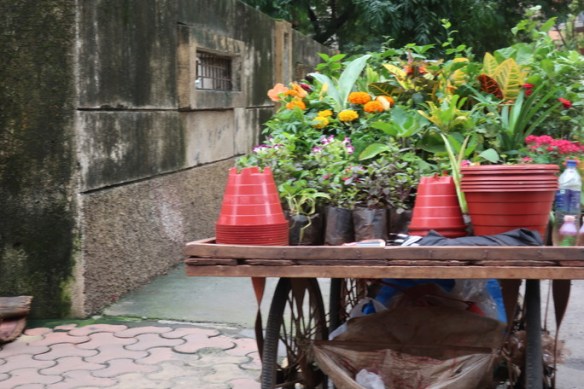
Plants for sale!
Decorative designs using flower petals, whole flowers and leaves,

(c) 2019 Shobha Vanchiswar

[do_widget “Blog Subscriptions (Jetpack)”]

Summer Joy

It’s the lazy days of summer. I hope you’re making the most of the season. They will become the memories that’ll get you through the dark, cold days of winter. Ignore the to-do list and savor the pleasures of summer.

Summer Nights

Wrapped in the thick air

heavy with heat

laden with moist

Watching fireflies

mimic the stars

against black velvet

Serenaded boldly

by tree frogs

and crickets

Fanned from on high

wings of bats

on purposeful sorties

While night moths

answer service calls

of moonflowers

and gardenias

Spicy notes of phlox

rise with the night

perfumed with clove,

oil of bergamot

essence of rose

Lulled into

well being

content to remain

Greet the dew

of a new day.

– Shobha Vanchiswar

Summer Dive

Sunlight spills

brilliant diamonds

blinding ripples

shimmering winks

sliced apart

by summer’s first dive.

-Shobha Vanchiswar

Summer Joy

Summer spreads wide

a picnic blanket

of meadow flowers and green, green grass

For legs to brush against

bodies to lie back

To gaze upon

lofty images of dogs and bears and hunting giants

From dazzling day to evening glitter

Dew gathers to mist

sun-warmed faces and naked toes

Summer seems

like an endless ride

filled with ice-cream cones and fireflies

Of water fights and watermelon wedges

children’s laughter intoxicated

on improbable tales

An ephemeral age, an ephemeral time

summer passes overnight.

– Shobha Vanchiswar

Note: The Small Works exhibit is on through August. Do make time to see it!

(c) 2019 Shobha Vanchiswar

[do_widget “Blog Subscriptions (Jetpack)”]

Freedom

Liberty is the freedom to do as one ought to do. I learned this definition in fifth grade civics class – it was how we started to understand what democracy meant.

A cornerstone of a thriving civilization, freedom is all about having choices. So one can chose their actions bearing in mind one’s moral responsibility. To choose to act after discerning between right and wrong, good and evil. To do what is ethically correct for the greater good.

Keeping that in mind, I take this power very seriously. Especially in the garden where all too often a gardener is inclined to play lord and master. It’s so easy. We have at our disposal so much control and power that all too often we forget that gardening is a privilege. The very notion that I can assume ownership of a piece of earth to do as I please is astounding. Arrogant even.

While I often kid that I’m the dictator-in-chief of the garden, in reality, I feel my responsibility greatly. I’m allowed to freely design, create and play in a this space in whatever way I please. Within good reason. And that is the key. To use good reason.

My principle commandment is to do no harm. Whatever action taken must have the least negative impact – on humans, animals, plants, soil, water or air. On that basis, only organic methods are employed. But, trying to control pests organically is not without cost. These natural products are not specific to the pest. They affect the good critters as well. So judicious application is imperative.

Compost is used as fertilizer and mulch. The plants enjoy it. As do members of the animal kingdom. They too thrive because they are not harmed by compost and hence roam free and make nests and homes underground and above, destroying root systems, chomping on leaves and flowers, girdling trees, ruining lawns with tunnels and burrows etc., Constant vigilance is required so action can be taken as soon as possible. Japanese beetles, red lily beetles and such are picked off and dropped into hot, soapy water. After years of battling those red devils, I’ve stopped planting lilies but since I still grow fritillaria ( their close relative), I must continue to keep a lookout. Mice, voles and other rodents are trapped. The fruit trees must be sprayed with dormant oil only under specific weather conditions and at a particular time of year. You get the idea. It’s not always easy to do the right thing.

Rain water is collected, a manual reel- mower cuts grass, since no herbicides are used, weeds are removed by hand, native plants dominate the garden and support native fauna and so on. Every one of those methods involves more work and effort. And there are times when I’m completely frustrated. However, my conscience is clear. I’m doing my part in exercising my freedom as I ought.

This translates very well to everything else in life. Relationships, raising children, at work, being a part of the community, a town, a city, a country, the world at large. Imagine how powerful exercising our liberties as we should can be.

Note: The reception to Small Works is this Thursday, August 8. I’d love to see you there!

A few images of the challenges in the garden:

Mice attack on the espalier.
Fully girdled trees were lost and had to be replaced.
Sanguisorba attacked by Japanese beetles

Subsequent damage
Evidence of voles under the front lawn
Lily’s under siege

(c) 2019 Shobha Vanchiswar
[do_widget “Blog Subscriptions (Jetpack)”]

Just July

Our house is taken in possession

By him, while he enjoys a rest

July, with summer air and thunder-

He is our temporary guest.

July, who scatters from his pockets

The fluff of blow-balls in a cloud,

Who enters through the open window,

Who chatters to himself aloud,

Unkempt, untidy, absent-minded,

Soaked through with smell of oil and rye,

With linden-blossom, grass and beet-leaves,

The meadow-scented month July.”

‘July’ by Boris Pasternak

July is coming to a close and what a month it has been in the garden. Hot, messy and erratic. That poem by Pasternak describes it so well.

Dictated by the weather, I’ve been negligent of my garden duties. It’s just really hard to get outside and work when merely standing still brings on the sweat and sends out irresistible invites to all the biting bugs near and far. Consequently, the chores get done in fits and starts, bits and pieces. A little weeding here, some deadheading there. The automatic watering system set up for the pots broke down and needed fixing – mercifully, the preceding days had been wet so the plants were relatively unharmed.

The heat wave put paid to the plants in the pots on the wall on the side terrace. Despite the daily watering, they simply could not take those high temperatures. I’ve decided to empty out the pots and not replant. With a very busy August schedule coming up, it’s time to simplify matters somewhat.

They say this June was the hottest one in recent history and July is turning out to match it. Who knows what August will do.

Sunflowers have appeared as happy surprises in one of the large bay standard pots. A lone sunflower grew in the vertical garden. I’d stopped planting lilies a few years ago because I lost the battle with the red lily beetles. Well, as though waking up after a long slumber, a couple of lily plants re-emerged this summer. Their leaves are ugly and chewed up but the flowers look fine and are busy perfuming the front garden.

The garden might look a bit unruly but it is fragrance heaven. Lilies in front soon to be followed by phlox, gardenias and orange-blossoms on the side and jasmine in the back. Heaven.

The meadow has been in serious need of attention. First, the jewelweed took advantage of my apathy and spread itself all over. Once they were deliberately reduced to more manageable numbers, a nettle of the sting-less variety moved in with a vengeance. It needs to be completely and ruthlessly removed all together. It’s been a real task trying to help the many new plants planted in late spring establish themselves. Fingers crossed …

The hydrangea are in bloom – they provide much needed color in the meadow right now. Elsewhere, the Echinacea in their brightness are drawing the pollinators. I really ought to plant more of these stalwarts and get rid of the fussy, finicky members of the garden. With harsh weather becoming the new normal, it behooves a gardener to rethink the plantings.

Tomato season has begun. We’re enjoying the golden cherry tomatoes and savoring the bigger varieties as they ripen. At this stage, each fruit is precious. Soon, there will be a glut and we’ll take them for granted as we make soups, salads and sauces.

It’s so easy to obsess over the disheveled state of the garden, complain about the heat in July. But, looking around, amidst the green jungle, I see heroic flowers splashing color and fragrance all over. The herbs, leafy greens and, early tomatoes grace our meals. Ripening grapes and pears hold the promise of an autumn harvest. The asters are coming up strong for a good showing to close out the summer.

Under stressful circumstances, the garden is working hard to deliver. I must move to do the same.

Note: Consider yourself invited –

My July garden –

Lilies. Note the hole-riddled leaves.
Echinacea
Late blooming clematis
Pears
Figs
Jasmine
The vertical garden with renegade sunflower
Sunflower surprise
Agapanthus
The meadow before the serious weeding happened.
Tomatoes
A harvest

(c) 2019 Shobha Vanchiswar
[do_widget “Blog Subscriptions (Jetpack)”]