February Is For Loving

Some months take on a single meaning. December is for the holidays, July for the fourth, September is about school, November is Thanksgiving and February is all love. I like that as it gives some motivation to stay engaged and celebrate life’s moments.

Valentine’s day can feel a bit over-hyped, too twee and bring undue pressure on those who are single or going through a rough patch in a relationship. But these days it has become a much more inclusive day for expressing love. We include everybody in our circle – spouse/significant others, children, friends (Galentine’s day!). To that list, I add the garden as it is a living thing; it’s a good day to express some love to that which nurtures me so wholly all year round.

Since winter has been indecisive this year, I took advantage of yet another mild day last Sunday and went scanning for signs of stirring in the garden. Just a week ago, there was barely nothing to coo over. But now! Snowdrops have bashfully shown up. That set my heart aflutter. What is it about these diminutive bells that cause them to ring so loud in our psyche?

The hellebores too seem to have decided its time to awaken. One in particular made me smile – it bears near black flowers and the buds were sitting like plump berries glinting in the afternoon light. Others, in their tight, elongated forms could not compete. In a couple of weeks I will cut back the protective old leaves so the opening buds can show off their beauty.

I heard the birds go about their business as though it were normal to be so active in February. It is concerning that they might begin nesting a too early. A blast of severe winter weather could be just around the corner. Usually, I put up a nesting wreath to assist the birds – a simple circle of grapevine bearing threads of cotton or jute, pieces of moss, bits of ribbon ( natural material of course) and some twigs. Not right now though. It’s too soon. Perhaps in early March if it continues to be unseasonably mild.

Meanwhile, the Calamondin oranges are bringing some juicy color to the greenhouse. The fruits hang like pretty ornaments. Not particularly good for eating, they do add something to a cocktail of vodka with a shot of St. Germain.

So cheers! Happy Valentine’s Day everybody. Take a moment to walk around the garden with gratitude and affection in your heart. Better yet, walk with those you love.

Observe the heart shaped bay leaf amidst the normal ones!

Oh those shiny black buds!

Calamondin orange

Snowdrops

(c) 2020 Shobha Vanchiswar

[do_widget “Blog Subscriptions (Jetpack)”]

Seeking Signs And Symbols

Instagram can play with this gardener’s heart. It’s bad enough that I’m confronted with lush summer gardens from down under and sure signs of spring from across the pond but, now there are images of early bulbs from my region. Spurred on by reports of snowdrop sightings and hellebore hunts, I decided to scan my own garden.

It’s funny how excited one can be at the thought of seeing those first signals hat the season is going to change. Yet, I was not that eager to actually find any blooms. It is way too early! We are still in January and frankly, any bulb in flower right now is not a good sign. Already, this winter is ringing alarm bells. With several days of above average temperatures and barely any snow, it’s hard to imagine what is to become of the seasons as we know them. Consequently, what, if at all, will flower and fruit is anybody’s guess. It’s all very unsettling.

A week ago, I’d come across a woolly worm. Folklore says that if the rusty brown band is wide, then it will be a mild winter. The more black there is, the more severe the winter. This one had a broad brown band. So there you have it.

Still, I ventured on my search. Nothing was blooming I’m kinda glad to report. No snowdrops or Iris reticulata. I peered around the hellebores still protected by leaf mulch and last years leaves. The buds are tightly closed but they’re emerging. That’s exactly how they should be!

Here’s a useful thing I recently learned about hellebore harvesting. You know how sometimes when you incorporate cut hellebore flowers in a floral arrangement, they go limp almost right away and yet at other times they stay bright and upright for as long as you like them? Turns out it is all in the timing of when you cut them. Erin Benzakein, the It girl of the flower world and owner of Florets, says to wait till the stamens have dropped and the seed pods are starting to set. Cut them at that moment and you’ve got yourself some nice, long lasting hellebores. I’m quite pleased to learn this nugget of wisdom.

The American wisteria and climbing hydrangea are showing the tiniest buds. So much promise in such minuscule packages.

These glimpses of what is yet to come was enough to make me optimistic. Thus far, there is no need to be worried about any premature activity. Fingers crossed, we will see a more familiar February.

The heart shaped stones I collect reminded me that hearts will be aflutter in February. Always a sweet tradition to express love to all who mean so much. And this brought me to Entada gigas. Otherwise known as Sea hearts/ sea bean/monkey ladder. I’d picked up a couple of seed packets on one of my trips. What attracted me to them were the large heart-shaped seeds that spread throughout the entire world via the sea currents and originate from the Amazon. One of the most special seed varieties in the world. The undisputed record for the longest bean pod is the sea heart.

I thought simply having the large, shapely seeds as decorative objects would be nice. But curious to see how they grow, I’ve given them to a gardener friend to get them started. Drew is experimenting with lots of unusual plants for annual arrangements in large pots and is willing to try out my contributions. So good to have him as my partner in horticultural high jinks. Love of all things plants is a sure sign of a friendship worth nurturing.

Woolly worm with broad, brown band

No sign of anything

Hardy sempervivum

Hellebores

Emerging hellebore buds

Climbing hydrangea buds. Still very tiny and tight.

Heart stones

Wall-in-waiting

Wall ferns being over-wintered in the potager

Sea hearts

(c) 2020 Shobha Vanchiswar

[do_widget “Blog Subscriptions (Jetpack)”]

It’s Open Season!

My garden’s Open Day is this Saturday, May 18. I’m hard at work primping and propping the garden to get it looking it’s best for you. So, cancel everything else and come on over. I’d love to see you here!

I was in Evanston, Illinois this past weekend and even though part of that time it was cold and wet, I was struck by how much horticultural effort is put into making the heart of the city look attractive. Tulips waved madly in bright colors on traffic islands, pocket parks and around trees along the streets. So cheery and seasonal. And very easy to do. I’m eager to see what the next plantings of annuals will be.

But beyond the show of annuals, I observed that there is a thoughtful approach to infusing seasonal color and fragrance in the landscape through the use of perennials. A small park dividing a busy road, is bordered with hedges of viburnum. I smelled the park before I noticed it! The viburnums were in full bloom and the fragrance wafted far and wide. Pure heaven. As though reminding pedestrians to pause a moment and refresh the spirit – be present. What a lovely idea. Flower beds within the park abounded in tulips but there were many perennials emerging through. Three benches and a single sculpture completed this perfect oasis.

Swathes of Virginia bluebells carpeted several other green spaces for the public to enjoy and under many hedges I noticed abundant lily-of-the-valley leaves unfurling in readiness for the sweet bells of white to perfume the days ahead – subliminally cheering the outlooks of passers-by.

I had hoped to visit Millennial Park in Chicago and take in the plantings but my schedule did not permit it. Instead, I got to experience the glorious efforts of a much smaller city that could match its big neighbor handily. My well is full.

Note : Enjoy some images of plantings in Evanston. I look forward to seeing you in my garden this Saturday!

Depending on which device you are reading this, some images appear on their side. I have no idea how to fix it. My apologies! Also, the pocket park appears expansive in the photos – it isn’t in reality!

(c) 2019 Shobha Vanchiswar

[do_widget “Blog Subscriptions (Jetpack)”]

There Are Gnomes In The Garden!

Gnomes. Makes you recall those all too familiar, garishly painted figures with pointy hats right? While these spirit creatures hark back to the 17th century and earlier, their presence today is viewed as somewhat naive and old-fashioned. Like gazing balls, they recall earlier times and are not commonly seen in today’s gardens. Truth be told, I myself have never been taken by them.

That is, until I recently came upon a modern take on gnomes at the Sullivan galleries in Chicago where highly talented, emerging ceramist August Brosnahan was debuting his gnome collection. And the creatures were getting a lot of attention and interest. Here is how Brosnahan describes his work –

I am interested in human interactions with objects and how objects help us relate to the world around us. Whether it be the handle of a mug or the facial expression on a figurative sculpture, these objects have unsaid and sometimes unnoticed methods of guiding us through spaces. Humans spend a tremendous amount of time interacting with clay and ceramic objects. I believe that humans have deep-seated connections with ceramics, more so than other materials, due to the rich history we share with clay. This mindset is central to the form and presentation of my work as I create intimate connections between viewers and the object.

Another element that is central to my practice is my love for walking. I have recently distanced myself from the white-walled gallery as I spend hours in forests and fields. A notable example of this is my ongoing series, “Gnomes.” I create small personified objects that preferably exist in an outdoor setting. Multiples of these objects create a community that viewers can interact with by walking through the same space that the gnomes exist in. I activate the space that the viewer is standing in rather than a space that the viewer is looking at. With my work I hope to re-invigorate the overlooked spaces of our day-to-day lives.”

I have long championed sculpture in the garden. Art in an outdoor space adds a new dimension and there is a shift in context that enriches the experience as opposed to seeing the same sculpture indoors. At this particular art show, I could clearly imagine how they might transform a garden or park. My curiosity to actually see that happen led to inviting the artist to show some of his work at my garden on Open Day.

So, five pieces were carefully packed and shipped to New York. I worked with Brosnahan on siting the gnomes in the garden and I’m really excited to share them with visitors on May 18th.

Meant for outdoor spaces, the seemingly whimsical pieces urge the viewer to consider the dynamics between all the elements in a space. The ceramic gnomes make one aware that there is an energy and presence beyond that which we can physically see or feel. They appear to blend into the background and yet, manage to surprise and be noticed. These sculptures maintain continuity in the human history of personifying natural and designed spaces. The impact is subtle and fresh. A modern twist to an old tradition.

Several weeks ago, I hinted that I was working on a new project in the garden – just for Open Day. This is it! I look forward to introducing you to the gnomes. See you in the garden on May 18.

Note: Open Day is less than two weeks away!

(c) 2019 Shobha Vanchiswar

[do_widget “Blog Subscriptions (Jetpack)”]

Garden Things

I’m in the thick of garden fever. Open Day is less than three weeks away. When I’m not actually in the garden, I’m thinking about it, perusing garden literature or talking about it. So much to consider – chores, plants, tips, new-to-me information, weather, wildlife, one’s own limitations ( physical, budget, time…), successes and failures. It’s never ending and I realize how tedious this can be for a non-gardener. A friend asked recently why gardeners always talked about the amount of work, the perils, trials and tribulations and then insisted on continuing the activity of gardening. How could I possibly convince her that those things are all part of the joy of gardening?!

It’s always exciting to learn something new and I’m happy to share. Maybe everybody is aware already but I discovered only recently that fritillaria are closely related to lilies. That in itself doesn’t make one sit up but here’s the reason to pay attention – they are just as attractive to the pretty but vile red lily beetle. Ugh. I’d all but stopped growing lilies because those horrid insects would always show up to ruthlessly decimate them. Now I have to worry about the many fritillaria I’m so happy to grow in the garden. Oy vay.

The somewhat low height ( 5 feet) at which the bluebird house is set up leaves it vulnerable to predators that can easily scramble up the metal pole to access the eggs/babies. It is worrisome and yet, the bluebirds prefer that open, low location. A coating of automotive grease along the length of the pole and over the copper covered roof helps enormously in deterring snakes, cats and squirrels. An easy solution like this always pleases me – fingers crossed it works.

All the stakes and supports are put in place before the plants are fully grown and it gets complicated to support them discretely. I also see this as a way to show the plants that I believe in their ability to reach their highest potential. Sly horticultural psychology.

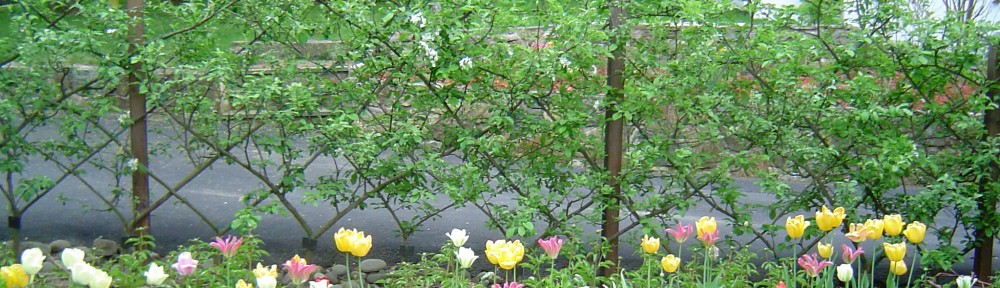
Over the years, the labels marking the assorted apple and pear trees of the espalier had faded. It’s so easy to get lax about keeping things such as labels in order. At the espalier, it is particularly relevant to see which tree is bearing fruit and which is not. It might simply be an academic sort of accounting but I believe good gardening should come with a sound knowledge of what’s going on everywhere in the garden. I’ve now relabeled the fruit trees and must admit to an undeserving amount of satisfaction.

In my bid to tweak things a bit, I’ve moved around an object or two, refreshed a couple of walls with a lick of paint and replaced a feature with another. In the process, my own spirit has been tweaked and I’m in a much better frame of mind. Go figure.

And so it goes. Seemingly small investments of time, energy and resources but with nice dividends.

Note – Open Day is May 18th!

(c) 2019 Shobha Vanchiswar

[do_widget “Blog Subscriptions (Jetpack)”]

Waxing Poetic

It’s a busy, busy time in the garden but I cannot let April go by without honoring it with poetry. It is National Poetry Month after all.

Deflowering Spring

The earth blushed cherry pink

Even as the forsythia glowed yellow

From innocent fresh born

to fertile maiden

In the flutter

of butterfly wings.

Shobha Vanchiswar

Spring Cleaning

Sweep away detritus

Winter’s wild remnants

Prune roses

June’s dress code

Straighten borders

Summer edges to spill

Outside order

Inside peace

Clearing, cutting

Room to breathe deep

Opening, widening

Mind broaden fast

Plants get bigger

Spirits grow higher

Colors multiply

Senses infused

Days lengthen

Smiles brighten

Outdoor classroom

Paradise within

Shobha Vanchiswar

Colors Of Rain

It rained cherry pink today

Drenched in pleasure

I walked on rafts of petals

floating on rivers of grass.

I predict tomorrow

it’ll drizzle pear white

Washing away footprints

leaving behind confetti flowers.

Shobha Vanchiswar

Note: Open Day is May 18. My garden as well as Rocky Hills will be ready and waiting for you!

IMG_3345.jpg

(c) 2019 Shobha Vanchiswar

[do_widget “Blog Subscriptions (Jetpack)”]

April Flowers

Almost overnight there’s been an explosion of blooms in these parts. The forsythia are having their spectacular moment with the magnolias keeping up rather impressively. And oh! the cherry blossoms! Taking the back roads to get around might be slow but the views of what’s doing in the countryside and private gardens are so worth it. I’m now about two inches taller from pausing to crane my neck to see more of what’s blooming over walls and fences. Undoubtedly, my car’s license number has been noted as it crawled suspiciously and even halted in front of some very grand homes with majestic gates and grounds. It must’ve looked like I was casing the neighborhood. I did stop short of taking photos lest they called the cops. All those gorgeous sights are now only in my head. Sigh.

About forsythia – in my humble opinion, they should never be neatly trimmed. They look their best when the sprays of flowers are naturally free and artistically unruly. The bohemians of the season.

Back in my own Eden, the hellebores continue to shine. The meadow is beginning to come alive with the minor bulbs. The snowdrops are fading but the scillas, crocuses and hyacinthoides are gently taking over. Early daffodils are in bloom and that shot of gold through the landscape is pure joy. Each day brings new bounty.

The freshly planted pansies have the sweetest faces – one cannot help but smile in response. In short order the primroses will be vying for attention. I’m also anticipating a blue-ing in the meadow – grape hyacinths, forget-me-nots, ajuga, iris reticulata … with white violas, and yellow daffodils and dandelions as counterpoint. That’s right, I said dandelions – they are not weeds in my meadow. Instead, they not only look like diminutive suns but they are some of the earliest sources of nectar for hummingbirds. So, get over your bias people!

Last Saturday was unseasonably mild and by Sunday, all sorts of plants had greened up and flowers popped open. It’s lovely to be given this chance to closely examine the beauties – all too soon, there will be such a profusion that it’ll be hard to keep up with the chores and linger around gazing at the blooms.

For now, I’m happily basking in the glow of early spring. With an occasional mojito in hand. Simple pleasures.

Note: Remember -My Open Day is May 18!


That last photo was taken at the NYBG last Saturday. It’s usually about 10 days ahead of my garden.

(c) 2019 Shobha Vanchiswar

[do_widget “Blog Subscriptions (Jetpack)”]

Sunday In The Garden

Last Sunday was a gift to this impatient gardener. Bright and sunny, temperatures in the mid-60s and a garden just waiting for a do-over. No bugs trying to feed on me, no place else to be. This was heaven.

With the scillas, hellebores, early crocuses and Abeliophyllum distichum ( white forsythia) in bloom, it felt as though I had a cheering squad. The air was gently scented by the Abeliophyllum – a bonus!

So many chores got done. The front lawn was scratched up, reseeded and layered over with compost. Lets hope no destructive rains occur till the grass comes up. A daily sprinkle for about an hour would be mightily appreciated.

A trip ( the first of the season! ) to my favorite nursery resulted in a host of plant purchases. A few perennials like Jacob’s Ladder, lungwort, unusual looking ajuga, dianthus and sweet woodruff, annuals such as pansies, nemesias and lobelias, potager must-haves – beets, Swiss chard, arugula, kale, lettuce. I helped myself to herbs as well – lavender, hyssop, lovage, bronze fennel, sage, thyme, tarragon, parsley, cilantro and one that I plan to use extensively through the spring and summer – Mojito mint. Yes, that is exactly what it is called.

The spring window-boxes were put up – daffodils, tete-a-tete and pansies. Urns and planters in various locations in the garden now sport similar plants to tie in the whole look.

The new ajuga accompany two young Japanese maples (also picked up at the nursery) in a large, copper container by the front door. The plan is for it to look elegantly understated through the seasons. I also stuck in some muscari to give it an early pop of color. Nothing flashy though – the window-boxes above take care of that. The urn nearby, also on the front porch, will echo both with its mix of the pansies and muscari.

The vegetables are esconsed in their bed looking fetching in diagonal rows in hues of deep plum, bronze and greens. The herbs are in terracotta pots that will go on the ‘herb wall’ but for now, until the weather truly warms up, they sit in the greenhouse biding their time.

My cherished Anduze pots with boxwood balls were brought out of the greenhouse and placed in their appropriate sites. Should a frost be imminent, they will be easy enough to protect with fleece and burlap. Other plants in the greenhouse will be brought out in a couple of weeks.

On the vertical garden, some ferns we had overwintered in the vegetable plot under a cover of burlap were put back on the wall. Fingers crossed this experiment will prove successful. If so, it’ll be a good development in our quest to preserve the ferns through the winter.

By days end, I felt so exhilarated. Good progress under very work-friendly circumstances renders a most delicious sense of satisfaction. At the same time, my muscles were tired and the back was sore. A hot shower followed by a tall mojito ( with eponymous mint ) in the embrace of a comfortable, plush chair was well deserved. I sincerely hope that said mint can keep up with all the drink orders to come.

Note: My Open Garden Day is May 18.

The reception to the New Horizons exhibit is this Sunday, April 14.


(c) 2019 Shobha Vanchiswar

[do_widget “Blog Subscriptions (Jetpack)”]


Springing Into Action

March left like a lamb. April showers came a day early. Work in the garden has commenced. And boy, does it feel good!

The snowdrops are setting the tone that it’s time to get up and get busy. With the other bulbs pushing their way up and the hellebores unfurling their petals, I’m following their cue and forging ahead with my to-do list. This past weekend provided the perfect weather to do so.

On Saturday, it was sunny and warm. The first opportunity thus far to get outside and remain there. It was glorious.

The large pots have been freed of their winter wrap of plastic and burlap and now stand ready to serve.

The peonies are barely poking through but the supports are already in place – once they start, the growth is rapid and knowing the cages are there frees me up to focus on other time-sensitive work.

The winter had loosened up some of the copper caps off the front fence posts so those got tended to.

The outdoor furniture was brought out making possible spontaneous al fresco meals and generally marking porch time every time the opportunity presents itself. It’s so exciting to think about the warmer months stretching ahead.

The gentle rain on Sunday morning was ideal to plant in the just-arrived buddleia ( Buddleia davidii Buzz ‘Soft Pink’) in the perennial beds. Got the two hellebores I’d received as a gift planted as well. Spent hyacinth bulbs that I’d forced for winter pleasure, were put in the ground – in unobtrusive areas where their floppy, yellowing leaves will not detract the eyes from enjoying the spring flowers coming into bloom.

A house for bluebirds was put up – I really want them in my garden. Fingers crossed. I’m hoping the native plants in the open space of the meadow will do the trick.

The entire circulating system for watering the vertical garden was flushed, cleaned and restarted. It feels like the proper signal to start the gardening season.

Two roses were pulled out. One, a climber, had been killed off by the winter before last but I kept it just in case it revived – not so. The other, a David Austin ‘Heritage’, seems to have reverted to its root-stock variety and was also doing poorly. Their replacements arrive this week. I’m excited to see how the new varieties will do.

From now on there is much to be done. Something(s) or other will need doing every day and occasionally it feels daunting. But, this is what a gardener dreams of all through the winter – it’s now time to make those visions and plans a reality. Plus, I have a hard deadline of May 18 – Open Day. So, there’s no time to waste and lets hope the weather cooperates. I am however determined to devote some time every day enjoying the garden. The sights, the smells, the sounds. After all, to have a garden might be a big responsibility but it is also a mighty big privilege. Lets not take it for granted.

Note – The New Horizons art show at the Greenwich Botanical Center Gallery starts today! It continues through April. Reception is on April 14, 2 – 4 pm. I hope you will stop by.

Here are images of what’s doing in my garden right now :

IMG_1032

Unfurling hellebores

IMG_1033

IMG_1034

First daffodils –

IMG_1044

Bulbs pushing through in the meadow –

IMG_1046

RIP to the roses the garden is losing – the Heritage rose and the New Dawn. They served this garden very well –


(c) 2019 Shobha Vanchiswar

[do_widget “Blog Subscriptions (Jetpack)”]


Hanging Out With Hellebores

Spring! It’s definitely staging a comeback. Where I reside, it’s not quite so obvious but the signs are there. The snowdrops are up. However, one has to look a bit harder to notice that the witch hazel is quietly gracing the garden with its tassels of flowers and characteristic fragrance. Bulbs like daffodils and hyacinths are fearlessly pushing through the still crusty earth and slender spears of crocus appear as though they were secretly planted in the cover of night. The climbing hydrangea is studded with fattening buds. I hear birdsong more clearly; it’s only a matter of time before feathered couples will begin house hunting. Everywhere, one can observe nature coming alive.

Which brings me to hellebores. In my opinion, no garden should be without them. They live to serve the gardener. Starting from that time of year when you know winter is still in session but you cannot help look for some signal that spring is on its way, one need only check carefully at the base of the hellebores. Nestled close to the ground, safely tucked under the canopy of large leaves of the previous year, the shy buds have silently emerged. Long before anything else is stirring, the hellebore gives a sweet heads up for spring. This singular sight is reassuring and exactly what an impatient gardener needs.

Soon after, it’s time to cut back the old leaves and unleash the new growth. Stands of upright stems extravagantly displaying cup-shaped flowers nodding in the garden are sure sights of spring. Single, semi-double or double, the hellebore flowers appear as though painted in watercolor. Translucent and soft, the hues range from dark, almost black to deep pink to rose to cream to yellow. Some new varieties sport petals gently edged in a complementary color recalling finely hand-painted porcelain cups of another era.

There are today a variety and color that would suit every taste or situation. The flowers last a very long time – often through summer. The colors may fade or deepen and turn less showy as the season progresses but I still love their look. Hellebores self seed very easily and some gardeners complain about it but in my experience, if you mulch diligently, then it is not a problem at all. The mulch suppresses the seeds from germinating. I typically get only a few seedlings that I often pot up to give away or plant elsewhere in the garden.

Hellebores prefer deep soil rich in hummus, moist but not soggy. They do not require regular feeding. I find that an annual application of compost topped with the mulch of wood chips is sufficient. The plants do best in cool, semi-shaded locations. At a full height of about 18 to 24 inches and a spread of the same, they are ideal in border fronts. The large leaves will shade out more diminutive neighbors so plant accordingly. In the fall, I let the leaves remain to protect the following season’s young buds and remove them only around late March. Hellebores are slow growing and do not get too big so it is best to not divide them. To grow your collection, get new plants or start from seed.

In pots – Because of their extensive root system, they require large pots to allow for growth. A nurseryman friend recently presented me with a couple of hellebores in bloom potted up splendidly in a French zinc pot. While I adore how beautiful it looks on my dining table, I think the plants are displaying a restlessness as though they want to be planted in the ground. As soon as the thaw happens, I will do exactly that.

Hardy, low-maintenance, easy to grow and oh so dependable, hellebores are a mainstay in my garden. Bonus – deer generally stay away from them.

Hanging out with hellebores is indeed a very good thing.

Note: I’m in the upcoming New Horizons art show in Cos Cob, Greenwich, CT. Do stop by to take a look! April 2 – 28. Click here for details.

Mark your calendar – my garden Open Day is May 18, 2019.

Here are images of some of the hellebores I hang out with:

(c) 2019 Shobha Vanchiswar

[do_widget “Blog Subscriptions (Jetpack)”]