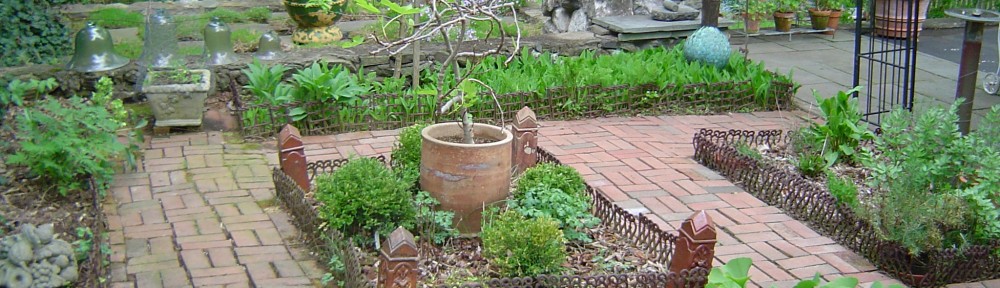
April Flowers

Almost overnight there’s been an explosion of blooms in these parts. The forsythia are having their spectacular moment with the magnolias keeping up rather impressively. And oh! the cherry blossoms! Taking the back roads to get around might be slow but the views of what’s doing in the countryside and private gardens are so worth it. I’m now about two inches taller from pausing to crane my neck to see more of what’s blooming over walls and fences. Undoubtedly, my car’s license number has been noted as it crawled suspiciously and even halted in front of some very grand homes with majestic gates and grounds. It must’ve looked like I was casing the neighborhood. I did stop short of taking photos lest they called the cops. All those gorgeous sights are now only in my head. Sigh.

About forsythia – in my humble opinion, they should never be neatly trimmed. They look their best when the sprays of flowers are naturally free and artistically unruly. The bohemians of the season.

Back in my own Eden, the hellebores continue to shine. The meadow is beginning to come alive with the minor bulbs. The snowdrops are fading but the scillas, crocuses and hyacinthoides are gently taking over. Early daffodils are in bloom and that shot of gold through the landscape is pure joy. Each day brings new bounty.

The freshly planted pansies have the sweetest faces – one cannot help but smile in response. In short order the primroses will be vying for attention. I’m also anticipating a blue-ing in the meadow – grape hyacinths, forget-me-nots, ajuga, iris reticulata … with white violas, and yellow daffodils and dandelions as counterpoint. That’s right, I said dandelions – they are not weeds in my meadow. Instead, they not only look like diminutive suns but they are some of the earliest sources of nectar for hummingbirds. So, get over your bias people!

Last Saturday was unseasonably mild and by Sunday, all sorts of plants had greened up and flowers popped open. It’s lovely to be given this chance to closely examine the beauties – all too soon, there will be such a profusion that it’ll be hard to keep up with the chores and linger around gazing at the blooms.

For now, I’m happily basking in the glow of early spring. With an occasional mojito in hand. Simple pleasures.

Note: Remember -My Open Day is May 18!


That last photo was taken at the NYBG last Saturday. It’s usually about 10 days ahead of my garden.

(c) 2019 Shobha Vanchiswar

[do_widget “Blog Subscriptions (Jetpack)”]

Sunday In The Garden

Last Sunday was a gift to this impatient gardener. Bright and sunny, temperatures in the mid-60s and a garden just waiting for a do-over. No bugs trying to feed on me, no place else to be. This was heaven.

With the scillas, hellebores, early crocuses and Abeliophyllum distichum ( white forsythia) in bloom, it felt as though I had a cheering squad. The air was gently scented by the Abeliophyllum – a bonus!

So many chores got done. The front lawn was scratched up, reseeded and layered over with compost. Lets hope no destructive rains occur till the grass comes up. A daily sprinkle for about an hour would be mightily appreciated.

A trip ( the first of the season! ) to my favorite nursery resulted in a host of plant purchases. A few perennials like Jacob’s Ladder, lungwort, unusual looking ajuga, dianthus and sweet woodruff, annuals such as pansies, nemesias and lobelias, potager must-haves – beets, Swiss chard, arugula, kale, lettuce. I helped myself to herbs as well – lavender, hyssop, lovage, bronze fennel, sage, thyme, tarragon, parsley, cilantro and one that I plan to use extensively through the spring and summer – Mojito mint. Yes, that is exactly what it is called.

The spring window-boxes were put up – daffodils, tete-a-tete and pansies. Urns and planters in various locations in the garden now sport similar plants to tie in the whole look.

The new ajuga accompany two young Japanese maples (also picked up at the nursery) in a large, copper container by the front door. The plan is for it to look elegantly understated through the seasons. I also stuck in some muscari to give it an early pop of color. Nothing flashy though – the window-boxes above take care of that. The urn nearby, also on the front porch, will echo both with its mix of the pansies and muscari.

The vegetables are esconsed in their bed looking fetching in diagonal rows in hues of deep plum, bronze and greens. The herbs are in terracotta pots that will go on the ‘herb wall’ but for now, until the weather truly warms up, they sit in the greenhouse biding their time.

My cherished Anduze pots with boxwood balls were brought out of the greenhouse and placed in their appropriate sites. Should a frost be imminent, they will be easy enough to protect with fleece and burlap. Other plants in the greenhouse will be brought out in a couple of weeks.

On the vertical garden, some ferns we had overwintered in the vegetable plot under a cover of burlap were put back on the wall. Fingers crossed this experiment will prove successful. If so, it’ll be a good development in our quest to preserve the ferns through the winter.

By days end, I felt so exhilarated. Good progress under very work-friendly circumstances renders a most delicious sense of satisfaction. At the same time, my muscles were tired and the back was sore. A hot shower followed by a tall mojito ( with eponymous mint ) in the embrace of a comfortable, plush chair was well deserved. I sincerely hope that said mint can keep up with all the drink orders to come.

Note: My Open Garden Day is May 18.

The reception to the New Horizons exhibit is this Sunday, April 14.


(c) 2019 Shobha Vanchiswar

[do_widget “Blog Subscriptions (Jetpack)”]


Hanging Out With Hellebores

Spring! It’s definitely staging a comeback. Where I reside, it’s not quite so obvious but the signs are there. The snowdrops are up. However, one has to look a bit harder to notice that the witch hazel is quietly gracing the garden with its tassels of flowers and characteristic fragrance. Bulbs like daffodils and hyacinths are fearlessly pushing through the still crusty earth and slender spears of crocus appear as though they were secretly planted in the cover of night. The climbing hydrangea is studded with fattening buds. I hear birdsong more clearly; it’s only a matter of time before feathered couples will begin house hunting. Everywhere, one can observe nature coming alive.

Which brings me to hellebores. In my opinion, no garden should be without them. They live to serve the gardener. Starting from that time of year when you know winter is still in session but you cannot help look for some signal that spring is on its way, one need only check carefully at the base of the hellebores. Nestled close to the ground, safely tucked under the canopy of large leaves of the previous year, the shy buds have silently emerged. Long before anything else is stirring, the hellebore gives a sweet heads up for spring. This singular sight is reassuring and exactly what an impatient gardener needs.

Soon after, it’s time to cut back the old leaves and unleash the new growth. Stands of upright stems extravagantly displaying cup-shaped flowers nodding in the garden are sure sights of spring. Single, semi-double or double, the hellebore flowers appear as though painted in watercolor. Translucent and soft, the hues range from dark, almost black to deep pink to rose to cream to yellow. Some new varieties sport petals gently edged in a complementary color recalling finely hand-painted porcelain cups of another era.

There are today a variety and color that would suit every taste or situation. The flowers last a very long time – often through summer. The colors may fade or deepen and turn less showy as the season progresses but I still love their look. Hellebores self seed very easily and some gardeners complain about it but in my experience, if you mulch diligently, then it is not a problem at all. The mulch suppresses the seeds from germinating. I typically get only a few seedlings that I often pot up to give away or plant elsewhere in the garden.

Hellebores prefer deep soil rich in hummus, moist but not soggy. They do not require regular feeding. I find that an annual application of compost topped with the mulch of wood chips is sufficient. The plants do best in cool, semi-shaded locations. At a full height of about 18 to 24 inches and a spread of the same, they are ideal in border fronts. The large leaves will shade out more diminutive neighbors so plant accordingly. In the fall, I let the leaves remain to protect the following season’s young buds and remove them only around late March. Hellebores are slow growing and do not get too big so it is best to not divide them. To grow your collection, get new plants or start from seed.

In pots – Because of their extensive root system, they require large pots to allow for growth. A nurseryman friend recently presented me with a couple of hellebores in bloom potted up splendidly in a French zinc pot. While I adore how beautiful it looks on my dining table, I think the plants are displaying a restlessness as though they want to be planted in the ground. As soon as the thaw happens, I will do exactly that.

Hardy, low-maintenance, easy to grow and oh so dependable, hellebores are a mainstay in my garden. Bonus – deer generally stay away from them.

Hanging out with hellebores is indeed a very good thing.

Note: I’m in the upcoming New Horizons art show in Cos Cob, Greenwich, CT. Do stop by to take a look! April 2 – 28. Click here for details.

Mark your calendar – my garden Open Day is May 18, 2019.

Here are images of some of the hellebores I hang out with:

(c) 2019 Shobha Vanchiswar

[do_widget “Blog Subscriptions (Jetpack)”]
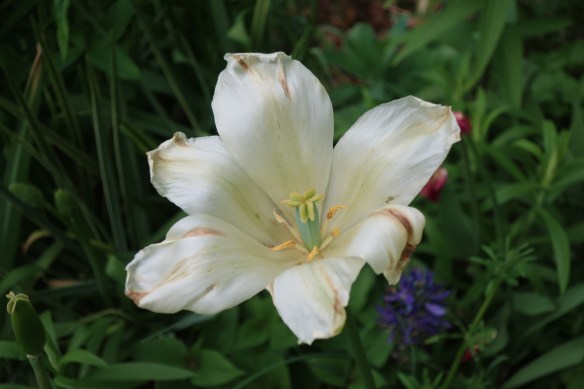
Prêt Pour Le Printemps?

Ready for spring? Of course you are! The season officially starts with the happening of the equinox on March 20. Open windows, put away blankets, swap out clothes, freshen up house … heck, redecorate. Bring in flowers, plant up the garden, prepare for celebrations and milestones. Easter, Passover, Mother’s and Father’s Days, Memorial Day, graduations, weddings, showers, birthdays – the list goes on. So much to look forward to. So much to do. Despite the eagerness and anticipation, it can feel somewhat overwhelming. A little inspiration, a splash of motivation is needed.

Enter the annual Lyndhurst Flower Show and Antique Show. Lyndhurst is a beloved treasure in my neck of the woods. I adore the house and, the grounds are absolutely sublime. And the river view! A total stunner. Well worth visiting at anytime but, there are seasonal events that quite simply put it at a much higher level. Aforementioned flower show is one of them. The beautifully proportioned and furnished rooms are spectacularly decorated by local florists. Each florist brings their unique artistry to appoint the spaces as they see fit. The visitor is promised an experience that will delight because after all we’re talking flowers here.

However, one gets more than that visual pleasure. Knowingly or unknowingly, we get to learn about colors, best combinations and complementary hues. This lesson can be extrapolated to the garden for planning new flower borders and beds. Sometimes a flower one never paid much attention to can be viewed in a new light and join the garden. Ideas abound in the flower show.

Indoors, it gives suggestions on how to translate the colors in our own homes and furnishings. I pick up novel ways to use flowers in the house. Because the florists are local, if you’re looking to hire one for an upcoming wedding or other event, this is an opportunity to review the style of several all at once in real time. Saves so much ‘interview’ time too! I heartily approve the decision to give area florists a chance to strut their stuff.

Armed with ideas and notes, move on from the flower show to the Antiques Show in the Carriage House – where one can get choice articles for both home and garden. You can pick up that elusive garden ornament, rare urn or add to your collection of period silver. Most times, all it takes is a single object to transform a space. Some of the best loved pieces in my garden are those I purchased at antique shows like this one. If your budget does not permit any purchase, you can still pick up more decorating ideas at this show. When the time is right, you will know exactly what you want and what will work best.

If these two shows are not enough, there is a plant sale! I feel giddy with anticipation when I’m at a plant sale. I invariably find plants I need but I secretly look forward to some impulse buys. A real guilty pleasure. And pretty harmless if one doesn’t get carried away.

By now, a visitor is more than likely feeling a bit peckish. A toothsome piece of cake, a flaky scone or a light sandwich accompanied by a strong cup of tea would hit the spot you think. Fear not, that situation has already been covered. High tea is served! Elegant, restorative and delicious. Exactly what you need right now. However did they know?!

Have I convinced you to catch spring fever by going to Lyndhurst April 6-7, 2019? Come on down! Shake off the winter apathy, envision your home and garden as you’d like them to be, grab your list, camera and note pad, pick up a friend or two to go with and, head to it. You’ll have yourselves a lovely time. Maybe we’ll even run into each other. And at that time you can thank me. So there.

Note: I’m sharing a few images of my garden as it looks right now. Spring is a stirring!

First Snowdrops!


In the greenhouse –
Orange blossom

(c) 2019 Shobha Vanchiswar

[do_widget “Blog Subscriptions (Jetpack)”]

Keep It Simple

I can feel the quickening. We turned the clock forward last Sunday. The temperature got close to 50 degrees yesterday. While its back to the 40s today, Friday looks promising – it could get as high as 60 degrees! Yes, I can sense winter’s grip loosening.

With that comes an almost overwhelming awareness that much needs doing in the garden. Especially if there is an upcoming occasion for which it must look tip-top. My garden Open Day is looming large. May 18 might still seem a bit far off but given the myriad tasks involved, the uncertainty of the weather and most significantly, my other commitments both personal and professional, that available time is shrinking. Between project deadlines and celebratory occasions, I must squeeze in the garden work. I’m feeling excited and apprehensive all at the same time. It’s a good problem to have.

To mitigate unnecessary stress and frustration, my focus is to simplify. I have nothing to prove. I don’t have to pretend to be super-anybody. I decided to skip starting plants from seed – my schedule just doesn’t have the time to tend to them this year. Instead, I’m getting young plugs of native plants to add to the meadow and vegetable plot. Even for that I was beginning to get anxious about getting them all planted before open Day till I thought more calmly and realized that the plants for summer and fall can most assuredly wait till after that day.

The bones or hardscaping of the garden are already in place. So, there is a sense of order and flow to the design. Some features are focal points and others are backdrops to the plantings which are the true stars. To shine that light on the plants, I’m sticking to a less is more attitude. Less variety, more numbers of the plants. Taking my cue from those stunning swathes of snowdrops or fields of poppies one sees in Europe, I’m going to plant in larger groups and have these groups complement each other. This should highlight forms, colors and texture to the meadow giving it a cohesive and distinct character. I hope.

Spatial identity for the garden is important and by keeping it simple and timeless, the different areas remain unique yet work together as a whole.

Keeping it simple, does not mean bland or generic. This is where details matter. Sculptures, pots and other features like fountains, troughs and seating bring style and personality. These can change or evolve as one desires. There is a certain feature I’m working on for this year – I’m hoping it will all come together in time for May 18. If not, it will be by next year. I’m not going to stress myself out. However, my fingers are crossed.

In the early years, I prided myself on doing as much if not all the work by myself. I had fewer responsibilities and obligations. And a whole lot more youthful energy. These days, I’m happy to bring in some help. What the English refer to as a jobbing gardener – someone who comes in when extra chores or heavy work needs doing during the season. It has made my life so much more manageable. Now, if I’m in the throes of meetings and appointments, I can still get those time sensitive garden jobs addressed. Such a relief. No sense in trying to do too much in too little time. I just wish I’d understood that much earlier instead of all the pressure I used to put on myself to act as though I was superwoman.

As Isaac Newton put it – Nature is pleased with simplicity. And nature is no dummy. And now, neither am I.

Note:  I’m currently busy with my second collection of the Printed Garden products. I’m sharing with you some of the pillow samples. The square pillows are 18×18 inches and the rectangular ones are 14×20. I would love to hear your thoughts ( favorites?) about them. So please drop a line or two in the comments column! Thank you!

(c) 2019 Shobha Vanchiswar

[do_widget “Blog Subscriptions (Jetpack)”]

Snowdrops Keep Swirling In My Head

I love snowdrops. How could one not? Shy and sweet, they appear exactly when the heart is weary and needs a sign of hope that spring is imminent. Defying all odds, these diminutive beauties push through the earth quietly and seemingly overnight, they delight our eyes with their slender green blades and tiny, white bells. With the garden still in winter’s grip, these small bulbs remind me to be positive and brave – despite the challenges, go forth and conquer the day. Good things do come in small packages.

In the course of passing the winter perusing plant catalogs and garden periodicals, I’ve been coveting a myriad varieties of Galanthus. It’s astonishing how many there – double/multiple petaled, unique markings of green on the white petals, some lightly fragrant. Even as I wonder how one is supposed to lie prostrate on the still cold ground to observe these special traits, I covet them all for my garden. Never mind that nobody will notice such details, just knowing they are there seems to warrant their purchase. Perhaps this fall I will be planting a sizable quantity and variety of snowdrops. Fingers crossed – if anything, I’ve learned from these pretties that hope springs eternal.

In extended ( okay, obsessive ) readings on snowdrops, I learned a heartwarming bit of snowdrop history. During the Crimean War, which is clearly the antithesis to Brits’ Agincourt, the starving and freezing British soldiers were deeply demoralized and hopeless. Till the earth, winter-worn and thus far bare of growth but covered in piles of shot and other warfare debris came alive as early bulbs forced their way through. Masses of snowdrops, crocuses and hyacinths turned the soldiers’ morale around. They were symbols of hope and optimism. Some of them planted snowdrops around their tents and huts. Others, brought or sent home specimens of snowdrops which were planted and duly identified.

It was only later that people fully appreciated just how significant the ‘flower of consolation’ and ‘star of hope’ were to the soldiers. This led to greater quantities of bulbs being imported.

Sharing their discovery with family and friends, the soldiers directly influenced a bulb mania of sorts. The best way to preserve precious or rare plants after all, is to disperse them widely. Growers and collectors and of course the rest of us gardeners owe much to them. The dedication of those early growers is why so many early varieties of snowdrops have survived. So a big thank you to them as well.

I love this story. Not only does it once again illustrate the healing, uplifting power of flowers but it shows us a soft, very human side of tough warriors. Something to bear in mind ( and heart ) at all times.

Let the snowdrop reign.

Note: Get out of the cold and stop by the Mooney Center Gallery. Enjoy the art!

Looking forward to – 

Snowdrops


(c) 2019 Shobha Vanchiswar

[do_widget “Blog Subscriptions (Jetpack)”]


Glacial Gifts, Tundra Tidings

We are heading into a deep, deep freeze today. It’s not pretty. Bitterly cold, icy and positively painful to endure. Obviously a natural reason to stay cozy and warm indoors. Get that fire roaring, have hot chocolate or something stronger on hand and settle in to read, dream and plan for warmer days. Spring seems far away right now but it’ll be here and I’d better be ready.

I really do appreciate the days when we’re forced to spend time within – literally and metaphorically. Time to reflect and review is the benevolence of this season. I’m no longer required to come up with excuses for lolling on the couch at odd times of the day. In fact, I’ve become something of an expert on getting cozy.

Gather those soft blankets, fuzzy socks, books, periodicals, notebook/ipad, phone, eye glasses, snack and drink. Turn on the music, light the fire and settle down on your favorite coach. Start reading, researching, make notes, plans and lists … on any subject you want. In my case, it’s the garden.

Typically, I have a hearty stew or one pot meal going in the slow cooker and I’m surrounded by forced bulbs and other flowers to set the stage for serious couch time.

I’ve been catching up on all the garden magazines and catalogs that piled up during the busy seasons. My notes are becoming extensive and I’m now desiring a space the size of a small country to implement all my ideas. I’m also following garden doings in Australia and the UK. This has on occasion got me all confused.

Since summer is in session down under, there is much talk about dahlias and roses. As a result, my mind skips over spring and starts imagining it is in August loitering amongst dahlias ( I actually don’t have any in my garden) and feeling the heat of the super hot days they’re experiencing in Australia. I get all anxious till I realize it’s very much winter here. Side note: We usually predict our flu season by observing how it was in Australia. Let’s hope their summer does not portend our own.

Meanwhile, in the UK, their hellebores, aconites and snowdrops are going gangbusters. That’s at least a couple of months ahead of us and yet, I’ve caught myself rushing out, risking frostbite and searching for signs of growth. Yes, I’m messed up.

The list of plants I’m hoping to include in the meadow is more or less finalized and I will order the plants later today. I’m now dreaming of a completely new garden feature to introduce this spring. No more will be said at present as I’m researching the feasibility of it. But, I’m having a good time plotting.

Last summer, I’d picked up Alexander Dumas’ “Black Tulip” at the Amsterdam Botanical Gardens shop. I had not been aware he’d written a book on anything botanical and this one seemed an appropriate purchase as it is set in the Netherlands. I’m reading it now. It’s not in any way hoticulturally informative and I’d forgotten that Dumas’ writing style is sort of archaic but the obsession two characters have about ‘creating’ a true black tulip is completely relatable. It is only at this period of forced lounging that such a piece of fiction does not feel like a waste of time.

There are a couple of books currently available in the UK that have me salivating. I fully intend to procure them soon. I shall report on them in due course.

And now, back to the serious work of contemplating on the couch.

Note: The ‘Personal Best’ art show at the Mooney Center Gallery in New Rochelle, NY is underway! Check it out please. I’d love feedback.

Since nothing is in bloom outside, I’m sharing some of my watercolors –

(c) 2019 Shobha Vanchiswar

[do_widget “Blog Subscriptions (Jetpack)”]

Peace On Earth And All That Jazz

It’s a time of celebration this week – joy, peace, love and goodwill. Are you feeling it? I’m not. There is just too much external noise distracting me. To be honest, I’m aware of being sorta unsettled and anxious. As though I’m waiting for calamity instead of calm and quiet. This is absolutely no way to be. So I’ve decided I wont.

And I’m going about it the only way I know how. By connecting to the earth. A simple stroll in a garden or the woods channels my attention to the present. I set off with a head cluttered with the news and state of the world but as I walk, a subtle shift occurs. At the beginning, I walk briskly to get my blood flowing. As I warm up, I draw deep breaths of the fresh, cold air and I become aware that my shoulders have begun to relax. As though a weight has been lifted.

My eyes take in the surroundings, The ribbons of sunlight cascading through the fretwork of bare branches above cast a radiant glow on the forest floor. I observe the squirrels making madcap dashes in seemingly random manner – it’s no wonder they forget where they’ve stashed their nutty treasures. The birds appear more organized and chatty and I get the feeling they communicate with each other to make whatever it is they’re doing more enjoyable. I can relate to that communal spirit.

Against the present starkness of the deciduous trees, the pines and firs take on the role of chief color givers. Their shades of green range from the blue-green to the yellow-green. The blue spruces to the variegated cedars. I understand their importance in the landscape much better now. They prevent the winter from looking bleak and foreboding. And after a snowfall, they are the ones to provide us with that quintessential image of the season. Picturesque and comforting.

I become so lost in my surroundings that it comes as a surprise that I’m almost back home. I feel like a new person. Uplifted and energized, I’ve rediscovered my true north, I’m ready to embrace the demands of the moment – that of taking pleasure in the company of family and friends. Renewing and reaffirming our bonds of love and friendship. In the end, this is all one has and all one wants. The rest is just noise. Tune it out.

(c) 2018 Shobha Vanchiswar

[do_widget “Blog Subscriptions (Jetpack)”]

Bend It Like Bakwin

My dear friend Mike Bakwin died on December 3. Since that day when I got word of the sad news, I’ve been spending a great deal of time thinking about him and our friendship.

Our mutual love of gardens and gardening brought us together about nine years ago. And then we discovered how much more we had in common. A lovely friendship flourished.

Mike was a man of great means that didn’t get in the way of relationships. I witnessed his philanthropy up close. Never for publicity or status, he got involved because he cared about the cause. He served on several boards and I was particularly aware of the ones to which I myself was connected albeit in a different capacity. At TeaTown Reservation, his concern for the environment and the imperative to preserve was apparent. As a keen fisherman, he understood the need for keeping the ecological balance and taking care of the land, water and air. At Untermyer, he genuinely believed in its restoration and what it could offer the community.

Mike’s own gardens were splendid and he was closely involved with every aspect of its creation and maintenance. This wasn’t simply an affluent person’s showpiece. It was his home – where he loved having family and friends visit and play. He shared magnanimously. He hosted fund raisers for charities and threw parties for friends. Heck, he had fruit orchards, a large caged house for soft fruit and a very big vegetable garden and donated almost all the produce.

He believed in stewardship of the land. When the property next to his came on the market, he bought it just so the land could be protected and not subdivided for development. A native plant meadow has been created there.

Speaking of friends, the man had plenty. From all walks of life. His insanely famous annual croquet party was a great testimonial to his generosity and vast army of diverse friends.

He knew how to enjoy life and make the most of every minute. I observed my friend take big bites of life and savor every chew. Always game for a get together, concert, lecture, performance or trip, he demonstrated his affection, wicked sense of humor and sharp intelligence. I could always count on him putting a person at ease when he attended my gatherings – he was sensitive, warm and kind.

Keeping up with developments and research in gardening, he’d consult me on various garden ideas and projects and I always felt truly honored and humbled that he thought so well of me. After all, the guy had access to just about all the horticultural luminaries/gods of the world. He was pragmatic and very down to earth ( no pun intended).

Mike Bakwin lived on his own terms. His love for his children, grandchildren and great grandchildren was so clear – I thought it simply wonderful. With his family and friends, he accepted each one as they were. No conditions, no hidden agendas.

I am blessed with many wonderful memories of our friendship and I miss him very much already. If I were to say just one lesson I learned from him it is this. Don’t waste any time – life is meant to be savored. With humor, curiosity and kindness.

Thank you Mike for being my friend. Your belief in me meant everything.

Note: Only four days left!

Memories –

Mike

Hanging out in my garden

Croquet award 2018

Mike was honored at Untermyer. June 2017

(c) 2018 Shobha Vanchiswar

[do_widget “Blog Subscriptions (Jetpack)”]

Real, Fake Or Alternative Facts

I’m referring to Christmas trees of course. Did something else come to mind? Ha.

The other day, I was asked for my advice about real vs fake. That led to some serious thinking.

For those amongst us who celebrate the holiday season with a tree, choosing a tree depends on a variety of matters but mostly, it is personal. And so, to change ones mind about it requires a lot of persuasion.

But I’m not out to dissuade anyone to choose one type for another. I simply think one ought to make informed decisions. Lets not be even a wee bit judgmental. Good will to all remember?

So, lets consider the real tree. It’s a long tradition for many to get a real tree. Some make it an event by going to a tree farm, selecting a tree, cutting it themselves and then bringing it home atop the family car. Others are just as happy going to the neighborhood tree lot and finding their tree of choice. A third kind likes to get a living tree to enjoy through the season and then plant it out on the property when spring comes along.

Real trees undoubtedly add a certain je ne sais quoi to any space. By virtue of being real, they are not quite perfect and that adds to their appeal. The fragrance of a pine tree in the house is pure joy. But lets face it, setting a tree up takes some effort. Get it on a stand so it stays straight and upright, water it regularly, contend with falling needles … there are some given inconveniences. In general however, I’m very partial to keeping it festive with a real tree.

It takes about ten years to grow a modest sized tree. Certainly there is the requirement of water and care but while these trees are growing, they do their part in helping the environment. Removing carbon dioxide and releasing oxygen into the atmosphere, supporting wildlife, preventing soil erosion etc., The biggest carbon footprint in this choice of tree is that made by the car that transports it. Of course, if trees are shipped in from Canada and northern USA, then that footprint just grew exponentially. So staying with local farms is preferable.

How such a tree is disposed of is another big consideration. If trees are chipped and turned into mulch then it is all good. But, if they are taken to landfills then, not only is that transport increasing the carbon footprint but a decaying tree in that site will add to the greenhouse gases by putting out methane. And that’s not good at all.

A living tree is of course the best choice of all.

Moving on to fake trees. These days, the synthetic ones can be almost lifelike. The high end models are barely distinguishable from the real stuff. They can do serious damage to the pocketbook. Cheaper fakes are often also cheap looking. In either case, the cost of manufacturing and distribution comes with a high environmental impact. While they can be reused ‘indefinitely’, when they are finally discarded they do not break down for ages and ages. Maybe never.

Fake trees are indeed very convenient to use and I’ve seen some vintage models that evoke a lovely, nostalgic time when things were seemingly ‘simpler’.

We finally come to alternative trees. Any number of things can stand in for a Christmas tree. As graduate students, my husband and I did not have funds to spare and were more than happy to decorate our three-tiered hanging planter with lights and homemade ornaments. I’ve seen ‘trees’ made of stacked books, ladders, peel and stick decals on a wall, metal ‘branches’ from whose bare limbs ornaments are easily hung and, even what seemed to me an inspired yet minimalist tree that was simply strips of brown paper placed in ascending order at equal intervals on a wall to indicate a tree. Stuck on the strips were acorns, small pine cones and bits of holly. This last version really captivated my imagination and I’m so sorry I did not take. any photos. One day, I shall aim to recreate it.

For years, we always got ourselves a real tree. Natural is after all our style. We’d cut up the tree after it had served its purpose and compost it in the woods. Our town also picks up the trees and converts them to mulch. But last year we finally stopped that practice. My daughter, who adores real Christmas trees is severely allergic to them. After years of making excuses that it was only for a few weeks, taking way too many anti-histamines and making tissue companies very wealthy, I’d had enough. It was just crazy to be so tortured for the entire duration of the holidays. It took almost two years to convince the girl that she had to give up on having a real tree.

Thus, we came to the decision that if we could not have a real tree then we’d do an alternative. I even discovered that I’d had it all along! It is a white metal pot fitted with a conical shaped tower made of chicken wire. It is intended to house a vining plant that can weave itself on the chicken wire support. What I did was to fill up the interior with strings of lights that are easily plugged in because of said chicken wire openings. Those openings are perfect for hanging ornaments on the outside.

While the ornaments get put away after the New Year is underway, the ‘light filled tree’ occupies a corner in the house and is commissioned at every celebration deserving of some flash and dash..

Frankly, I have not missed the real stuff at all and it does my heart good to see my daughter sans tissue-box, anti-histamines, distressed nose, hacking cough and boggy head.

Fa la la la.

Note:
The Art Students League

Holiday Art Sale

Opens Today! Get there before you miss out on some great art!


Tree in the past

Our last real tree.

The allergic one

The alternative tree in daylight

Amaryllis tree

At night

NYC

(c) 2018 Shobha Vanchiswar

[do_widget “Blog Subscriptions (Jetpack)”]