Water, Water!

Water is in the news quite a bit these days. Too little or none at all. Too much, too soon is just as bad. Certainly this is predicted to be the biggest, most critical problem we will have to resolve in the not too distant future. Water will direct the next mass migrations of humans as they are forced to adapt to the changing weather patterns – a result of both natural and man-made acts. As a global community we will have to decide right now how we will deal with shifting populations/refugees, how we grow our food, utilize energy, reprogram our use of water and indeed our entire way of living. While government agencies and related organizations grapple with the big picture, if one has not personally begun taking steps towards this impending crisis, it is now time to start. As of this minute. I’m not being an alarmist – the snooze button to that alarm has been hit way too often already.

I’m writing this during a ten day stay in monsoon swamped Mumbai. It is wet, warm and muggy. The air feels spongy even when it isn’t raining. The dampness pervades everywhere. Without air-conditioning to lower the humidity, I’d be hard pressed to be comfortable and sleep would be impossible. This has been a particularly heavy monsoon season.

Despite so much rain, the city is still aware of the undependable nature of its water supply. It has signs all over asking her citizens to conserve, avoid waste and respect this life giving Adam’s Ale. And that got me wondering if those signs have any real impact on the mass. Does one read and/or pay attention to such ‘nudges’? As one drives through the generally thick traffic, is the mind even open to receiving any such advice? It then occurred to me that it was because of the stop and start, slow moving, thick traffic snaking along that I was able to notice the signs and ponder them. A seed, so to speak, had been sown. I can only imagine that a daily dose of ‘Don’t Waste Water’, ‘No Water, No Life’ will percolate into one’s conscience and guide the mind to the judicious use of water. Not a bad idea to have those signs put up after all. They certainly cannot hurt.

In my own garden back home, I’ve long collected rainwater to water parts of the garden. Particularly pots. To ensure that the plants do not get parched when we’re away or otherwise distracted, we have also rigged up a drip-system to routinely water the pots as some of the plants require a consistent supply. The mechanism is attached to a moisture sensor so that it will not release water if it has rained or is raining. That way, no water is unduly wasted.

Water from cooking eggs, boiling vegetables etc is also collected for watering. Often the boiling hot water is poured directly over the weeds trying to make their way through brick or flagstone paths. Kills the weeds effectively.

Still, in a particularly dry period when rain is scarce, there are areas in the garden that need a healthy splash. Thus far, it’s been okay but I worry that the time when watering our gardens whenever we see a need is coming to a close. There will be a need to shift to plants that do better in semi-dry or arid conditions. Fussy plants will have to be phased out.

It feels a bit sad. But, we gardeners are a resilient species. We will adapt. Indeed, we can lead the way. I for one have resolved to source interesting/beautiful native plants that do well under dry conditions and start introducing them into the garden. The process will be deliberate, mindful and with any luck, enjoyable. Learning is growth.

Postscript: Of the many drinks I have consumed in the many places I’ve stopped at ( fancy as well as hole-in-the-wall joints), I have not seen a single plastic straw. The only straws I’ve been served have been compostable. Often, they are elegant, colorful, sturdily constructed paper. This is what progress looks like.

Note: There’s still time to see the Inside Small art show!

Heads Up! The second annual Untermyer Symposium is scheduled for Saturday, October 19. Mark your calendars. I will be moderating the panel discussion. Stay tuned for more details.

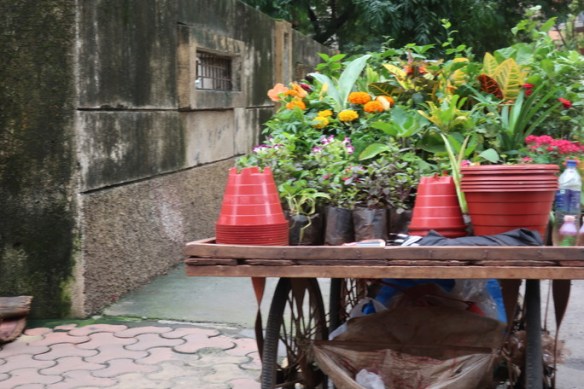
Some images from Mumbai –

Plants for sale!
Decorative designs using flower petals, whole flowers and leaves,

(c) 2019 Shobha Vanchiswar

[do_widget “Blog Subscriptions (Jetpack)”]

Summer Joy

It’s the lazy days of summer. I hope you’re making the most of the season. They will become the memories that’ll get you through the dark, cold days of winter. Ignore the to-do list and savor the pleasures of summer.

Summer Nights

Wrapped in the thick air

heavy with heat

laden with moist

Watching fireflies

mimic the stars

against black velvet

Serenaded boldly

by tree frogs

and crickets

Fanned from on high

wings of bats

on purposeful sorties

While night moths

answer service calls

of moonflowers

and gardenias

Spicy notes of phlox

rise with the night

perfumed with clove,

oil of bergamot

essence of rose

Lulled into

well being

content to remain

Greet the dew

of a new day.

– Shobha Vanchiswar

Summer Dive

Sunlight spills

brilliant diamonds

blinding ripples

shimmering winks

sliced apart

by summer’s first dive.

-Shobha Vanchiswar

Summer Joy

Summer spreads wide

a picnic blanket

of meadow flowers and green, green grass

For legs to brush against

bodies to lie back

To gaze upon

lofty images of dogs and bears and hunting giants

From dazzling day to evening glitter

Dew gathers to mist

sun-warmed faces and naked toes

Summer seems

like an endless ride

filled with ice-cream cones and fireflies

Of water fights and watermelon wedges

children’s laughter intoxicated

on improbable tales

An ephemeral age, an ephemeral time

summer passes overnight.

– Shobha Vanchiswar

Note: The Small Works exhibit is on through August. Do make time to see it!

(c) 2019 Shobha Vanchiswar

[do_widget “Blog Subscriptions (Jetpack)”]

Freedom

Liberty is the freedom to do as one ought to do. I learned this definition in fifth grade civics class – it was how we started to understand what democracy meant.

A cornerstone of a thriving civilization, freedom is all about having choices. So one can chose their actions bearing in mind one’s moral responsibility. To choose to act after discerning between right and wrong, good and evil. To do what is ethically correct for the greater good.

Keeping that in mind, I take this power very seriously. Especially in the garden where all too often a gardener is inclined to play lord and master. It’s so easy. We have at our disposal so much control and power that all too often we forget that gardening is a privilege. The very notion that I can assume ownership of a piece of earth to do as I please is astounding. Arrogant even.

While I often kid that I’m the dictator-in-chief of the garden, in reality, I feel my responsibility greatly. I’m allowed to freely design, create and play in a this space in whatever way I please. Within good reason. And that is the key. To use good reason.

My principle commandment is to do no harm. Whatever action taken must have the least negative impact – on humans, animals, plants, soil, water or air. On that basis, only organic methods are employed. But, trying to control pests organically is not without cost. These natural products are not specific to the pest. They affect the good critters as well. So judicious application is imperative.

Compost is used as fertilizer and mulch. The plants enjoy it. As do members of the animal kingdom. They too thrive because they are not harmed by compost and hence roam free and make nests and homes underground and above, destroying root systems, chomping on leaves and flowers, girdling trees, ruining lawns with tunnels and burrows etc., Constant vigilance is required so action can be taken as soon as possible. Japanese beetles, red lily beetles and such are picked off and dropped into hot, soapy water. After years of battling those red devils, I’ve stopped planting lilies but since I still grow fritillaria ( their close relative), I must continue to keep a lookout. Mice, voles and other rodents are trapped. The fruit trees must be sprayed with dormant oil only under specific weather conditions and at a particular time of year. You get the idea. It’s not always easy to do the right thing.

Rain water is collected, a manual reel- mower cuts grass, since no herbicides are used, weeds are removed by hand, native plants dominate the garden and support native fauna and so on. Every one of those methods involves more work and effort. And there are times when I’m completely frustrated. However, my conscience is clear. I’m doing my part in exercising my freedom as I ought.

This translates very well to everything else in life. Relationships, raising children, at work, being a part of the community, a town, a city, a country, the world at large. Imagine how powerful exercising our liberties as we should can be.

Note: The reception to Small Works is this Thursday, August 8. I’d love to see you there!

A few images of the challenges in the garden:

Mice attack on the espalier.
Fully girdled trees were lost and had to be replaced.
Sanguisorba attacked by Japanese beetles

Subsequent damage
Evidence of voles under the front lawn
Lily’s under siege

(c) 2019 Shobha Vanchiswar
[do_widget “Blog Subscriptions (Jetpack)”]

Just July

Our house is taken in possession

By him, while he enjoys a rest

July, with summer air and thunder-

He is our temporary guest.

July, who scatters from his pockets

The fluff of blow-balls in a cloud,

Who enters through the open window,

Who chatters to himself aloud,

Unkempt, untidy, absent-minded,

Soaked through with smell of oil and rye,

With linden-blossom, grass and beet-leaves,

The meadow-scented month July.”

‘July’ by Boris Pasternak

July is coming to a close and what a month it has been in the garden. Hot, messy and erratic. That poem by Pasternak describes it so well.

Dictated by the weather, I’ve been negligent of my garden duties. It’s just really hard to get outside and work when merely standing still brings on the sweat and sends out irresistible invites to all the biting bugs near and far. Consequently, the chores get done in fits and starts, bits and pieces. A little weeding here, some deadheading there. The automatic watering system set up for the pots broke down and needed fixing – mercifully, the preceding days had been wet so the plants were relatively unharmed.

The heat wave put paid to the plants in the pots on the wall on the side terrace. Despite the daily watering, they simply could not take those high temperatures. I’ve decided to empty out the pots and not replant. With a very busy August schedule coming up, it’s time to simplify matters somewhat.

They say this June was the hottest one in recent history and July is turning out to match it. Who knows what August will do.

Sunflowers have appeared as happy surprises in one of the large bay standard pots. A lone sunflower grew in the vertical garden. I’d stopped planting lilies a few years ago because I lost the battle with the red lily beetles. Well, as though waking up after a long slumber, a couple of lily plants re-emerged this summer. Their leaves are ugly and chewed up but the flowers look fine and are busy perfuming the front garden.

The garden might look a bit unruly but it is fragrance heaven. Lilies in front soon to be followed by phlox, gardenias and orange-blossoms on the side and jasmine in the back. Heaven.

The meadow has been in serious need of attention. First, the jewelweed took advantage of my apathy and spread itself all over. Once they were deliberately reduced to more manageable numbers, a nettle of the sting-less variety moved in with a vengeance. It needs to be completely and ruthlessly removed all together. It’s been a real task trying to help the many new plants planted in late spring establish themselves. Fingers crossed …

The hydrangea are in bloom – they provide much needed color in the meadow right now. Elsewhere, the Echinacea in their brightness are drawing the pollinators. I really ought to plant more of these stalwarts and get rid of the fussy, finicky members of the garden. With harsh weather becoming the new normal, it behooves a gardener to rethink the plantings.

Tomato season has begun. We’re enjoying the golden cherry tomatoes and savoring the bigger varieties as they ripen. At this stage, each fruit is precious. Soon, there will be a glut and we’ll take them for granted as we make soups, salads and sauces.

It’s so easy to obsess over the disheveled state of the garden, complain about the heat in July. But, looking around, amidst the green jungle, I see heroic flowers splashing color and fragrance all over. The herbs, leafy greens and, early tomatoes grace our meals. Ripening grapes and pears hold the promise of an autumn harvest. The asters are coming up strong for a good showing to close out the summer.

Under stressful circumstances, the garden is working hard to deliver. I must move to do the same.

Note: Consider yourself invited –

My July garden –

Lilies. Note the hole-riddled leaves.
Echinacea
Late blooming clematis
Pears
Figs
Jasmine
The vertical garden with renegade sunflower
Sunflower surprise
Agapanthus
The meadow before the serious weeding happened.
Tomatoes
A harvest

(c) 2019 Shobha Vanchiswar
[do_widget “Blog Subscriptions (Jetpack)”]

Scaling Labyrinths

The word labyrinth comes from the Greek labyrinthos and describes any maze-like structure with a single path through it which differentiates it from an actual maze which may have multiple paths intricately linked.

Labyrinths and labyrinthine symbols have been dated to the Neolithic Age in diverse regions across the globe. They continue playing a role in modern times.

My love affair with labyrinths began at childhood. The mystery books I devoured often featured a labyrinth or maze to offer riddles and clues in ways I now realize might have been a tad bit romanticized. Over the years, while mazes remain fun and exciting in a ‘hide-and-seek’ meets treasure-hunting sort of way, labyrinths have taken on a more meaningful, sacred role. To me, mazes get you to focus exclusively on the task of finding ones way to the center and then making the return trip to get out, thereby providing a complete distraction which can be refreshing and exhilarating. Getting lost and/or confused is all part of the experience.

In traversing a labyrinth, one can ostensibly see its entire design. The center is visible at all times. Where one is trying to get to is apparent. How to do so is not as clear. It’s only by mindful walking, taking in all the turns and switchbacks, that an individual makes it to the center – itself a site for rest and reflection. Labyrinths are not meant to be challenging. Instead they gently guide the walker to move through at an easy pace whilst permitting him/her to observe, think and center the mind. In doing so, by the time one reaches the labyrinth’s center, the mind has shed itself of all other distractions and arrives prepared for deeper meditation.
In perfect silence, a well laid labyrinth teaches life lessons to all who walk it. Like the best of therapists it has us work out all our issues by ourselves.

A labyrinth sits there as a ready escape from chaos, a world gone mad, to find once again one’s true north. Typically set outdoors, it partners beautifully with nature to calm the mind and heart by purposefully removing the walker from the normal, linear understanding of time and direction. Slowly, the outside world recedes and one becomes aware of the world within ourselves. How we are feeling, what we hope for, the conflicting thoughts, the elusive solutions rise up and get understood. This active meditation leads to the deep meditation awaiting at the center. Sitting in quiet, breathing deeply and surrendering all diversionary thoughts gives one the gift of emerging clear headed and relaxed. Ready to face with clarity and acceptance that complex, noisy world we live in.

I’ve always longed to design a labyrinth. A good labyrinth has an ideal size. Too small and it fails to decompress the mind because the center is reached too quickly. Too big and it can get tedious. The amount of walking and turning must be just right. Even the width of the path must be correct – not too narrow and constricting or too wide and spacious. Creating an ideal labyrinth is not as easy as it might seem. Scale is key.
Making paths of grass or mulch bordered by stones, low growing plants or any other natural material keeps the cost quite low. The simpler the better. Yet, an ideal design and layout is a call for creativity.

The only part of my garden that could support a proper labyrinth would be where the meadow lies. However, this area is sloped and uneven and must not be leveled for reasons of water drainage and run-off. I’m thus resigned to not having this feature of my own.

Last Sunday, I was taken to an absolutely lovely labyrinth at the Priory in Weston, Vermont. Sited on an open, flat space laid with paths of grass outlined by single lines of brick set in the ground, it is beautifully simple. The size is perfect and the design takes you just long enough to get to the inviting seats in the center. Beyond the labyrinth is a vast, open meadow full of native grasses and wild flowers. Birds, butterflies, bees and other critters abound. Feeling vulnerable and humble, I walked with the sounds of nature keeping me company. The sun was bright and a light breeze kept me from getting too warm. Seated in the center, as I came out of my reflections empowered and reaffirmed, I observed the meadow with the swaying grasses woven through with seasonal blooms of milkweed, daisies, black-eyed Susans and other flowers, above them, swallowtail butterflies played tag with each other – it all seemed so tranquil despite the obvious activity going on. The whole scene serving as a reminder that “creativity flows from a quiet mind”.
As a flight of goldfinches rose up from within this meadow and made their separate ways, I too got up and purposefully followed the path to take me back to my awaiting world. Just as I left the labyrinth the priory bell was rung calling all to prayer and morning service. I did not join – I had after all just completed my worship.

The labyrinth in Weston, Vermont
The meadow beyond.
Notice the swallowtail on the milkweed at center lower half?!
A labyrinth I visited in Cape Cod some years ago. Set amidst tall trees, it gives the sense of being in a cathedral.
A labyrinth in upstate New York

(c) 2019 Shobha Vanchiswar

[do_widget “Blog Subscriptions (Jetpack)”]

Slow Dancing With Summer

It’s July. Fireworks, fireflies, picnics, barbecues, beaches and books. In addition, for me, mosquitoes, mojitos, air-conditioning, heat, humidity and guilt. I have very mixed feelings about summer.

The light filled days promise endless hours of outdoor pleasures and the nights punctuated with bursts of firefly light and the fragrance of summer phlox and gardenias bewitch and yet, I find myself banished indoors for a good portion of the day seeking solace in air-conditioned rooms redolent with gardenia in budvases and rose-geranium infused lemonade. During the day, prone to migraines triggered by the heat and humidity, I succumb easily to those conditions. At night, the mosquitoes turn out in full force making it near impossible to sit without itching and scratching. I’m loathe to reach out for the only truly effective deterrent – a DEET spray. Using it every now and then is fine but slathering it on everyday makes me uneasy.

What works for me is to get some garden chores done in the cool, early hours of the morning. It is actually quite pleasant working at that time as the chorus of birds keep me company and the bees getting a head start to their day inspire me to get cracking with my own. At this mostly quiet period of the morning, I find myself occupied with what needs doing whilst still enjoying the garden in its rather riotous state of summer growth. A good couple of hours go by before I’m made aware that I’m hot, uncomfortable and quite ready to escape to cooler confines.

I’m certainly not inclined to deprive myself of the joys of spending summer nights watching fireflies and inhaling the sweet perfumes of flowers that I’ve grown for that very purpose. Spritzing myself with a blend of citronella and cloves I go forth into the evening. A fan is brought out to do double duty – deter all flying bugs and keep us relatively comfortable in the circulating air. The DEET spray is always on stand-by – it’s a love-hate relationship.

At a party last week, I was introduced to a new anti-mosquito gadget brought to the event for a test run by another friend. It seemed to work as I was not bitten that evening. So I’ve purchased one for my own use. Before I rush to endorse it, I shall use it a few times first. Stay tuned.

To take advantage of the warmer months, I ease up on chores and find myself slowing down my pace. More books are read, outdoor summer concerts and plays replace screen-time almost entirely. It seems only right to linger over al fresco meals and sip a cocktail or two slowly as one walks around inspecting the garden. Impromptu picnics, sunset viewings and star gazing stretch out the season. Time is taken to savor the bounty from the garden and farm stand. I love to slowly roast corn on the cob directly over the coals and then, with a sprinkling of flakes of sea salt and a dusting of cayenne pepper brightened with a splash of lime, it explodes in the mouth in a burst of sweet, salty, spicy and sour. Divine. And how about a watermelon salad tossed with fresh cherry tomatoes, feta and torn up basil? I think I even eat ice cream more slowly and mindfully in summer than at any other season.

While I’m reveling in the unhurried rhythm of summer, there is a fair amount of guilt that shadows me. The garden looks like a small child allowed to dress herself. Sweet but quite messy. I’m not keeping up with the pace the plants grow and need deadheading, staking and trimming. Weeds shoot up even as I work to keep them at bay. The tiny lawn looks ragged beseeching me for a regular feed of compost and the meadow quickly gets overrun by jewelweed smothering out less aggressive but more desirable plants. Still consumed with guilt, I’m determined to go on fully engaging with summer. It’s all too short and I know I will regret it if I have too few memories of it to keep me warm in winter.

And so I keep dancing with summer. Barefoot and guilty.

Note: Images of the neglected state of my garden – they should make you feel good about yours!

Wisteria in need of some grooming. But the geraniums divert your attention!
Wall pots straggling
Foxgloves need deadheading
Meadow could use some thinning out
Gardenia ready to be picked for indoor enjoyment
Sanguisorba ‘Alba’ having its moment
Asters waiting to be cut by one-third for better fall display
Acabthus in bloom but what’s that allium doing there?!
The pretty astilbe are being hidden by the overgrown asters.

(c) 2019 Shobha Vanchiswar
[do_widget “Blog Subscriptions (Jetpack)”]

Romancing The Garden

Gardeners are romantic. I have come to realize and accept this. In making anything beautiful, it pretty much goes without saying (but I’m saying) that one must also be romantic. You aren’t convinced? Hmmm. Let me tell you how I’ve come to realize my own idealistic, sentimental nature in action in the garden. You tell me if you’ve never been similarly inclined.

I’ll start with the very poster child of romance. The rose. I love them. I have included several in my garden – all in shades of pink, profuse and preferably perfumed. The very display of roses in bloom brings to the forefront matters of the heart. You absolutely cannot see a rose and not think of love and romance. Am I right?

When I chose to place two arches and plant roses to scramble up them, I envisioned something very traditional. The arch one must go through to reach the front door was to invite and disarm the visitor. It puts one in good cheer. The subtle fragrance sends an additional message of welcome. The three different clematis weaving through this rose takes the whole to a higher level. Pure romance.

The second arch which is a gateway to the gardens in the back, has a different rose. Brighter in its rosy hue and with a stronger perfume. It makes its presence felt long before you get near it. A temptation to coax the curious to come forth.

A shrub rose I planted on the side path in early spring was chosen for its prettiness, hardiness and its scent. The whole idea being that its fragrance will waft into the house through the studio windows just above and assault my senses in the nicest possible way as I paint. I’d like to think my work can only be made better under such influences.

In truth, one can smell the roses in all the rooms on that side of the house. It makes me pause, inhale deeply and appreciate the aroma. Life feels good. Similarly, I position the pots of citrus, jasmine and gardenia on the side terrace so the night air is redolent with their strong aromas – hopefully sweetening our dreams and slumber.

In the herb garden, I included plants mentioned in Shakespeare’s plays. Lovage, rue, hyssop, comfrey, foxgloves and such. Apart from the lovage which pairs well with fish, the others merely look pretty and remind me of earlier times. Hyssop while purported to soothe sore throats, was popularly used as a spiritual bath. The hyssop bath is usually considered to be a personal ritual to remove sin and negativity in life. It has a Biblical significance. Rue means disdain or regret. Comfrey too had a role in early medicine as a poultice to treat joint pains. All so quaint and romantic right?

Even a feature like the ‘meadow’ has an element of idealism and romance. It is a place for congeniality between the native flora and fauna. Where butterflies, birds and bees pollinate and populate my corner of paradise. Life supporting life, all creatures living together in peace and all is well with the world. What a concept!

The espalier of 27 apple and 5 pear trees hark back to a time when all of this neighborhood was full of apple orchards. I like to think I’ve in some way restored something precious to this place.

The pergola in the back terrace was designed so the wisteria would grow over its top, generously providing shade under which we can gather to break bread and sip wine with friends and family as often as possible. And we do. Idyllic escapes in a world gone mad.

And so it goes. I see how in creating this garden, I have subconsciously let my inner romantic guide me. It is about beauty, history, literature, harmony, the sacred and most of all, love.

Now, how about you?

Note: Enjoy these romantic images!

View from the upstairs window boxes
Hyssop
Gardenia
Citrus

(c) 2019 Shobha Vanchiswar

[do_widget “Blog Subscriptions (Jetpack)”]

Plant Power

Humans have always known the importance of being connected to the natural world. Not simply for the obvious – food, shelter ( caves, construction materials), fuel and, medicine. We are inherently aware that there is a deeper, spiritual relationship between us and the plant kingdom. From using flowers/plants to mark every significant event in our lives, returning our spent bodies to the embrace of the earth, to adorning and anointing ourselves with flowers, leaves, bark and roots for their perfume, cosmetic properties in a bid to enhance our looks, the horticultural world is intrinsic to our human-ness.

There is a plethora of anecdotal and scientific evidence to support the positive effect of time spent outdoors. Garden therapy is an accepted and valued method to heal all sorts of human conditions – physical and mental. Be it a stroll in the park, a hike in the woods, puttering in the garden or just sitting quietly amidst some greenery, a positive effect is palpably felt. Lifting ones mood, being physically energized after a stint out in nature is something every one of us can relate to. Gardening is empowering. To create something useful and beautiful is transforming. There is even a ‘Gardens Without Borders’ effort to help refugees in camps and war zones cope with their circumstances. That’s plant power.

Humans generally go about assuming their position at the very top of the living world. I’m not certain how we got to possess such hubris because in my experience, nothing is more humbling than observing nature closely as one does in gardening. Before one assumes what we do outsideis the principal effector, consider the plant community itself. What do we truly know about the kingdom of plants?

We have generally assessed plants from a very human perspective – how do they serve us? We regard plants as being there for our specific purposes. And we are in charge. Their very separation from us and all animals to a kingdom of their own shows how we think about plants. They are totally unlike us. But, are they really?

This past Saturday, I attended two highly interesting talks/panel discussions. Both were events made possible by the World Science Festival. The WSF takes place at this time of year in New York City – five days chock full of talks and discussions on all sorts of scientific topics. Leading scientists from different parts of the world participate in these talks and enlighten auditoriums packed with people thirsting for answers and understanding the issues currently affecting our lives. From cancer research to cosmic riddles to climate change to contemplating the cerebrum as we know it. I’ve been going to the WSF since it began about 11 years ago. I get positively giddy with excitement going through the line-up of talks and making my choices for the ones I’m most eager to attend.

This year, I chose two events that were so closely related that I believe they should’ve been proposed as a double feature. ‘Rethinking Thinking’ and ‘ Intelligence Without Brain’ were my picks. Both were so interesting and certainly enlightening. The take home is having a brain and neurons is only one way to think and navigating life. And humans are not special at all – we are just one form of life. Given my own background in molecular biology, this was not surprising or hard to accept.

It was fascinating to learn that even stuff like fungi and slime mold are capable of communication, problem solving and decision making. More so than one can imagine. In the animal kingdom, there is’ intelligence’ that parallels humans – only in ways more suited to their own genus and/or species. And when it comes to plants, they do so much more than we ever thought possible!

In recent years, we have learned that plants communicate by sending out chemical messages to warn, commiserate about disease and other life conditions. On Saturday, I found out that they make sounds via their roots! They have voices. At this time, we don’t know the how or why. It’s possible they can ‘talk’ above ground as well – we just don’t know how to test/hear them. Yet. Cogitate on that.

Going further, there is now data that plants can reason and remember. Yes, that’s right. This is all cutting edge scientific research and terribly thrilling. I won’t go into details and you don’t have to take my word for it as all the talks can be accessed at worldsciencefestival.com

So, circling back to my original commentary about how we are healed and invigorated by just being in the presence of plants. Perhaps, plants ‘silently’ comfort and/or treat our wounded selves in ways we are yet to determine or measure. They have after all been around so much longer than we humans and get this – the plant kingdom is 99% of all living forms found on earth. Surely then, it stands to reason that they know more than us. Stay tuned!

Here are some feel good images from the garden. Enjoy –

(c) 2019 Shobha Vanchiswar

[do_widget “Blog Subscriptions (Jetpack)”]

Weather Perfect

A change in the weather is sufficient to recreate the world and ourselves.” Marcel Proust

Ah, Open Day has come and gone leaving me with a sense of relief, well-being and satisfaction. The weather was perfect. After three straight years of cold, wind and rain on Open Day, this exquisite day was well overdue.

The sun shone bright, the air was dry, the temperature was ideal – not hot, not cold, a gentle breeze prevailed and the garden was filled with the buzz, tweets and hums of bees, birds and butterflies. The flowers rose to the occasion and shone bright and beautiful. I could not have asked for any better.

It is almost impossible not to respond positively to weather such as that. There is an imperceptible yet powerful shift in one’s mood and outlook. For myself, it felt as though a new energy had moved into my body. Being outside in the garden felt so right. There was no other place to be. No bugs biting, no jackets weighing me down, no sweat to wipe off and, best of all, no chores to do. This was as good as it gets.

It was the perfect weather to share the garden. And the garden looked its best despite the cold and rain it had endured thus far this spring. Several plants were lagging in their bloom time but the others stepped up admirably. Every visitor arrived with happy spirits and curious minds. Of the 100 or so visitors, I did not encounter a single person with the slightest hint of negativity.

As much as I love sharing my garden, I adore meeting other gardeners and garden lovers. I learn so much. This time, I picked up on a new-for-me nursery to check out, a few gardens I must visit, a book to add to my summer reading, enjoyed several good laughs, received feedback on my own garden and made new partners in horticultural-crime. At the end of the day, I was so much the richer – in heart and head.

Under such ideal conditions, it was inevitable that the best conversations ensued, strangers became friends, and for the one brief day, all was well with the world. Marcel Proust was so right.

A heartfelt thank you to all who made this Open Day a resounding success. Visitors, volunteers, friends and family – nothing is possible without you.

Note: Here are lots of photos for all those of you who failed to show up!

IMG_1343

Friends from Chicago

(c) 2019 Shobha Vanchiswar

[do_widget “Blog Subscriptions (Jetpack)”


There Are Gnomes In The Garden!

Gnomes. Makes you recall those all too familiar, garishly painted figures with pointy hats right? While these spirit creatures hark back to the 17th century and earlier, their presence today is viewed as somewhat naive and old-fashioned. Like gazing balls, they recall earlier times and are not commonly seen in today’s gardens. Truth be told, I myself have never been taken by them.

That is, until I recently came upon a modern take on gnomes at the Sullivan galleries in Chicago where highly talented, emerging ceramist August Brosnahan was debuting his gnome collection. And the creatures were getting a lot of attention and interest. Here is how Brosnahan describes his work –

I am interested in human interactions with objects and how objects help us relate to the world around us. Whether it be the handle of a mug or the facial expression on a figurative sculpture, these objects have unsaid and sometimes unnoticed methods of guiding us through spaces. Humans spend a tremendous amount of time interacting with clay and ceramic objects. I believe that humans have deep-seated connections with ceramics, more so than other materials, due to the rich history we share with clay. This mindset is central to the form and presentation of my work as I create intimate connections between viewers and the object.

Another element that is central to my practice is my love for walking. I have recently distanced myself from the white-walled gallery as I spend hours in forests and fields. A notable example of this is my ongoing series, “Gnomes.” I create small personified objects that preferably exist in an outdoor setting. Multiples of these objects create a community that viewers can interact with by walking through the same space that the gnomes exist in. I activate the space that the viewer is standing in rather than a space that the viewer is looking at. With my work I hope to re-invigorate the overlooked spaces of our day-to-day lives.”

I have long championed sculpture in the garden. Art in an outdoor space adds a new dimension and there is a shift in context that enriches the experience as opposed to seeing the same sculpture indoors. At this particular art show, I could clearly imagine how they might transform a garden or park. My curiosity to actually see that happen led to inviting the artist to show some of his work at my garden on Open Day.

So, five pieces were carefully packed and shipped to New York. I worked with Brosnahan on siting the gnomes in the garden and I’m really excited to share them with visitors on May 18th.

Meant for outdoor spaces, the seemingly whimsical pieces urge the viewer to consider the dynamics between all the elements in a space. The ceramic gnomes make one aware that there is an energy and presence beyond that which we can physically see or feel. They appear to blend into the background and yet, manage to surprise and be noticed. These sculptures maintain continuity in the human history of personifying natural and designed spaces. The impact is subtle and fresh. A modern twist to an old tradition.

Several weeks ago, I hinted that I was working on a new project in the garden – just for Open Day. This is it! I look forward to introducing you to the gnomes. See you in the garden on May 18.

Note: Open Day is less than two weeks away!

(c) 2019 Shobha Vanchiswar

[do_widget “Blog Subscriptions (Jetpack)”]