Occupying October

October. Time to get busy in the garden. Even though temperatures are higher than usual and it feels so glorious, I know that failing to get cracking on the chores will only have me full of regrets should a sudden frost arrive or worse, snow. Best not to take any chances.

The Things To Do page provides a monthly list of garden tasks and I hope it is useful. However, being human, one forgets to check in a timely fashion. So, I thought I’d start giving a reminder at the start of each month. For this month, I’m providing the whole list below just so you can see that October demands a lot.

Things To Do In October

1. Yes, weeding continues!

2. Time to plant perennials and trees. Give a good dose of compost to each. Water regularly. Perennials already in place can be divided and planted as well.

3. Cut back all spent plants except what is needed for seasonal interest.

4. Collect seeds. Store in labeled envelopes in a cool, dry space.

5. Last call to root cuttings of geraniums, coleus, rosemary etc.,

6. Get all pots of tender perennials into clean greenhouse or other winter shelters. Wash plants and pots thoroughly first – minimizes pest infestation.

7. Plant bulbs as weather gets consistently cooler. Bulbs can be planted once soil temperature gets down to 55 degrees right up to the time the soil freezes solid.

8. Rake leaves. Add to compost pile or deposit in woods.

9. Give compost heap a good stir.

10 Clean out vegetable garden except for cool weather plants that are still producing. Apply several inches of compost on cleared beds. Plant green manure to enrich the soil – optional.

11. Clean and put away (or cover) outdoor furniture.

12. Check what needs repairing, repainting, replacing and get to it!

13. Lift tender bulbs, corms and tubers. Store in dry, frost-free place.

14. Drain and close all outdoor water faucets. Empty rain barrel and hoses. Store.

15 Clean all equipment and tools. Store neatly.

16. As temperatures plummet, protect tender shrubs and immovable  frost sensitive pots and statuary. I cover the former with burlap and for the latter, I first cover with sturdy plastic and then use burlap so it looks halfway decent.

17. Remove suckers from ornamental and fruit trees. Prune roses and wisteria. Remove dead and decaying limbs from all plants.

18. Fill up bird feeders. Keep them filled through the winter. Put up nest boxes for the spring.

19. Get into the autumnal spirit – fill window boxes and urns with seasonal plants and produce.

Sincere gardeners never stop learning. On the 19th of this month, the Untermyer symposium is sure to instruct us all. Do sign up for it. While the topic is on restoring historic gardens, there will surely be plenty of ideas and advice to be picked up for ones own garden.

Join us for a symposium on different approaches to historic garden restoration. Suzanne Clary, President of the Jay Heritage Center, Howard Zar, Executive Director of Lyndhurst, and Timothy Tilghman, Head Gardener of Untermyer Gardens, will share their experiences in restoring great New York gardens and landscapes. A pictorial introduction to each garden will be followed by a discussion moderated by well-known garden blogger Shobha Vanchiswar and a tour of Untermyer Gardens by Timothy Tilghman.”

(c) 2019 Shobha Vanchiswar

[do_widget “Blog Subscriptions (Jetpack)”]

Homecoming

Traveling makes one modest: one sees what a tiny place one occupies in the world.”

The Letters of Gustave Flaubert, 1830-1857

It feels good to be back home. Refreshed from my travels, I’m eager to get back in the garden. Returning after an absence always makes me approach it with some trepidation. What if something has gone terribly wrong? is a thought that hits me every single time. Thankfully, all is well. Sure the weeds have made merry, the beds are a bit messy with some plants calling it it quits for the season and, the tiny lawn is in need of a trim but in general, it’s all par for the course. The garden is transitioning into autumn.

I’d been concerned that the hummingbird feeder would run empty and thereby the birds would be denied their regular supply but it’s perplexing that after a whole two weeks, the feeder is still a third full. Have the hummingbirds moved on already? I sincerely hope nothing untoward has happened to them. I must look into understanding this before I’m consumed with worry.

The figs tree was heavy with ripe fruit that were enjoyed right away. In fact, the enthusiasm over the splendid harvest made me forget to take a photograph before they disappeared. You just have to take my word for it. The tomatoes are still going strong and I’m getting ready to make sauce for canning.

The asters are just starting to bloom and I think they’re a bit late. Usually, they’re in full swing by now. I’d actually thought I might be late to the show. The vertical garden is having its moment – looking lush and full just as so much else is waning.

The turtleheads in the meadow are growing strong. I love how dependable they are. I’ve come to the realization that the flowers of the oak-leaved hydrangea (H. quercifolia) do not last as long into fall as the my other hydrangea(H. paniculata). The former already look crisp and brown while the latter have moved from white to that soft blush that I so adore. However, the leaves of the oak-leaved have the added bonus of changing color so, I’m looking forward to that display.

All the Concord grapes have either dropped too early or the robins that nest amidst the vine have got to the fruits first. No jelly this year. So be it. Postscript -just last night I discovered that the gardeners at Hortus Arboretum and Botanical Gardens use ordinary paper lunch bags to protect their grapes. Somehow, these humble bags even survive the rain! I’ll be trying that next year.

No apples or pears either. Just as the fruit trees were in beautiful bloom in the spring, a very cold spell hit and the pollinators stayed home. The flowers spent themselves out soon after. First hand lessons in the garden. The leaves of the apples dropped off by early August and I saw that the trees at Stonecrop gardens had a similar problem but those still bore some ripening apples so, I’m a bit envious. I can only assume that the very hot months of summer took a toll and the leaves fell early.

Even in his most artificial creations, nature is the material upon which man has to work.”

— Marcel Proust, Swann’s Way

It’s been a really weird summer season this year – much too hot with spells of either too much rain or complete lack thereof. Perhaps this will be the new normal and we will have to adjust what and how we garden. I’m trying to keep pace. This is after all, our future. That has to concern everyone.

In a month, I’ll be cutting and tidying in preparation for the winter. Hundreds of bulbs ordered earlier in summer will also arrive at that time for fall planting.

As the sun sets earlier and earlier, I’m determined to enjoy every available hour of daylight before I get caught up in all the busy-ness. All too soon, it’ll be winter and I want to be warmed by that sense of smugness that I had a good time while I could.

Note: I invite you to come to the “Restoring Historic Gardens” Symposium at Untermyer Gardens on Saturday October 19, 2019. I’m excited to be moderating the panel discussion that will follow after the three speakers share experiences with their respective historic gardens.

The “Walk In Our Shoes” exhibit is on till September 30. Hope you will visit this wonderful art show.

Turtleheads in the meadow
Hydrangea paniculata
Crispy flowers of the oak-leaved hydrangea
The leaves of the oak-leaved slowly changing color
Cardinal flowers still doing well
The wall
Tomatoes in the greenhouse
Figs ripening
Hot!
Pretty

(c) 2019 Shobha Vanchiswar

[do_widget “Blog Subscriptions (Jetpack)”]

Back In The Garden

The weather this past weekend was nothing short of stellar. It could not be beat. Bright and sparkly, low humidity, temperatures in the low 70’s. After two weeks in rain soaked Mumbai, this was quite literally a breath of fresh air. What an amazing homecoming.

Taking advantage of this gift, I visited Stonecrop Gardens in Cold Spring, NY on Saturday. If you’ve never been, you must. It was Frank Cabot’s home – yes, the man who helped found the Garden Conservancy. You can read all about this garden on their website. It’s quite a gem.

Summer’s end is not typically the best time to visit most gardens. But I was in need of it. Inspiration is always to be found and I was not disappointed. Big splashes of summer color and a seasonal untidiness abounded. I loved the fullness of the plantings everywhere. The realities of the season made apparent by burgeoning seed-heads, flamboyant flowers, plants jostling for space in their beds and a certain wildness to it all. This was Life at full throttle. In contrast, the verdant quietude found in the wisteria pavilion by the pond provided that pause to breathe deeply and free the mind from quotidian worries.

In walking around, I realized that the high point for me, was the general end-of-season mess and the sight of the ravaged leaves of kale and other plants. Critter(s) had gone to town and riddled the leaves so they looked like badly made lace antimacassars. I found that very comforting because it made me feel like my own garden was in good company. This is the reality. If you’re using organic methods, one cannot have a pristine, near perfect, neat and tidy garden at the close of the summer. Given the strange spring and summer we have had, it’s been particularly difficult to manage the garden as one has in years past. Weather fluctuations have been so erratic that my expectations were lowered sufficiently to protect my ego from too much injury.

By observing how lovely Stonecrop looked despite everything made me see my own garden with kinder eyes and appreciation.

Energized by that visit, on Sunday, I whipped the garden into better shape. A little cosmetic fiddling goes a long way. Weeding, deadheading, pruning and a general tidying up did wonders. I revamped the window-boxes and other urns and pots with a bit of tropical flair that I can only explain as the influence of my recent sojourn to India. Traveling has that impact doesn’t it?

And now, I’m set to enjoy the remaining weeks of summer with renewed enthusiasm. Salut!

Chilies in the window boxes
Pruned back espalier
Last rose(s) of summer?
Lemons
Note the banana plants standing sentry
New batch of cool weather greens
The meadow
Pink turtleheads in the meadow
Party ready

(c) 2019 Shobha Vanchiswar

[do_widget “Blog Subscriptions (Jetpack)”]

Water, Water!

Water is in the news quite a bit these days. Too little or none at all. Too much, too soon is just as bad. Certainly this is predicted to be the biggest, most critical problem we will have to resolve in the not too distant future. Water will direct the next mass migrations of humans as they are forced to adapt to the changing weather patterns – a result of both natural and man-made acts. As a global community we will have to decide right now how we will deal with shifting populations/refugees, how we grow our food, utilize energy, reprogram our use of water and indeed our entire way of living. While government agencies and related organizations grapple with the big picture, if one has not personally begun taking steps towards this impending crisis, it is now time to start. As of this minute. I’m not being an alarmist – the snooze button to that alarm has been hit way too often already.

I’m writing this during a ten day stay in monsoon swamped Mumbai. It is wet, warm and muggy. The air feels spongy even when it isn’t raining. The dampness pervades everywhere. Without air-conditioning to lower the humidity, I’d be hard pressed to be comfortable and sleep would be impossible. This has been a particularly heavy monsoon season.

Despite so much rain, the city is still aware of the undependable nature of its water supply. It has signs all over asking her citizens to conserve, avoid waste and respect this life giving Adam’s Ale. And that got me wondering if those signs have any real impact on the mass. Does one read and/or pay attention to such ‘nudges’? As one drives through the generally thick traffic, is the mind even open to receiving any such advice? It then occurred to me that it was because of the stop and start, slow moving, thick traffic snaking along that I was able to notice the signs and ponder them. A seed, so to speak, had been sown. I can only imagine that a daily dose of ‘Don’t Waste Water’, ‘No Water, No Life’ will percolate into one’s conscience and guide the mind to the judicious use of water. Not a bad idea to have those signs put up after all. They certainly cannot hurt.

In my own garden back home, I’ve long collected rainwater to water parts of the garden. Particularly pots. To ensure that the plants do not get parched when we’re away or otherwise distracted, we have also rigged up a drip-system to routinely water the pots as some of the plants require a consistent supply. The mechanism is attached to a moisture sensor so that it will not release water if it has rained or is raining. That way, no water is unduly wasted.

Water from cooking eggs, boiling vegetables etc is also collected for watering. Often the boiling hot water is poured directly over the weeds trying to make their way through brick or flagstone paths. Kills the weeds effectively.

Still, in a particularly dry period when rain is scarce, there are areas in the garden that need a healthy splash. Thus far, it’s been okay but I worry that the time when watering our gardens whenever we see a need is coming to a close. There will be a need to shift to plants that do better in semi-dry or arid conditions. Fussy plants will have to be phased out.

It feels a bit sad. But, we gardeners are a resilient species. We will adapt. Indeed, we can lead the way. I for one have resolved to source interesting/beautiful native plants that do well under dry conditions and start introducing them into the garden. The process will be deliberate, mindful and with any luck, enjoyable. Learning is growth.

Postscript: Of the many drinks I have consumed in the many places I’ve stopped at ( fancy as well as hole-in-the-wall joints), I have not seen a single plastic straw. The only straws I’ve been served have been compostable. Often, they are elegant, colorful, sturdily constructed paper. This is what progress looks like.

Note: There’s still time to see the Inside Small art show!

Heads Up! The second annual Untermyer Symposium is scheduled for Saturday, October 19. Mark your calendars. I will be moderating the panel discussion. Stay tuned for more details.

Some images from Mumbai –

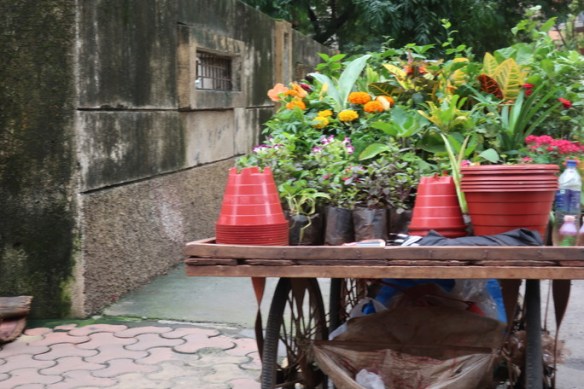
Plants for sale!
Decorative designs using flower petals, whole flowers and leaves,

(c) 2019 Shobha Vanchiswar

[do_widget “Blog Subscriptions (Jetpack)”]

Freedom

Liberty is the freedom to do as one ought to do. I learned this definition in fifth grade civics class – it was how we started to understand what democracy meant.

A cornerstone of a thriving civilization, freedom is all about having choices. So one can chose their actions bearing in mind one’s moral responsibility. To choose to act after discerning between right and wrong, good and evil. To do what is ethically correct for the greater good.

Keeping that in mind, I take this power very seriously. Especially in the garden where all too often a gardener is inclined to play lord and master. It’s so easy. We have at our disposal so much control and power that all too often we forget that gardening is a privilege. The very notion that I can assume ownership of a piece of earth to do as I please is astounding. Arrogant even.

While I often kid that I’m the dictator-in-chief of the garden, in reality, I feel my responsibility greatly. I’m allowed to freely design, create and play in a this space in whatever way I please. Within good reason. And that is the key. To use good reason.

My principle commandment is to do no harm. Whatever action taken must have the least negative impact – on humans, animals, plants, soil, water or air. On that basis, only organic methods are employed. But, trying to control pests organically is not without cost. These natural products are not specific to the pest. They affect the good critters as well. So judicious application is imperative.

Compost is used as fertilizer and mulch. The plants enjoy it. As do members of the animal kingdom. They too thrive because they are not harmed by compost and hence roam free and make nests and homes underground and above, destroying root systems, chomping on leaves and flowers, girdling trees, ruining lawns with tunnels and burrows etc., Constant vigilance is required so action can be taken as soon as possible. Japanese beetles, red lily beetles and such are picked off and dropped into hot, soapy water. After years of battling those red devils, I’ve stopped planting lilies but since I still grow fritillaria ( their close relative), I must continue to keep a lookout. Mice, voles and other rodents are trapped. The fruit trees must be sprayed with dormant oil only under specific weather conditions and at a particular time of year. You get the idea. It’s not always easy to do the right thing.

Rain water is collected, a manual reel- mower cuts grass, since no herbicides are used, weeds are removed by hand, native plants dominate the garden and support native fauna and so on. Every one of those methods involves more work and effort. And there are times when I’m completely frustrated. However, my conscience is clear. I’m doing my part in exercising my freedom as I ought.

This translates very well to everything else in life. Relationships, raising children, at work, being a part of the community, a town, a city, a country, the world at large. Imagine how powerful exercising our liberties as we should can be.

Note: The reception to Small Works is this Thursday, August 8. I’d love to see you there!

A few images of the challenges in the garden:

Mice attack on the espalier.
Fully girdled trees were lost and had to be replaced.
Sanguisorba attacked by Japanese beetles

Subsequent damage
Evidence of voles under the front lawn
Lily’s under siege

(c) 2019 Shobha Vanchiswar
[do_widget “Blog Subscriptions (Jetpack)”]

Hot Topic

We’re just emerging from a brutal heatwave. Whew. This one was fierce. If it weren’t for air-conditioning I’d be a blob of melted flesh in migraine hell. I’m acutely aware of how heat affects me and I’m so grateful for everything that allows me to keep cool.

This got me to thinking about how the garden must cope when subjected to the stress of a heatwave. Do they sense when the temperatures are going to spike? I imagine they’re in better shape to deal with it if up until that time they’re provided with adequate water and decent soil conditions. Just as in humans, all other living things must face adversity better when they’re healthy. So, I figured my garden ought to at least be grateful for all the tender, loving care it receives all year round. Well, except when I’m on vacation, unwell, in the thick of other work or, being lazy. In general, the garden this year has little to complain about its human carers.

A timely thundershower just ahead of the heatwave saturated the ground handsomely. The roots must’ve plumped out and fed their above ground parts nicely. I was glad I’d deadheaded and cut back some vigorous growers recently. A round of weeding was accomplished as well. Therefore, at the end of the first super hot day, things did not look too bad. Some plants such as the Joe Pye appeared to droop but by late evening they perked up. I wonder if the roots slow down and measure out the water/nutrient supply when conditions are adverse. Then, when they sense that temperatures have dropped below the dangerous numbers, do they speeds up in damage control mode? Or, like me, do the plants have poor appetites when it is so hot? Perhaps when I’ve overcome my own heat related ennui I will research this matter – surely some laboratory must be studying the subject. The results could potentially help us deal with weather related challenges better.

I noticed that during the heatwave, there wasn’t much critter activity. I didn’t see many bees or butterflies and the birds seemed to be limiting their flights and singing. The heat brought on a quiet that seemed appropriate. I too was not inclined to exert much energy. The languor connected us all.

The potted plants received water daily. The high humidity kept the ground from drying out but, the soil in the pots dried out. Those plants must have been stressed so much more than their counterparts in the ground. A friend had dropped off two pots of sizable hibiscus a couple of days prior to the heatwave. Until now, they had always been kept indoors so the fact that they were suddenly out in the open must’ve been a shock. Despite being watered, within a day, the leaves on top were wiped out – they got totally dry. So ahead of the canicular days, they were given a cut back and moved to shadier quarters resembling the indoors they were familiar with. Fingers-crossed they will toughen up in due course. After all, they hail originally from warmer climes.

Given water regularly, the vertical garden and tropicals ( in pots) like the jasmine, gardenia and citrus seem unscathed by the high heat. The perfume of the flowers of the jasmine and gardenia are almost overpowering at the beginning and end of day. The lemons are coming along nicely. The pelargoniums have also come through very well. Ditto the tomatoes – we enjoyed the first crop of cherry tomatoes over the weekend. And the meadow looks none the worse for wear.

Any long term effect of the heatwave will no doubt make itself known. I’m hoping there won’t be any. And with any luck there will not be any more heatwaves either. But, I’m not holding my breath.

Note: I would love to see you at the reception to Small Works at The Stable Gallery, Ridgefield, NJ on August 8. 7:00 – 9:00pm. The show runs August 2 – 29.

(c) 2019 Shobha Vanchiswar

[do_widget “Blog Subscriptions (Jetpack)”]

Romancing The Garden

Gardeners are romantic. I have come to realize and accept this. In making anything beautiful, it pretty much goes without saying (but I’m saying) that one must also be romantic. You aren’t convinced? Hmmm. Let me tell you how I’ve come to realize my own idealistic, sentimental nature in action in the garden. You tell me if you’ve never been similarly inclined.

I’ll start with the very poster child of romance. The rose. I love them. I have included several in my garden – all in shades of pink, profuse and preferably perfumed. The very display of roses in bloom brings to the forefront matters of the heart. You absolutely cannot see a rose and not think of love and romance. Am I right?

When I chose to place two arches and plant roses to scramble up them, I envisioned something very traditional. The arch one must go through to reach the front door was to invite and disarm the visitor. It puts one in good cheer. The subtle fragrance sends an additional message of welcome. The three different clematis weaving through this rose takes the whole to a higher level. Pure romance.

The second arch which is a gateway to the gardens in the back, has a different rose. Brighter in its rosy hue and with a stronger perfume. It makes its presence felt long before you get near it. A temptation to coax the curious to come forth.

A shrub rose I planted on the side path in early spring was chosen for its prettiness, hardiness and its scent. The whole idea being that its fragrance will waft into the house through the studio windows just above and assault my senses in the nicest possible way as I paint. I’d like to think my work can only be made better under such influences.

In truth, one can smell the roses in all the rooms on that side of the house. It makes me pause, inhale deeply and appreciate the aroma. Life feels good. Similarly, I position the pots of citrus, jasmine and gardenia on the side terrace so the night air is redolent with their strong aromas – hopefully sweetening our dreams and slumber.

In the herb garden, I included plants mentioned in Shakespeare’s plays. Lovage, rue, hyssop, comfrey, foxgloves and such. Apart from the lovage which pairs well with fish, the others merely look pretty and remind me of earlier times. Hyssop while purported to soothe sore throats, was popularly used as a spiritual bath. The hyssop bath is usually considered to be a personal ritual to remove sin and negativity in life. It has a Biblical significance. Rue means disdain or regret. Comfrey too had a role in early medicine as a poultice to treat joint pains. All so quaint and romantic right?

Even a feature like the ‘meadow’ has an element of idealism and romance. It is a place for congeniality between the native flora and fauna. Where butterflies, birds and bees pollinate and populate my corner of paradise. Life supporting life, all creatures living together in peace and all is well with the world. What a concept!

The espalier of 27 apple and 5 pear trees hark back to a time when all of this neighborhood was full of apple orchards. I like to think I’ve in some way restored something precious to this place.

The pergola in the back terrace was designed so the wisteria would grow over its top, generously providing shade under which we can gather to break bread and sip wine with friends and family as often as possible. And we do. Idyllic escapes in a world gone mad.

And so it goes. I see how in creating this garden, I have subconsciously let my inner romantic guide me. It is about beauty, history, literature, harmony, the sacred and most of all, love.

Now, how about you?

Note: Enjoy these romantic images!

View from the upstairs window boxes
Hyssop
Gardenia
Citrus

(c) 2019 Shobha Vanchiswar

[do_widget “Blog Subscriptions (Jetpack)”]

Artful Arrangements

Art In Bloom’ the poster said. Paintings of flowers I thought. It was so much more.

Weston, a quintessentially charming Vermont town best known for the legendary Vermont Country Store and its thriving eponymous playhouse. I have, over the years, discovered that this little place has some mighty impressive events and highly energetic, innovative and generous residents. For all those of us ( my hand is up) in and close to New York City who assume everything interesting and noteworthy happens in our neck of the woods, Weston is there to say “not so fast’.

The annual antique and craft shows are world class. While the craft show is restricted to Vermont artisans only, dealers from all over the country participate in the antiques show. With none of the uber-hype and big city ‘sophistication’ getting in the way, they showcase the best of Vermont. And the best is precisely that.

This past weekend, I was in for an unexpected treat in the show ‘Art In Bloom’. Not simply art on display, it was a show of flower arrangements by members of the local garden club inspired by paintings donated by local artists. While we are all accustomed to art inspired by nature and still-life paintings of floral arrangements, it was a nice twist to see what a person could do with flowers to interpret art. And quite a challenge it was.

The art works of mostly paintings and a couple of lovely examples of fiber arts, ranged from renditions of flowers to still-lifes with flowers to landscapes and abstract art. I imagine the abstracts and some of the landscapes must’ve been particularly challenging. How does one interpret a snow scene, a covered bridge, a musical instrument or a frog? Well, the members of the Green Mountain Garden Club rose to the occasion splendidly. From the literal to the imaginative, artistic, thoughtful and creative, each arrangement interpreted its corresponding artwork handsomely. Clearly, the flower arrangers knew their flowers and plants, understood nature, had a sense of humor and appreciated the arts very well.

I had come to this exhibit out of curiosity. Having never been to such a ‘reverse’ pairing of art and flower arranging, I had no expectations. So, it wasn’t just a welcome surprise – here was a wonderful demonstration of creativity and artistry. I was taught, I was inspired, I was humbled.

I came, I saw, I ascended.

Note – I’m giving myself the challenge of creating a flower arrangement inspired by a favorite painting. Maybe you will do the same? Please share!

Depending on the device on which you’re reading this, some of the images below will appear on their side. I do not yet know how to rectify the problem. I apologize!

(c) 2019 Shobha Vanchiswar

[do_widget “Blog Subscriptions (Jetpack)”]

Plant Power

Humans have always known the importance of being connected to the natural world. Not simply for the obvious – food, shelter ( caves, construction materials), fuel and, medicine. We are inherently aware that there is a deeper, spiritual relationship between us and the plant kingdom. From using flowers/plants to mark every significant event in our lives, returning our spent bodies to the embrace of the earth, to adorning and anointing ourselves with flowers, leaves, bark and roots for their perfume, cosmetic properties in a bid to enhance our looks, the horticultural world is intrinsic to our human-ness.

There is a plethora of anecdotal and scientific evidence to support the positive effect of time spent outdoors. Garden therapy is an accepted and valued method to heal all sorts of human conditions – physical and mental. Be it a stroll in the park, a hike in the woods, puttering in the garden or just sitting quietly amidst some greenery, a positive effect is palpably felt. Lifting ones mood, being physically energized after a stint out in nature is something every one of us can relate to. Gardening is empowering. To create something useful and beautiful is transforming. There is even a ‘Gardens Without Borders’ effort to help refugees in camps and war zones cope with their circumstances. That’s plant power.

Humans generally go about assuming their position at the very top of the living world. I’m not certain how we got to possess such hubris because in my experience, nothing is more humbling than observing nature closely as one does in gardening. Before one assumes what we do outsideis the principal effector, consider the plant community itself. What do we truly know about the kingdom of plants?

We have generally assessed plants from a very human perspective – how do they serve us? We regard plants as being there for our specific purposes. And we are in charge. Their very separation from us and all animals to a kingdom of their own shows how we think about plants. They are totally unlike us. But, are they really?

This past Saturday, I attended two highly interesting talks/panel discussions. Both were events made possible by the World Science Festival. The WSF takes place at this time of year in New York City – five days chock full of talks and discussions on all sorts of scientific topics. Leading scientists from different parts of the world participate in these talks and enlighten auditoriums packed with people thirsting for answers and understanding the issues currently affecting our lives. From cancer research to cosmic riddles to climate change to contemplating the cerebrum as we know it. I’ve been going to the WSF since it began about 11 years ago. I get positively giddy with excitement going through the line-up of talks and making my choices for the ones I’m most eager to attend.

This year, I chose two events that were so closely related that I believe they should’ve been proposed as a double feature. ‘Rethinking Thinking’ and ‘ Intelligence Without Brain’ were my picks. Both were so interesting and certainly enlightening. The take home is having a brain and neurons is only one way to think and navigating life. And humans are not special at all – we are just one form of life. Given my own background in molecular biology, this was not surprising or hard to accept.

It was fascinating to learn that even stuff like fungi and slime mold are capable of communication, problem solving and decision making. More so than one can imagine. In the animal kingdom, there is’ intelligence’ that parallels humans – only in ways more suited to their own genus and/or species. And when it comes to plants, they do so much more than we ever thought possible!

In recent years, we have learned that plants communicate by sending out chemical messages to warn, commiserate about disease and other life conditions. On Saturday, I found out that they make sounds via their roots! They have voices. At this time, we don’t know the how or why. It’s possible they can ‘talk’ above ground as well – we just don’t know how to test/hear them. Yet. Cogitate on that.

Going further, there is now data that plants can reason and remember. Yes, that’s right. This is all cutting edge scientific research and terribly thrilling. I won’t go into details and you don’t have to take my word for it as all the talks can be accessed at worldsciencefestival.com

So, circling back to my original commentary about how we are healed and invigorated by just being in the presence of plants. Perhaps, plants ‘silently’ comfort and/or treat our wounded selves in ways we are yet to determine or measure. They have after all been around so much longer than we humans and get this – the plant kingdom is 99% of all living forms found on earth. Surely then, it stands to reason that they know more than us. Stay tuned!

Here are some feel good images from the garden. Enjoy –

(c) 2019 Shobha Vanchiswar

[do_widget “Blog Subscriptions (Jetpack)”]

It’s Open Season!

My garden’s Open Day is this Saturday, May 18. I’m hard at work primping and propping the garden to get it looking it’s best for you. So, cancel everything else and come on over. I’d love to see you here!

I was in Evanston, Illinois this past weekend and even though part of that time it was cold and wet, I was struck by how much horticultural effort is put into making the heart of the city look attractive. Tulips waved madly in bright colors on traffic islands, pocket parks and around trees along the streets. So cheery and seasonal. And very easy to do. I’m eager to see what the next plantings of annuals will be.

But beyond the show of annuals, I observed that there is a thoughtful approach to infusing seasonal color and fragrance in the landscape through the use of perennials. A small park dividing a busy road, is bordered with hedges of viburnum. I smelled the park before I noticed it! The viburnums were in full bloom and the fragrance wafted far and wide. Pure heaven. As though reminding pedestrians to pause a moment and refresh the spirit – be present. What a lovely idea. Flower beds within the park abounded in tulips but there were many perennials emerging through. Three benches and a single sculpture completed this perfect oasis.

Swathes of Virginia bluebells carpeted several other green spaces for the public to enjoy and under many hedges I noticed abundant lily-of-the-valley leaves unfurling in readiness for the sweet bells of white to perfume the days ahead – subliminally cheering the outlooks of passers-by.

I had hoped to visit Millennial Park in Chicago and take in the plantings but my schedule did not permit it. Instead, I got to experience the glorious efforts of a much smaller city that could match its big neighbor handily. My well is full.

Note : Enjoy some images of plantings in Evanston. I look forward to seeing you in my garden this Saturday!

Depending on which device you are reading this, some images appear on their side. I have no idea how to fix it. My apologies! Also, the pocket park appears expansive in the photos – it isn’t in reality!

(c) 2019 Shobha Vanchiswar

[do_widget “Blog Subscriptions (Jetpack)”]